A water heater that runs out at 7 a.m. is not broken. It is sized for a house that does one thing at a time, and your house does four things at once. At 7 a.m., when two people shower while the washing machine fills and the dishwasher runs, the same heater empties in minutes. The failure is in the arithmetic nobody did before buying the heater.
The fix is to size the heater for the peak, not the average: count every hot-water use that runs at the same time on the busiest morning, add up their flow rates, and compare the total against what the heater can deliver. That one calculation decides whether you need a bigger tank, a tankless unit, or simply a different morning routine.
The decision first: count simultaneous uses, not people
Heater sizing guides often start with the number of bedrooms or people in the house. Both are proxies, and both mislead: five people who shower at different times need a small heater, while three who shower at the same time need a large one. The number that matters is how many hot-water uses run at once, and for how long.
Walk through the busiest morning and list every use: two showers, a washing machine, a dishwasher, a running tap. Each use has a flow rate in gallons per minute. A shower runs at about 2 gallons per minute — check the fixture label, because low-flow heads run less and older heads run more. A washing machine draws about 2 while it fills, and a dishwasher about 1.5. Add the simultaneous uses together, and you have the peak demand the heater must meet.
The second number is duration. A shower lasts about ten minutes, and a washing machine fills for about five, then stops drawing water. The peak is therefore ten to fifteen minutes of everything running at once.
Tank heaters: usable gallons, not tank gallons
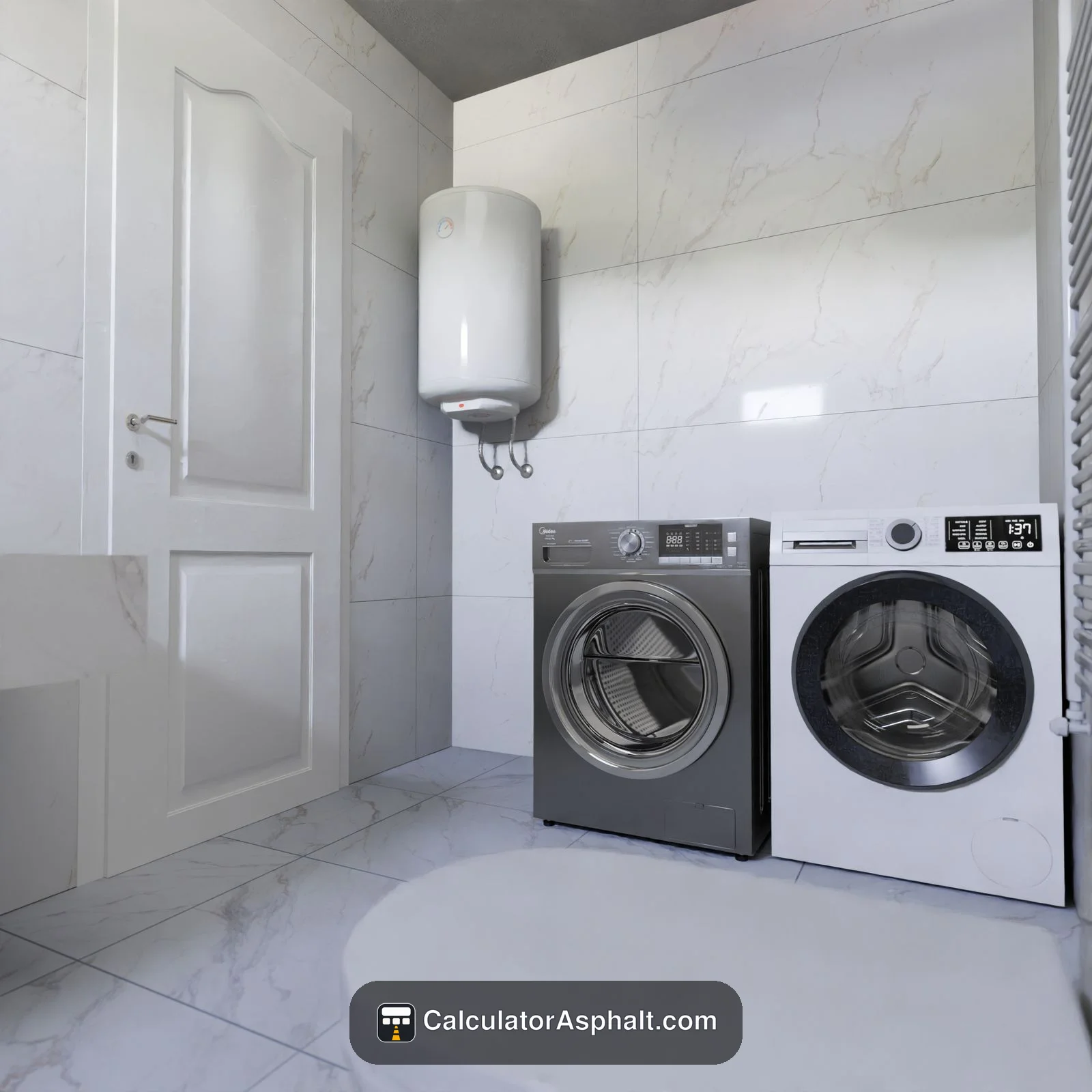
A 50-gallon tank does not hold 50 gallons of usable hot water. As hot water leaves the top, cold water enters the bottom, and the two mix. By the time it has delivered about 70 percent, the water is no longer hot enough to shower in — so a 50-gallon tank delivers about 35 usable gallons.
That distinction decides most morning failures. Two ten-minute showers at 2 gallons per minute use 40 gallons, and a 50-gallon tank holds 35 usable gallons, so the second shower runs cold with two minutes to go. The heater delivered exactly what its size allows; the house simply asked for five gallons more than the tank holds.
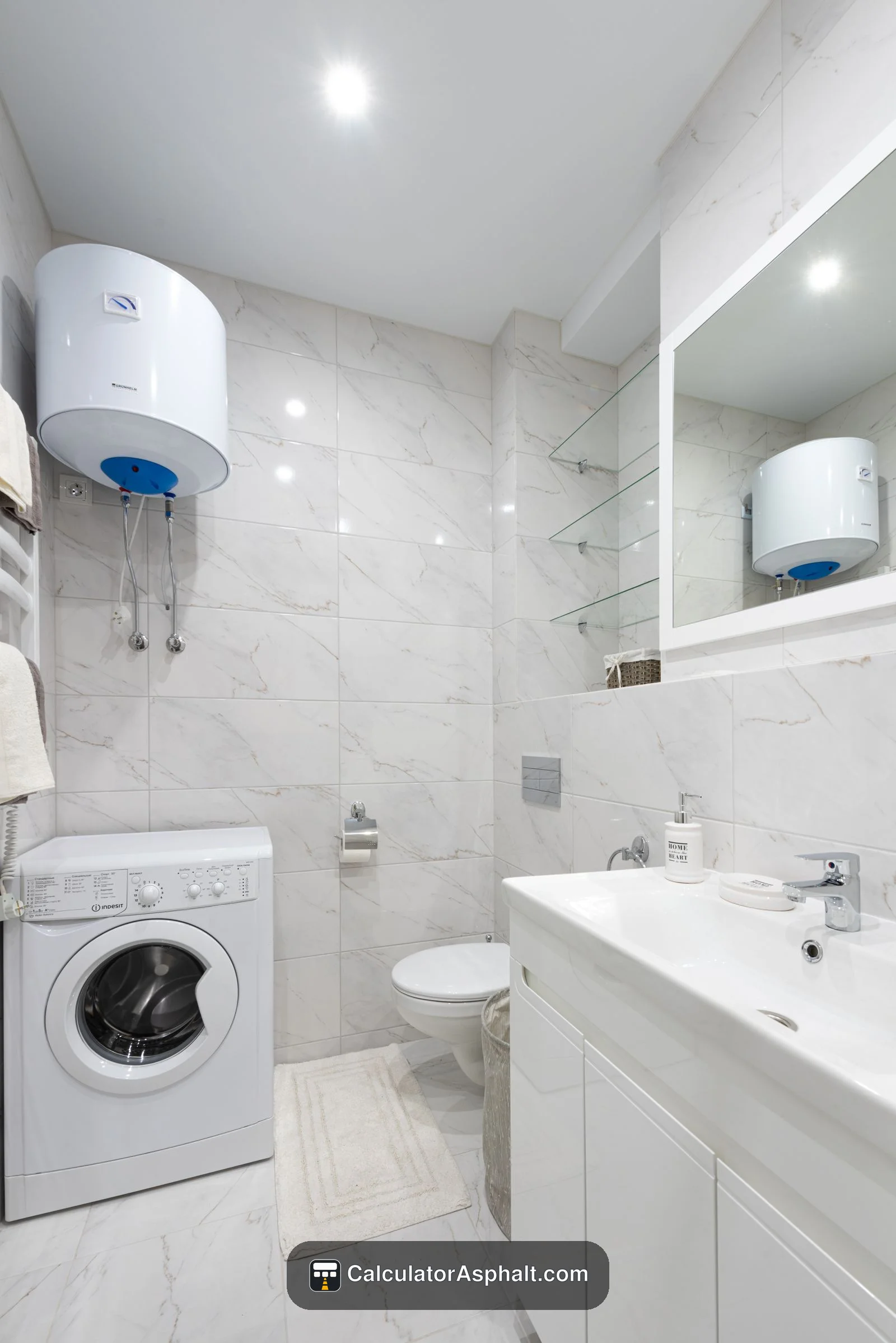
Recovery is the second half of the tank story: how fast the heater reheats the water after the peak. A standard gas burner of 40,000 BTU per hour reheats about 40 gallons per hour through a 70-degree rise — from 50-degree incoming water to 120-degree tap water. The arithmetic: reheating 40 gallons through 70 degrees takes 40 × 8.33 × 70 = 23,324 BTU, because each gallon weighs 8.33 pounds and each pound needs one BTU per degree. At 40,000 BTU per hour, that takes 23,324 ÷ 40,000 = 0.58 hours, or about 35 minutes. After the peak empties the tank, the next hot shower is 35 minutes away.
Tankless heaters: flow rate at your temperature rise
A tankless heater has no tank to empty, so it never runs out in the tank sense. Instead it has a maximum flow rate at a given temperature rise, and if the house asks for more than that, the water comes out cooler than the thermostat setting. The rise is the difference between the incoming cold water and the target tap temperature: in winter, incoming water can be 50 degrees and the target is 120, so the rise is 70 degrees. Size against that number, not the mild-weather rise the brochure quotes.
Read the tankless spec sheet for the flow rate at a 70-degree rise, not the headline flow rate. A unit rated at 9 gallons per minute may deliver that only at a 35-degree rise, and only 5 at a 70-degree rise. If your peak demand is 7.5 gallons per minute, a unit that delivers 5 at your rise will give you lukewarm showers on the coldest mornings. Size for the winter rise.
Worked example: a family of five at 7 a.m.
Take a household of five. On the busiest morning, two showers run at once, the washing machine fills on a hot cycle, and the dishwasher fills. The showers each run at 2 gallons per minute — check the fixture labels, because that number comes from the showerhead, not the heater.
Step 1: add up the peak flow. Two showers at 2 gallons per minute are 4. The washing machine adds 2 while filling, and the dishwasher 1.5. The peak demand is 4 + 2 + 1.5 = 7.5 gallons per minute.
Step 2: work out the volume the peak uses. Two showers, ten minutes each: 2 × 2 × 10 = 40 gallons. The washing machine fills for five minutes at 2 gallons per minute, which is 10 gallons, and the dishwasher fills for five minutes at 1.5, which is 7.5. The total drawn in the peak window is 40 + 10 + 7.5 = 57.5 gallons.
Step 3: compare against a 50-gallon tank. About 70 percent is usable: 50 × 0.70 = 35 gallons. The peak needs 57.5, so the shortfall is 57.5 − 35 = 22.5 gallons, and the second shower and the dishwasher finish cold. A 50-gallon tank cannot serve this morning.
Step 4: check a bigger tank. An 80-gallon tank holds 80 × 0.70 = 56 usable gallons, but the peak needs 57.5 — still 1.5 gallons short. Close still means a cold finish. The honest fix is a 100-gallon tank, which holds 70 usable gallons, or a change in routine.
Step 5: check the tankless option. A tankless unit must deliver 7.5 gallons per minute at a 70-degree rise, from 50-degree incoming water to 120-degree tap water. A unit rated at 9 at a 35-degree rise will not do it; the spec sheet must show at least 7.5 at a 70-degree rise, or the showers run cooler than the thermostat whenever everything runs at once.
Step 6: check the cheap fix first. Staggering the showers by fifteen minutes cuts the peak demand from 7.5 to 5.5 gallons per minute, and the peak volume from 57.5 to 37.5 gallons, because the second shower starts after the washing machine has finished filling. An 80-gallon tank holds 56 usable gallons, which covers 37.5 with room to spare. A fifteen-minute stagger is free.
Decision table: heater options for a 7.5-gallon-per-minute peak
| Option | What it delivers | Morning result | What it costs |
|---|---|---|---|
| 50-gallon tank, 40,000 BTU burner | 35 usable gallons, 35-minute recovery | Second shower runs cold | Nothing to buy |
| 80-gallon tank, 40,000 BTU burner | 56 usable gallons, 70-minute recovery | Still 1.5 gallons short | A bigger tank |
| 100-gallon tank, 40,000 BTU burner | 70 usable gallons | Covers the peak, slow recovery after | A large tank |
| Tankless, 7.5 gpm at 70-degree rise | Unlimited volume at that flow | Covers the peak if the rating is honest | A larger gas line or service |
| Tankless, 5 gpm at 70-degree rise | 5 gallons per minute at full heat | Lukewarm showers when everything runs | A unit that only looks big enough |
| Staggered showers, 80-gallon tank | 56 usable gallons against a 37.5-gallon peak | Covers the peak with 18.5 gallons spare | Fifteen minutes |
A bigger tank buys gallons, a tankless unit buys flow, and a staggered routine buys both for free. Try the stagger first: it costs nothing and tells you whether the problem is the heater or the timetable.
Where heater sizing goes wrong
Sizing by bedrooms. A four-bedroom house with one bathroom needs a smaller heater than a two-bedroom house with three bathrooms. Bedrooms do not use hot water; fixtures do. Count fixtures and simultaneous uses, not rooms.
Reading the headline flow rate on a tankless unit. The big number on the box is measured at a small temperature rise. Your winter rise is 70 degrees, and the flow at that rise is the only number that matters: a unit that delivers 9 gallons per minute at a 35-degree rise may deliver only 5 at a 70-degree rise, and that gap is the cold shower.
Forgetting the washing machine and dishwasher. Both draw hot water while they fill, and both are usually set to run in the morning. A peak calculation that counts only showers understates the demand by 3.5 gallons per minute in the worked example — nearly half the peak.
Ignoring recovery time. A tank that empties at 7 a.m. is not ready again at 7:15: at 40,000 BTU per hour, reheating 40 gallons takes about 35 minutes. A family that showers in waves needs to know the gap between waves, or the third wave showers cold.
Field checklist: before you buy a heater
- Busiest morning listed: every shower, appliance, and tap running at once
- Flow rate of each use noted from the fixture or appliance label
- Peak flow added up in gallons per minute
- Peak volume calculated for the ten-to-fifteen-minute window
- Existing tank checked: volume times 0.70 for usable gallons
- Recovery time calculated from the burner or element rating
- Tankless spec checked for flow at a 70-degree rise, not the headline rate
- Incoming winter water temperature checked for the area
- Staggered routine tried for a week before buying a new heater
Mistakes that cost a cold shower
The most expensive mistake is buying a bigger tank without doing the peak calculation, and finding it still falls short by a gallon and a half. The second is buying a tankless unit on its headline flow rate and discovering the winter rise cuts it nearly in half. The third is counting only the showers and forgetting the washing machine and dishwasher, which understates the peak by almost half. The fourth is assuming the tank refills as fast as it empties, when recovery takes 35 minutes for 40 gallons. Every one is a sizing mistake, fixed by adding up the morning before buying anything.
Frequently asked questions
How do I find my shower's flow rate?
Check the showerhead label for the flow in gallons per minute. If the label is gone, time a one-gallon jug: 30 seconds means 2 gallons per minute, 40 seconds means 1.5. Measure at the normal shower temperature.
Is a tankless heater always better for a large family?
Not always. A tankless unit is better when the peak flow is high and lasts a long time, because it never empties. But it needs a gas line or electrical service large enough to feed it, and a rating for your winter rise. A large tank with a staggered routine often costs less and performs as well.
Why does the water run cold only in winter?
Incoming water is colder in winter, so the rise is larger — 70 degrees instead of 45 or 50. A tankless unit delivers less flow at a larger rise, and a tank's recovery takes longer because each gallon needs more heat. The heater did not get weaker; the water got colder.
Can I just turn the thermostat up?
Turning the tank thermostat above 120 degrees stores more heat per gallon, which helps slightly, but it raises the scalding risk and the standing heat loss. It does not add gallons, and it cannot fix a 22-gallon shortfall.