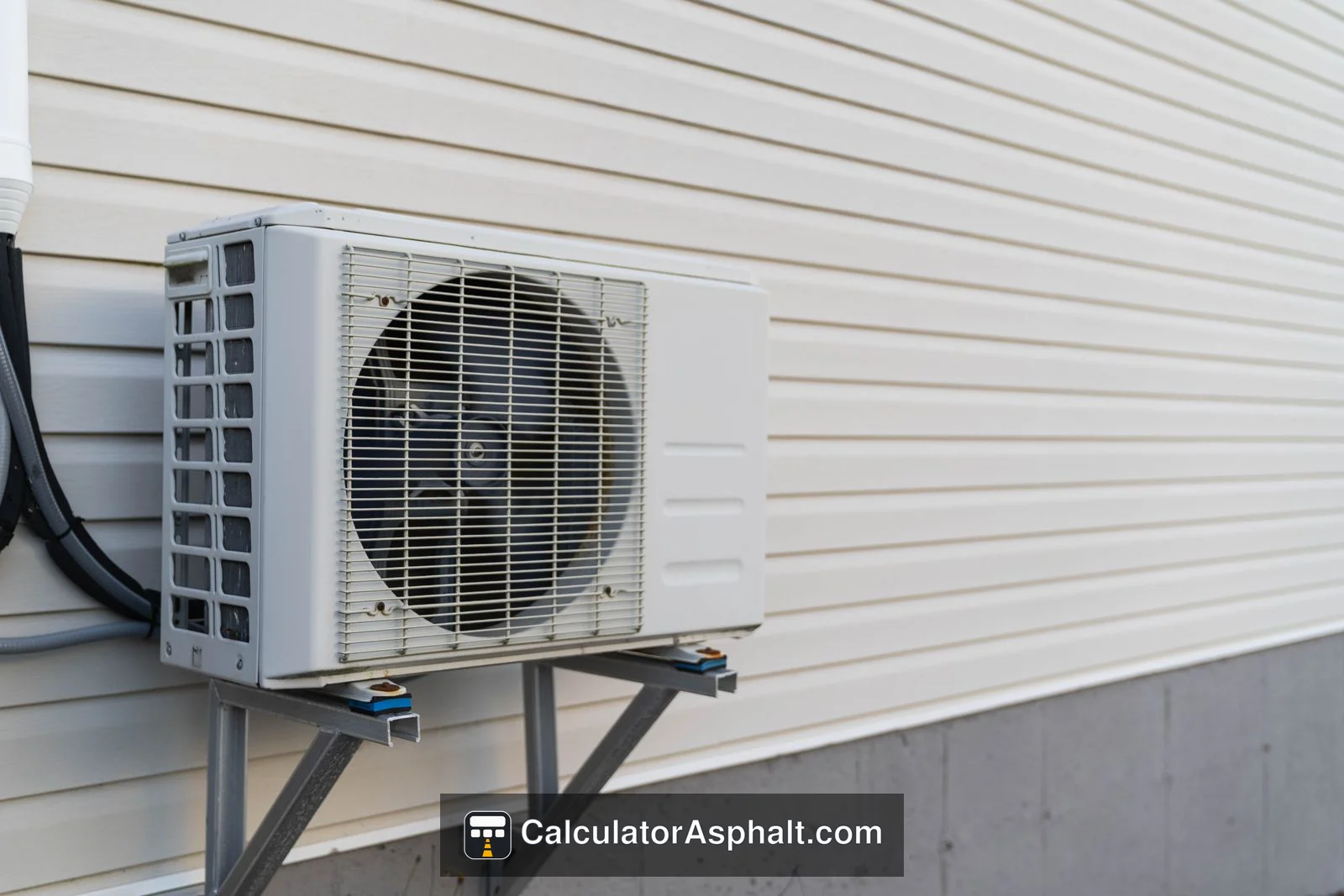
The old air conditioner dies, the contractor quotes a replacement, and the advice is always the same: go one size bigger, just to be safe. The bigger unit cools the house faster, the thermostat is satisfied sooner, and everyone assumes the job is done. Then the house feels clammy, the unit clicks on and off all afternoon, and the humidity never quite drops.
The problem is short-cycling. An oversized air conditioner meets the temperature setpoint in a few minutes and switches off before it has run long enough to pull moisture out of the air. Cooling is fast; dehumidifying is slow, and it needs a long, steady run. A unit sized to the actual load runs longer, steadier cycles, and leaves the house dry as well as cool.
The decision first: loads, not square feet
The sizing shortcut everyone uses is square feet per ton — one ton of cooling for every 500 square feet, say — and it is wrong in both directions. Two houses of the same size can need very different cooling: one faces west with big windows and a dark roof, the other faces north with shade trees and good insulation. Square footage alone cannot see any of that.
The right method is a room-by-room load screen. Each room gets its own heat load: its floor area, its windows and their direction, its insulation, and the heat from the people and appliances in it. Add the rooms together and you have the house load in BTU per hour. One ton of cooling equals 12,000 BTU per hour, so dividing the total by 12,000 gives the size in tons.
The load figures in this article are planning factors to check against a proper load calculation for your house — they are not a substitute for one. But the screen is enough to catch the expensive error: buying a 3.5-ton unit for a house that needs 2.5 tons.
What a room load is made of
Four things put heat into a room. The first is the building itself: heat coming through the walls, the ceiling, and the windows, driven by the temperature difference between inside and outside. A room with R-11 walls and single-pane windows gains far more heat than the same room with R-19 walls and double glazing.
The second is the sun through the windows. A west-facing window in the afternoon admits several times the heat of the same window facing north, and the difference is large enough to change the size of the unit. Window area and direction matter more than floor area in a sunny room.
The third is the people in the room. Each person adds heat — roughly 400 BTU per hour of sensible heat at rest, more when active — and a living room that holds six people on a summer evening needs more cooling than the same room holding one.
The fourth is the appliances. A kitchen with an oven, a fridge, and a dishwasher adds thousands of BTU per hour while cooking. A home office with a computer and a monitor adds a few hundred. Rooms are not interchangeable, and the load screen is what shows it.
The short-cycle problem, in numbers
An air conditioner removes humidity only while it is running, and it needs about 15 to 20 minutes of continuous running before the coil is cold enough and wet enough to wring moisture out of the air in earnest. A correctly sized unit runs long cycles on a hot afternoon and keeps the humidity down. An oversized unit hits the temperature setpoint in eight or ten minutes, switches off, and the coil never gets its long run — so the temperature is right and the air still feels sticky.
Short-cycling also wears the equipment. Every start is the hardest moment for the compressor, and a unit that starts six times an hour instead of twice wears out faster and draws a surge of current at every start. The bigger unit costs more to buy, starts more often, and leaves the house damper — the opposite of a bargain.
Worked example: a 1,600-square-foot house that needs 2.5 tons
Take a single-story house of 1,600 square feet. The square-feet shortcut says one ton per 500 square feet, so 1,600 ÷ 500 = 3.2 tons — and the contractor rounds up to a 3.5-ton unit. The room-by-room screen says something different. All load factors below are planning figures to check against a proper load calculation.
Step 1: the room loads. Living room, 12 by 15 feet, 180 square feet at a planning factor of 25 BTU per hour per square foot: 180 × 25 = 4,500 BTU per hour. Kitchen, 10 by 12 feet, 120 square feet at 35 BTU per hour per square foot to allow for cooking appliances: 120 × 35 = 4,200. Master bedroom, 12 by 14 feet, 168 square feet at 25: 168 × 25 = 4,200. Second bedroom, 10 by 12 feet, 120 square feet at 25: 120 × 25 = 3,000. Third bedroom, 10 by 10 feet, 100 square feet at 25: 100 × 25 = 2,500. Dining room, 12 by 12 feet, 144 square feet at 25: 144 × 25 = 3,600.
Step 2: add the rooms. 4,500 + 4,200 + 4,200 + 3,000 + 2,500 + 3,600 = 22,000 BTU per hour for the rooms.
Step 3: add the extras. Sun through the west windows, occupants, and appliances not already counted add a planning allowance of 8,000 BTU per hour — 3,000 for solar gain through the west-facing glass, 3,000 for occupants and cooking, and 2,000 for the remaining appliances. The house total is 22,000 + 8,000 = 30,000 BTU per hour.
Step 4: convert to tons. One ton equals 12,000 BTU per hour, so 30,000 ÷ 12,000 = 2.5 tons. The house needs a 2.5-ton unit.
Step 5: compare with the shortcut. The shortcut sold a 3.5-ton unit — 3.5 × 12,000 = 42,000 BTU per hour — against a real load of 30,000. The oversize is 42,000 ÷ 30,000 = 1.4, or 40 percent too big. On a design afternoon the 3.5-ton unit meets the setpoint after running about 30,000 ÷ 42,000 = 71 percent of the cooling the house actually needs in that hour, then switches off — short cycles, all afternoon, while the 2.5-ton unit runs long and steady and pulls the humidity down with it.
Decision table: two units for the same house
| Option | Capacity | Against a 30,000 BTU/h load | Cycle behaviour |
|---|---|---|---|
| 2.5-ton unit | 30,000 BTU/h | Matched | Long, steady runs; dehumidifies |
| 3-ton unit | 36,000 BTU/h | 20% oversized | Shorter cycles; mild humidity penalty |
| 3.5-ton unit | 42,000 BTU/h | 40% oversized | Short-cycles; house feels clammy |
| 2-ton unit | 24,000 BTU/h | 20% undersized | Runs non-stop on the hottest days |
A small oversize — half a ton — is forgiving. A full ton is not.
Where AC sizing goes wrong
Sizing by square feet alone. The shortcut ignores windows, direction, insulation, and occupants, and it almost always oversizes, because the rule was written for the worst house, not your house. A shaded, well-insulated house needs far less than 500 square feet per ton.
Copying the old unit's size. The old unit may have been oversized when it was installed, or the house may have gained insulation, new windows, or shade since then. The old nameplate is a record of a past guess, not a measurement of the present load.
Ignoring the ducts. A correctly sized unit on undersized or leaky ducts cannot deliver its cooling to the rooms. Ducts in a hot attic can lose a large share of the cooling before it reaches a vent, and a load screen that ignores the ducts sizes the wrong thing.
Chasing the lowest temperature. Setting the thermostat to 65 degrees does not make an oversized unit dehumidify — it makes it run even shorter cycles at a colder setpoint, and the house ends up cold and damp instead of cool and dry.
Field checklist: before you sign for a new unit
- Floor area of every room measured, not guessed
- Window area and direction noted for every room
- Wall and attic insulation levels noted
- Room-by-room load totalled in BTU per hour
- Total divided by 12,000 to get tons
- Old unit's size noted — and not trusted as the answer
- Duct size and condition checked, including attic runs
- Contractor's load calculation asked for in writing
- Humidity complaint noted, not just temperature — it points to short-cycling
Mistakes that leave a house clammy
The most expensive mistake is buying a ton too big on a contractor's say-so, because the unit costs more, starts more often, and never runs long enough to dry the air. The second is sizing by square feet and skipping the room-by-room screen, which is the only step that catches the oversize before the money is spent. The third is replacing the unit without checking the ducts, so the new equipment inherits the old delivery problem. The fourth is judging the system by temperature alone and ignoring humidity, which is the thing short-cycling actually breaks. Every one is a sizing mistake, fixed by a load screen done before the quote is signed.
Frequently asked questions
Is a slightly oversized unit really a problem?
Half a ton over is usually fine — the unit still runs reasonably long cycles. A full ton over is where short-cycling and humidity problems start in earnest, and a ton and a half over is a clammy house all summer.
Can I fix short-cycling without replacing the unit?
Sometimes. A thermostat with a wider temperature swing makes cycles longer, and a variable-speed or two-stage unit can run at part capacity instead of full blast. But a single-stage unit that is 40 percent too big cannot be tuned into a right-sized one — the capacity is what it is.
Does insulation change the size I need?
Yes, and it is the cheapest way to shrink it. Going from R-11 to R-38 in the attic cuts the ceiling heat gain sharply, and sealing the ducts cuts the loss further. A house that needed 3 tons before insulation may need 2.5 tons after it.
Why does my house feel cold and damp at the same time?
Because the unit cools the air fast and switches off before it dries it. Cold, damp air feels colder than dry air at the same temperature, which is why the thermostat gets turned down further and the problem gets worse. Longer runs, not colder air, are the fix.