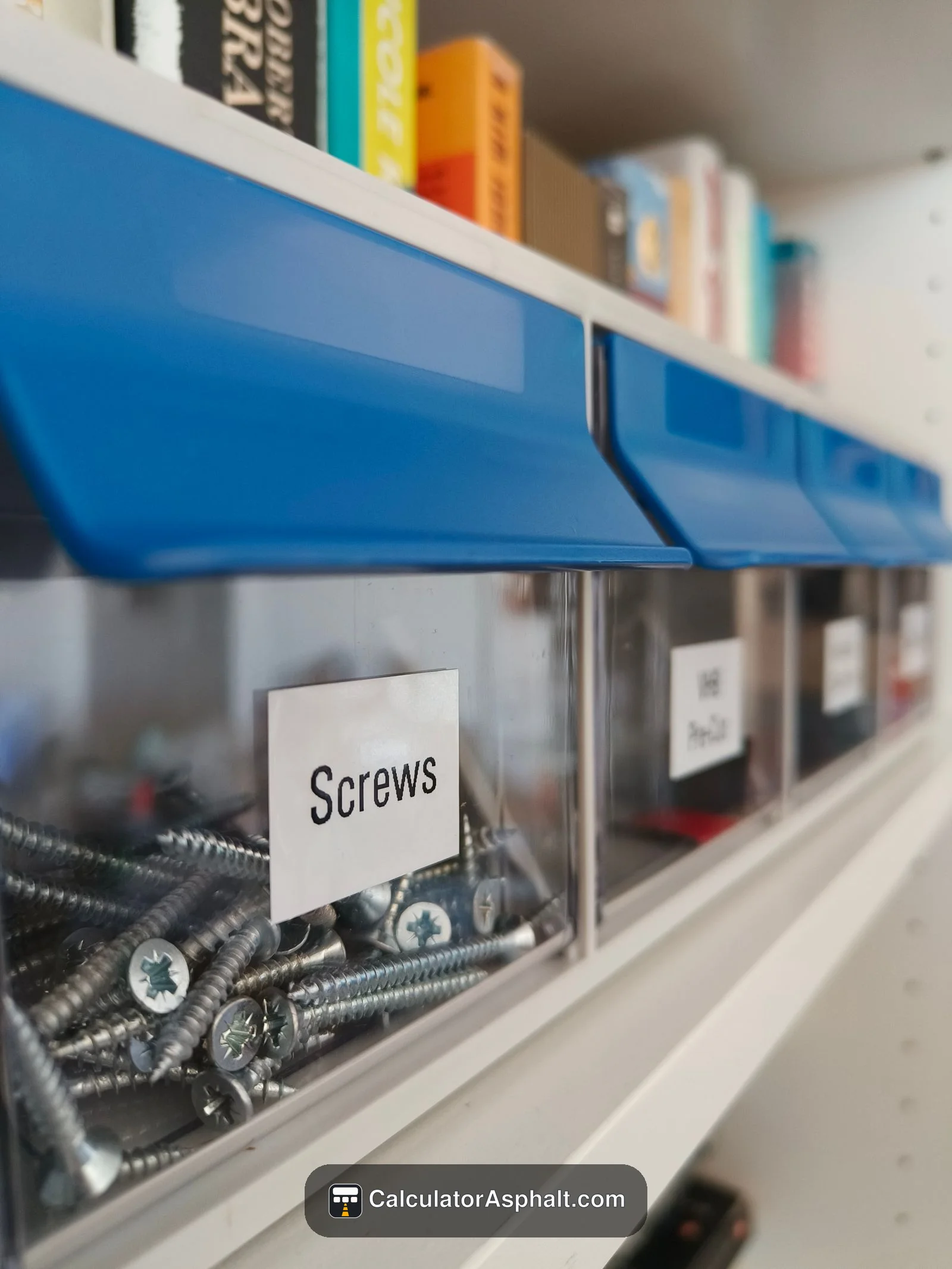
You own a spare hose fitting. You know you own it, because you bought it last year. You cannot find it, so you buy another one, and now you own two. The garage is full of things you own twice, and the reason is not that you are forgetful. The reason is that the bins have no labels, and a bin without a label is a box you cannot see into. This guide is for the homeowner who keeps buying what they already own, and it makes one promise: twenty labels in forty minutes end the duplicates.
The fix is a label on every bin, on the front and on the lid, with the contents written in plain words. This guide works through one example with real arithmetic, compares labels with colour codes, and gives a labelling plan that survives the household.
The decision first
Label every bin with the contents in plain words, on the front and on the lid, and never label a bin "miscellaneous". The label is the system. Colour codes, numbers, and memory are not systems, because they all depend on someone remembering what the code means, and the person who remembers is never the person looking for the hose fitting.
Why the duplicates happen
Duplicates happen for one reason: looking is harder than buying. Opening six unlabelled bins to find a hose fitting takes eight minutes, and the eighth minute is the moment you give up and drive to the shop. Buying takes twenty minutes and feels like progress. So you buy, and the garage gains another duplicate, and the next search takes even longer, because there are now seven bins to open.
A label breaks the cycle. A labelled bin tells you what is inside it before you open it, so the search takes one minute instead of eight, and buying stops being the easier option. The label does not make you tidier. It makes looking cheaper than buying, and that is enough.
Worked example: twenty labels, forty minutes
Every number here comes from the assumptions below, and every step shows its arithmetic. Count your own bins before you buy anything.
Assumptions: twenty bins in the garage, three searches a week for things in bins. These are assumptions, not facts about your garage.
The labels: twenty labels, forty minutes
Twenty bins, one label each, two minutes per label: 20 x 2 = 40 minutes. Two minutes covers writing the label, sticking it on the front of the bin, and sticking a second copy on the lid, so the label is visible whether the bin is on a shelf or stacked under another bin. Forty minutes is the whole job, and it is done once.
The hunting: 21 hours a year without labels
Without labels, one search takes 8 minutes: open a bin, look inside, close it, open the next. Three searches a week: 3 x 8 = 24 minutes a week. Twenty-four minutes a week, 52 weeks: 24 x 52 = 1,248 minutes, which is 1,248 / 60 = 20.8 hours, or about 21 hours a year. Twenty-one hours spent opening bins and closing them again.
With labels, one search takes 1 minute: read the labels, open the right bin. Three searches a week: 3 x 1 = 3 minutes a week. Three minutes a week, 52 weeks: 3 x 52 = 156 minutes, which is 156 / 60 = 2.6 hours a year. The saving: 21 – 2.6 = 18.4 hours a year, or about 18 hours. Forty minutes of labelling buys back eighteen hours a year.
The duplicates: five a year down to one
In the example household, the unlabelled garage produces 5 duplicate purchases a year: a hose fitting, a pack of screws, a tube of sealant, a pair of gloves, and a roll of tape. Five duplicates a year, every year, because the search always fails first. With labels, the household still buys 1 duplicate a year, because one search in twenty still fails, and one item in twenty is genuinely lost. The saving: 5 – 1 = 4 duplicate purchases a year that never happen. Four duplicates a year, every year, for forty minutes of labelling.
The rule: one kind of thing per bin
Twenty bins, one kind of thing per bin. A bin holds hose fittings, or screws, or sealant, and the label says which. A bin that holds two kinds of things needs two labels, and two labels on one bin is a bin that nobody can read. Split the bin, or shrink the pile. One kind, one label, every time.
Run the same steps for your garage: count your bins, count your searches per week, and multiply the minutes out to a year. The arithmetic is the argument, and it is hard to argue with.
Labels or colour codes
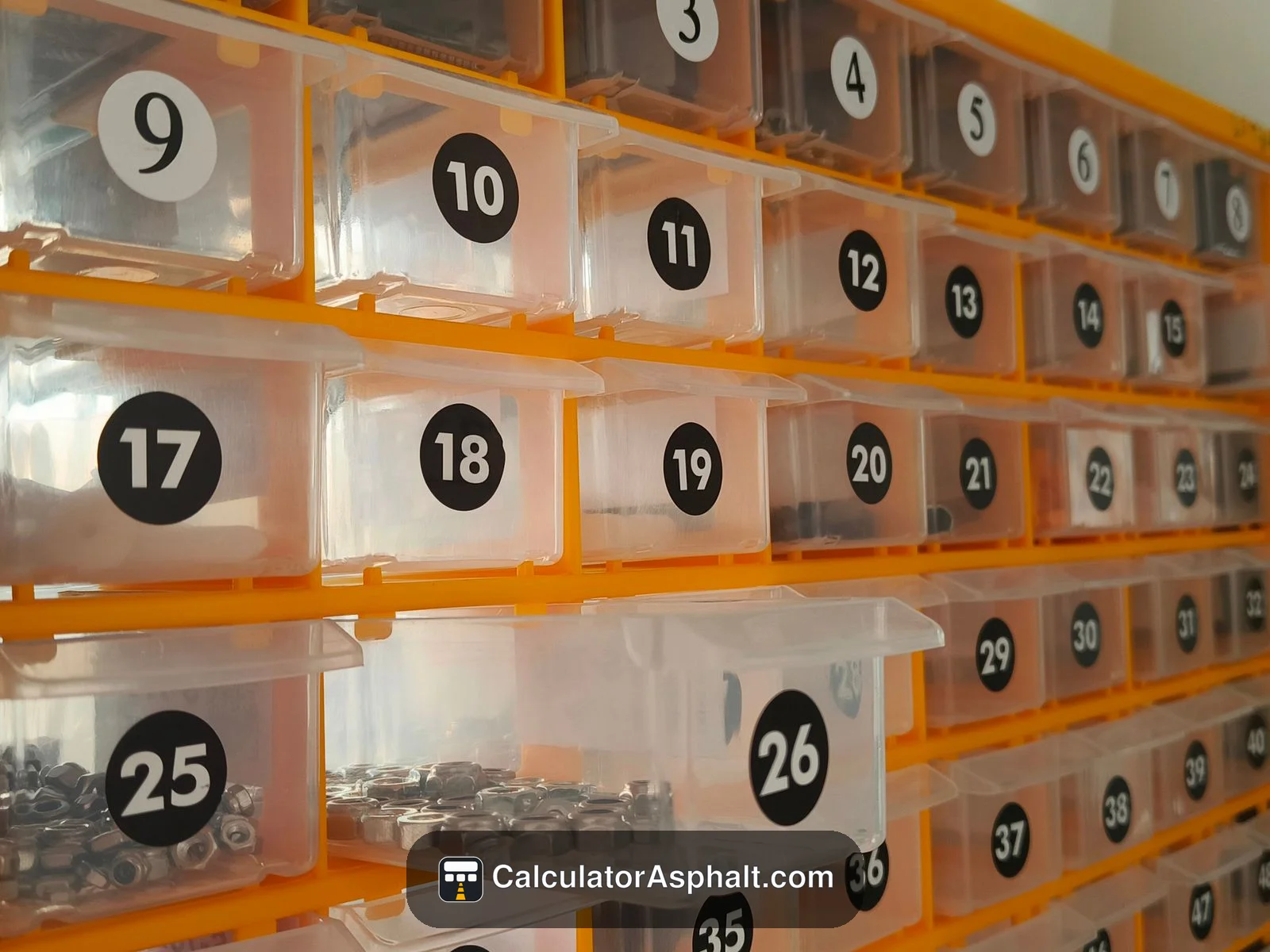
The choice is not which one looks tidier. It is which one survives the household.
| Choice | What happens | Best for | Watch out for |
|---|---|---|---|
| Labels in plain words | Anyone can read the bin and find the thing | Every household, every garage | The label must be specific, and the bin must hold one kind of thing |
| Colour codes | The bins look tidy, and nobody remembers the code | A garage used by one person only | The code lives in one person's head, and it dies the day they forget it |
| Numbers | The bins are numbered, and the list is lost | Nobody: this is the trap to avoid | The list is on a piece of paper somewhere, and the paper is in a bin |
| No labels, good memory | The garage works until it does not | A garage with three bins in it | Memory fails at twenty bins, and it fails exactly when you are in a hurry |
The right answer is labels in plain words. A label is a system anyone can read, including the person who did not set the system up, and that is the whole point.
How to label twenty bins in forty minutes
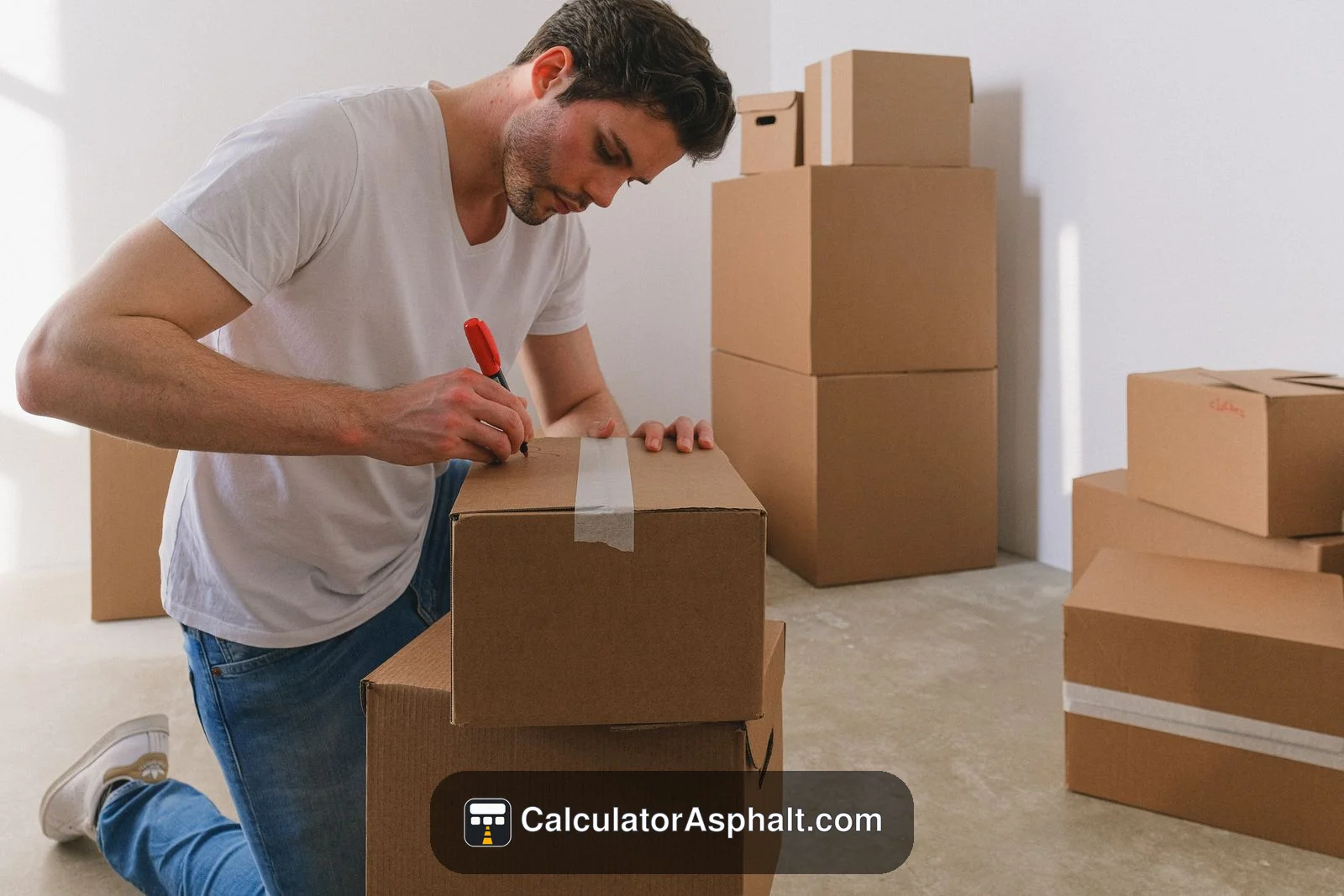
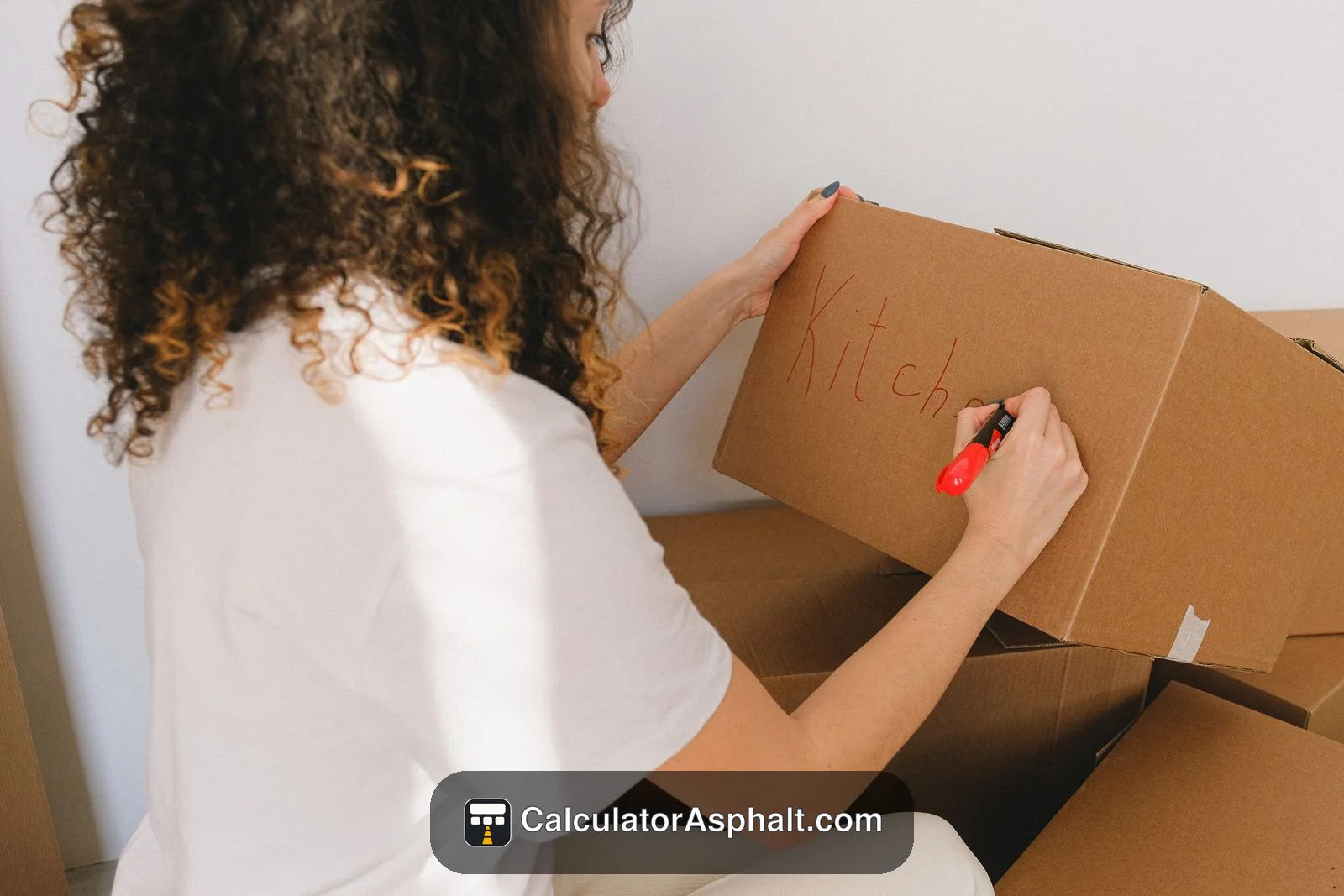
Start by emptying one bin at a time, not all twenty at once. Take the first bin off the shelf, open it, and sort what is inside into one kind of thing. If the bin holds two kinds of things, split it into two bins, or move one kind out. A bin that holds two kinds of things is a bin that needs two labels, and two labels is a bin nobody can read.
Write the label in plain words, with the kind of thing and nothing else. "Hose fittings" is a label. "Garden stuff" is not a label, because garden stuff could be anything, and a label that could be anything is a label that says nothing. "Screws, 25 mm" is a label. "Fixings" is not.
Stick one copy on the front of the bin and one copy on the lid. The front label is for the bin on the shelf. The lid label is for the bin stacked under another bin, where the front is hidden. A label you cannot see is a label that does not exist.
Work through the bins one at a time, shelf by shelf, and do not stop halfway. Ten labelled bins and ten unlabelled bins is a garage where the searches still fail half the time, because the thing you need is always in an unlabelled bin. Forty minutes, twenty bins, all of them, in one session.
Field checklist: before you label anything
Use this checklist in order.
- Count the bins and write the number down.
- Count your searches per week, and work out the yearly hours.
- Buy labels and a marker, or a label maker if you prefer one.
- Empty one bin at a time, and sort each bin to one kind of thing.
- Split any bin that holds two kinds of things, and count the new bins.
- Write each label in plain words, with the kind of thing and nothing else.
- Stick one copy on the front and one copy on the lid of every bin.
- Never label a bin "miscellaneous", "garden stuff", or "fixings".
- Work shelf by shelf, and finish all twenty bins in one session.
- Walk the garage with everyone who uses it, and show them the labels.
Mistakes that make labels useless
Labelling a bin "miscellaneous" is the first mistake. A miscellaneous bin is a junk drawer with a lid, and it grows until it swallows the shelf. Every bin holds one kind of thing, and the label says which kind.
Labelling only the front is the second mistake. A bin stacked under another bin hides its front, and a hidden label is no label at all. Front and lid, every bin, every time.
Writing vague labels is the third mistake. "Garden stuff" and "fixings" are not labels, because they could mean anything, and a label that could mean anything means nothing. Plain words, one kind of thing, nothing else.
Stopping halfway is the fourth mistake. Ten labelled bins and ten unlabelled bins is a garage where the searches still fail half the time, because the thing you need is always in the unlabelled half. Forty minutes, twenty bins, all of them.
Using a code nobody else knows is the fifth mistake. Colour codes and numbers are systems that live in one person's head, and they die the day that person forgets, or the day someone else looks for the hose fitting. Plain words, readable by anyone, every time.
Frequently asked questions
What if a bin holds two kinds of things?
Split it. A bin that holds two kinds of things needs two labels, and two labels on one bin is a bin nobody can read. Put one kind in the bin and the other kind in another bin, or move one kind out of the garage. One kind, one label, every time.
Do I need a label maker?
No. A marker and a pack of labels do the job, and they cost less than one duplicate purchase. A label maker is neater, and it is worth it if you like neat labels, but neatness is not the system. Plain words on a sticky label are the system.
What if the labels fall off?
They will, eventually, and that is normal. Check the labels once a year, on the same day you do the seasonal swap, and replace any that have fallen off or faded. A label check takes ten minutes, and it is the maintenance the system needs.
What if I have more than twenty bins?
Count them first, then ask what they hold. Twenty bins is the example, not the limit, and a garage with thirty bins needs thirty labels and sixty minutes. If the count keeps growing past thirty, the problem is not labelling, it is sorting: more than thirty bins usually means a dozen of them should leave the house entirely.