See where a stone border pays off and how to size it before you buy.
Before choosing a pattern or shopping for finishes, test the design on the space you already use. Look at the pavement from the curb and check where the edge changes condition. List the points where it meets grass, a bed, the sidewalk or another material.
Continuous pale frame
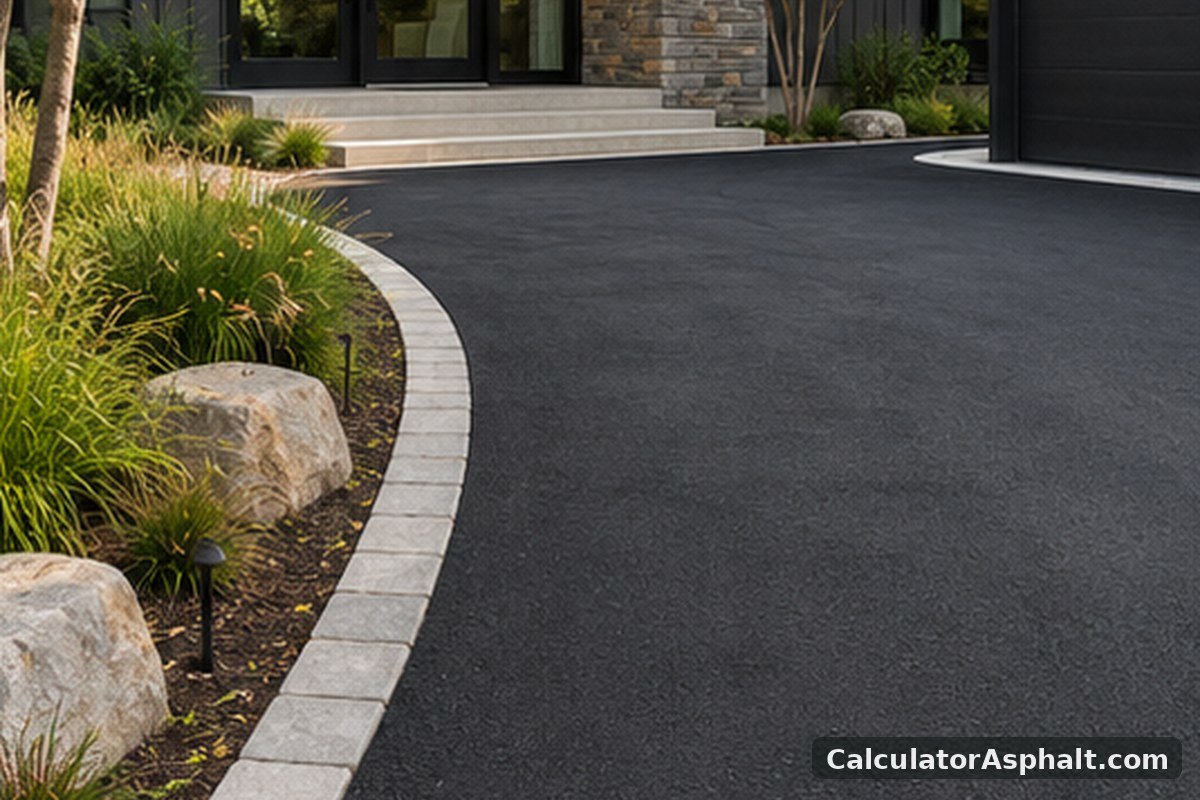
Use one line to make the outline readable. Dry-lay a short sample beside the asphalt and compare it wet and dry.
Two ways to adapt the idea
- Interrupted stone inserts
- Frame just the garage end or the street approach. Match the beginning and end to existing design lines.
- Planting beside a matching stone edge
- Repeat the border near the front walk. Keep the plants back far enough to preserve the contrast as they grow.
Work through a measured example
A 3-by-24-foot example covers 72 square feet before you account for cutouts. Keep separate totals for each material and avoid counting the same surface twice. Measure the straight runs, the corner lengths and the sections that will receive trim. Show your sequence to the installer so the edge, adjoining surface and finished grade are priced together.
Check the design from both sides
The most convincing border usually begins and ends at an existing feature. Look for the line of the garage opening, a step or the edge of a raised bed. Test a shorter section before running light stone around every edge. A full outline can make an irregular footprint more obvious.
A question to settle before ordering
Can I estimate a border from square footage?
Start with the linear length of each edge. Multiply by its planned width for area, or divide by the installed length of each unit as a piece estimate. Price corners, cuts and the supporting assembly separately.
Estimate the materials
Before you buy
Open the site checklist
- Take a photo from the point where the project is first seen.
- Look at the pavement from the curb and check where the edge changes condition. List the points where it meets grass, a bed, the sidewalk or another material.
- Measure the straight runs, the corner lengths and the sections that will receive trim. Show your sequence to the installer so the edge, adjoining surface and finished grade are priced together.