Compare three ways to fit useful herbs near a paved area and calculate the soil before delivery.
Before choosing a pattern or shopping for finishes, test the design on the space you already use. Mark the route from the kitchen to the bed. Check the available light against your intended herb list and test how well you can reach the far edge.
One shallow narrow bed
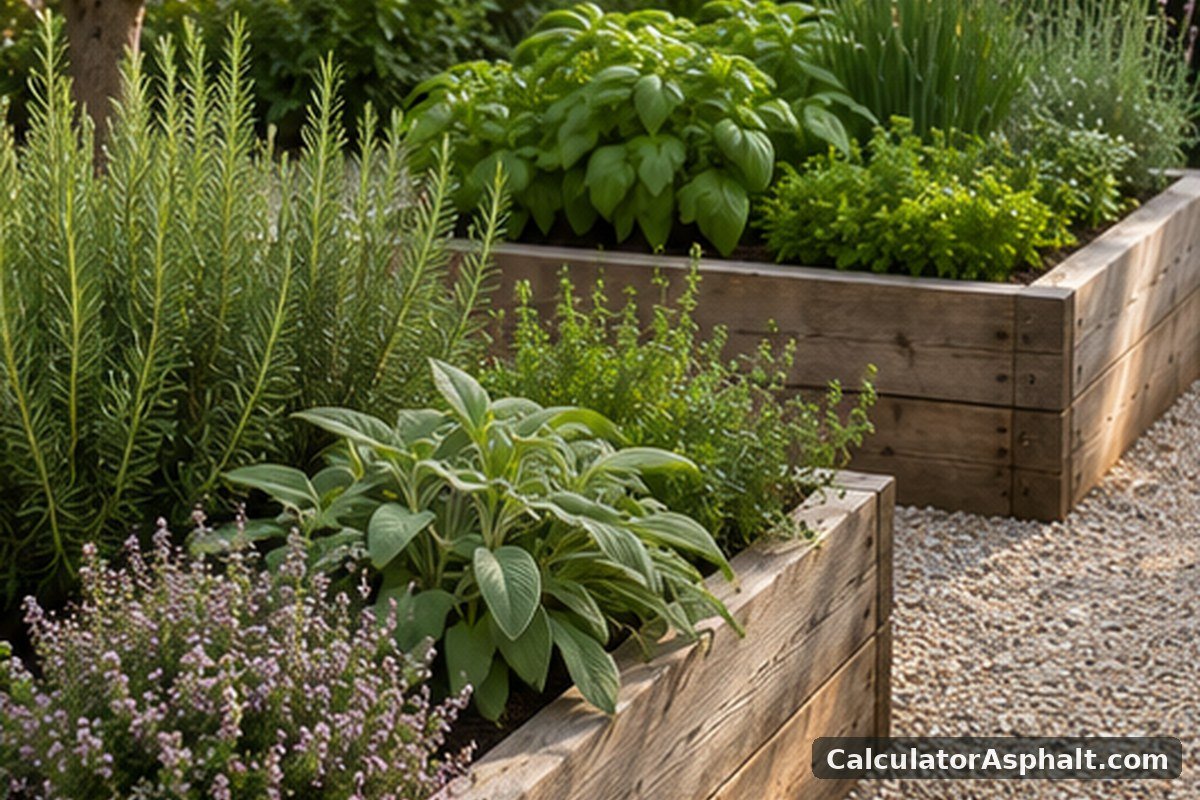
Put the herbs you harvest most often nearest the approach. Estimate fill from inside dimensions.
Two ways to adapt the idea
- Two short beds with a gap
- Try walking the gap while carrying a watering can. Group herbs by light and water requirements.
- Small beds with separate pots
- Use individual containers where preferred for vigorous spreaders or different growing needs.
Work through a measured example
Measure the inside of the growing bed and calculate fill using the intended depth. Measure the outside separately to make sure there is space left between the bed and the route. For the example bed, multiply inside length by width by the actual fill depth in feet. A 3-by-8-foot rectangle filled 9 inches uses 18 cubic feet, about 0.67 cubic yard.
Check the design from both sides
An herb bed close to the kitchen only saves trips if it is easy to pick from. Try holding a bowl in one hand as you reach across the proposed width. Place the heaviest or tallest container where it can be watered comfortably. Size the planting and path based on the mature plants, especially at the corner nearest the door.
A question to settle before ordering
How many bags does the example need?
At 1.5 cubic feet per bag, 18 cubic feet takes exactly 12 bags before any allowance for adjustment. Compare that count with the supplier's delivered bulk units.
Estimate the materials
Before you buy
Open the site checklist
- Take a photo from the point where the project is first seen.
- Mark the route from the kitchen to the bed. Check the available light against your intended herb list and test how well you can reach the far edge.
- For the example bed, multiply inside length by width by the actual fill depth in feet. A 3-by-8-foot rectangle filled 9 inches uses 18 cubic feet, about 0.67 cubic yard.