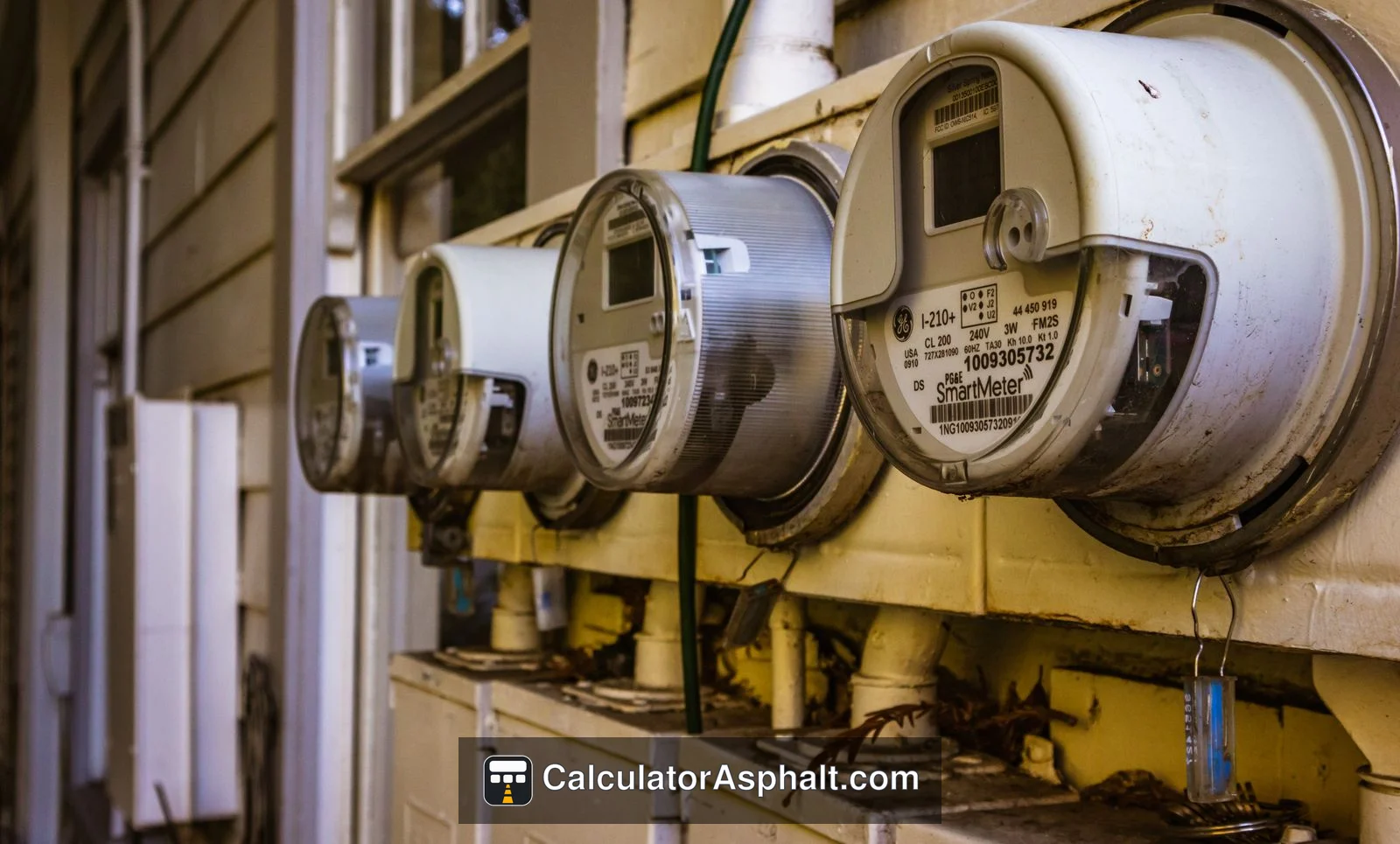
The energy bill arrives as one number. It never says which appliance ran up the total, so a household staring at a high bill has no idea whether to blame the fridge, the water heater, the air conditioner, or the dryer. Guessing usually lands on the wrong appliance, and the wrong appliance gets replaced while the real culprit keeps running.
The fix is a kilowatt-hour breakdown. Every appliance has a wattage and a number of hours it runs, and multiplying the two gives its monthly kilowatt-hours. Add up the big appliances and the total should come close to the bill — and the biggest slice is usually obvious once it is written down.
The decision first: watts times hours equals the bill
A kilowatt-hour is one thousand watts running for one hour. A 150-watt fridge running around the clock uses 150 times 24 hours, or 3,600 watt-hours a day — 3.6 kilowatt-hours. A 3,000-watt dryer running for 45 minutes uses 3,000 times 0.75 hours, or 2,250 watt-hours — 2.25 kilowatt-hours per load. The arithmetic is the same for every appliance: watts, times hours, divided by 1,000.
Wattage comes from the label on the appliance, usually on the back or inside the door, or from the manual. Hours come from honest counting: how many hours a day it actually runs, not how many hours it is switched on. A television switched on for four hours uses four hours of watts; a fridge switched on for 24 hours runs its compressor for only part of that time, so its label wattage has to be multiplied by its duty cycle — the fraction of the time the compressor actually runs.
The rate comes from your own bill: divide the total charge by the total kilowatt-hours to get the effective rate, or read the rate line directly. The worked example below uses an example rate of $0.15 per kilowatt-hour, labelled as an example to check against your own bill.
The usual suspects, in order

Start with the appliances that run longest or draw the most power: a handful usually account for most of the bill.
The water heater is the first suspect in an all-electric house. An electric tank heater uses roughly 9.55 kilowatt-hours a day in the worked example from the water-heating article — about 287 kilowatt-hours a month — and it runs every day of the year. The air conditioner is the second suspect in summer: a 2,000-watt unit running six hours a day uses 360 kilowatt-hours a month. The fridge is the third: it never switches off, so even a modest 150 watts adds up to 108 kilowatt-hours a month.
After those three, the numbers fall fast. A dryer at 3,000 watts sounds alarming, but 12 loads a month at 45 minutes each is only 27 kilowatt-hours. Lighting is smaller still: ten 9-watt LED bulbs running four hours a day use under 11 kilowatt-hours a month. The television, the laptop, and the phone chargers are rounding errors next to the big three — which is why replacing light bulbs rarely fixes a high bill, and why the water heater and the air conditioner deserve the first look.
Worked example: an example $135 bill, broken down

Take a household with an example monthly bill of 900 kilowatt-hours at an example rate of $0.15 per kilowatt-hour — $135 for the month. All rates and wattages below are labelled examples; replace them with your own label figures and your own bill rate.
Step 1: the fridge. A 150-watt fridge running 24 hours a day uses 150 × 24 = 3,600 watt-hours a day, or 3.6 kilowatt-hours. Over 30 days that is 3.6 × 30 = 108 kilowatt-hours, and at $0.15 that is 108 × 0.15 = $16.20 a month.
Step 2: the water heater. An electric tank heater using 9.55 kilowatt-hours a day uses 9.55 × 30 = 286.5 kilowatt-hours a month, and at $0.15 that is 286.5 × 0.15 = $42.98 a month. It is the single biggest slice of this bill.
Step 3: the air conditioner. A 2,000-watt unit running 6 hours a day uses 2,000 × 6 = 12,000 watt-hours a day, or 12 kilowatt-hours. Over 30 days that is 360 kilowatt-hours, and at $0.15 that is $54.00 a month.
Step 4: the dryer. A 3,000-watt dryer running 45 minutes per load uses 3,000 × 0.75 = 2,250 watt-hours, or 2.25 kilowatt-hours per load. Twelve loads a month use 2.25 × 12 = 27 kilowatt-hours, and at $0.15 that is $4.05 a month.
Step 5: lighting and television. Ten 9-watt LED bulbs running 4 hours a day use 10 × 9 × 4 = 360 watt-hours a day, or 0.36 kilowatt-hours, which is 10.8 kilowatt-hours a month and $1.62. A 150-watt television running 4 hours a day uses 150 × 4 = 600 watt-hours a day, or 18 kilowatt-hours a month and $2.70.
Step 6: add it up. Fridge 108, water heater 286.5, air conditioner 360, dryer 27, lighting 10.8, television 18 — the total is 810.3 kilowatt-hours, or $121.55 at the example rate. The bill was 900 kilowatt-hours, so 900 − 810.3 = 89.7 kilowatt-hours, or about $13.45, is unaccounted for: the washing machine, the dishwasher, the router, the chargers, and everything else small. The breakdown is close enough to name the culprits: the air conditioner and the water heater together are 646.5 of the 900 kilowatt-hours — nearly three quarters of the bill.
Decision table: the example month, ranked
| Appliance | Monthly kWh | Monthly cost at example rate | Share of bill |
|---|---|---|---|
| Air conditioner, 2,000 W × 6 h/day | 360 | $54.00 | 40% |
| Electric water heater, 9.55 kWh/day | 286.5 | $42.98 | 32% |
| Fridge, 150 W × 24 h/day | 108 | $16.20 | 12% |
| Dryer, 3,000 W × 12 loads | 27 | $4.05 | 3% |
| Television, 150 W × 4 h/day | 18 | $2.70 | 2% |
| LED lighting, 10 × 9 W × 4 h/day | 10.8 | $1.62 | 1% |
| Everything else | 89.7 | $13.45 | 10% |
| Total | 900 | $135.00 | 100% |
Run the same table with your own wattages, hours, and rate before you replace anything.
The old fridge test

The fridge deserves its own test because it is the appliance most often blamed and the one most often innocent. A new fridge at 100 watts uses 100 × 24 × 30 ÷ 1,000 = 72 kilowatt-hours a month, or $10.80 at the example rate. An old fridge at 250 watts uses 250 × 24 × 30 ÷ 1,000 = 180 kilowatt-hours a month, or $27.00. The difference is 180 − 72 = 108 kilowatt-hours a month, or $16.20 a month — $194.40 a year at the example rate.
That saving is real, but only if the old fridge actually draws 250 watts. The test is a plug-in energy meter, run for a full week, not a single afternoon: the meter reads the real kilowatt-hours, including the compressor's duty cycle, and the weekly figure multiplied by four and a bit gives the month. If the meter says the fridge uses 110 kilowatt-hours a month, replacing it saves almost nothing — and the money is better spent on the water heater or the air conditioner.
Where bill breakdowns go wrong
Counting switched-on hours instead of running hours. A fridge is switched on for 24 hours but its compressor runs for only part of that time. A washing machine is switched on for an hour but its heater runs for only part of the cycle. Using switched-on hours for everything inflates the small appliances and hides the big ones.
Using the maximum wattage on the label. The label states the peak draw, not the average. A microwave labelled 1,200 watts draws that only while heating; a television labelled 200 watts may average 120. The plug-in meter settles it — the label starts the estimate.
Forgetting the always-on loads. The router, the set-top box, the standby draw of a dozen chargers and the garage door opener add up to a steady 30 to 50 watts, which is 22 to 36 kilowatt-hours a month. They are not the culprit in a high bill, but they explain the gap between the big appliances and the total.
Blaming the light bulbs. Ten LED bulbs cost $1.62 a month in the example. Swapping every bulb in the house saves a few dollars a year, while one degree on the thermostat or one shorter shower a day saves more in a month. Lighting matters, but it is rarely the reason a bill jumped.
Field checklist: before you audit the bill
- Total kilowatt-hours and total charge read off the last three bills
- Effective rate per kilowatt-hour calculated from your own bill
- Wattage noted from the label of each big appliance
- Running hours counted honestly for a typical day
- Water heater type and daily use noted
- Air conditioner wattage and daily running hours noted
- Fridge age noted, and a plug-in meter borrowed or bought for a week
- Always-on loads listed: router, set-top box, chargers, standby draw
- Breakdown total compared with the bill total — the gap named, not ignored
Mistakes that hide the real culprit
The most expensive mistake is replacing the appliance you suspect instead of the appliance the numbers name, because a new fridge costs far more than the $194 a year an old one wastes at the example rate — and if the fridge was not the culprit, the bill does not fall at all. The second is comparing one month's bill with the previous month without checking the weather, because a hot month runs the air conditioner harder and a cold month runs the heater harder. The third is using national average wattages instead of the labels on your own appliances. The fourth is auditing once and never again, when the culprit changes with the seasons. Every one is a measuring mistake, fixed by a week of counting before a dollar is spent.
Frequently asked questions
Why did my bill jump if I did not buy anything new?
The usual answers are weather and a failing appliance. A hot month adds air-conditioning hours, a cold month adds heating hours, and a fridge or water heater with a failing thermostat can run far longer than it used to. Compare the kilowatt-hours, not the dollars, with the same month last year — and check the fridge with a plug-in meter if the jump has no weather explanation.
Is a plug-in energy meter worth buying?
Yes, for any appliance you are thinking of replacing. It costs less than one month of the saving it can confirm or rule out, and it measures real kilowatt-hours including duty cycle, which no label can tell you. Run it for a full week on each suspect in turn.
What counts as a high bill?
There is no single number, because house size, climate, and household size change everything. The useful comparison is your own bill against the same month last year, and against the breakdown: if one appliance is a third or more of the total, that appliance is where the saving lives.
Should I switch to a time-of-use tariff to cut the bill?
Only after the breakdown. A time-of-use tariff helps if the big loads can move — laundry and dishwashing to off-peak hours — and does nothing if the big loads are the fridge and the water heater, which run whenever they run. Do the breakdown first, then read the tariff against it.