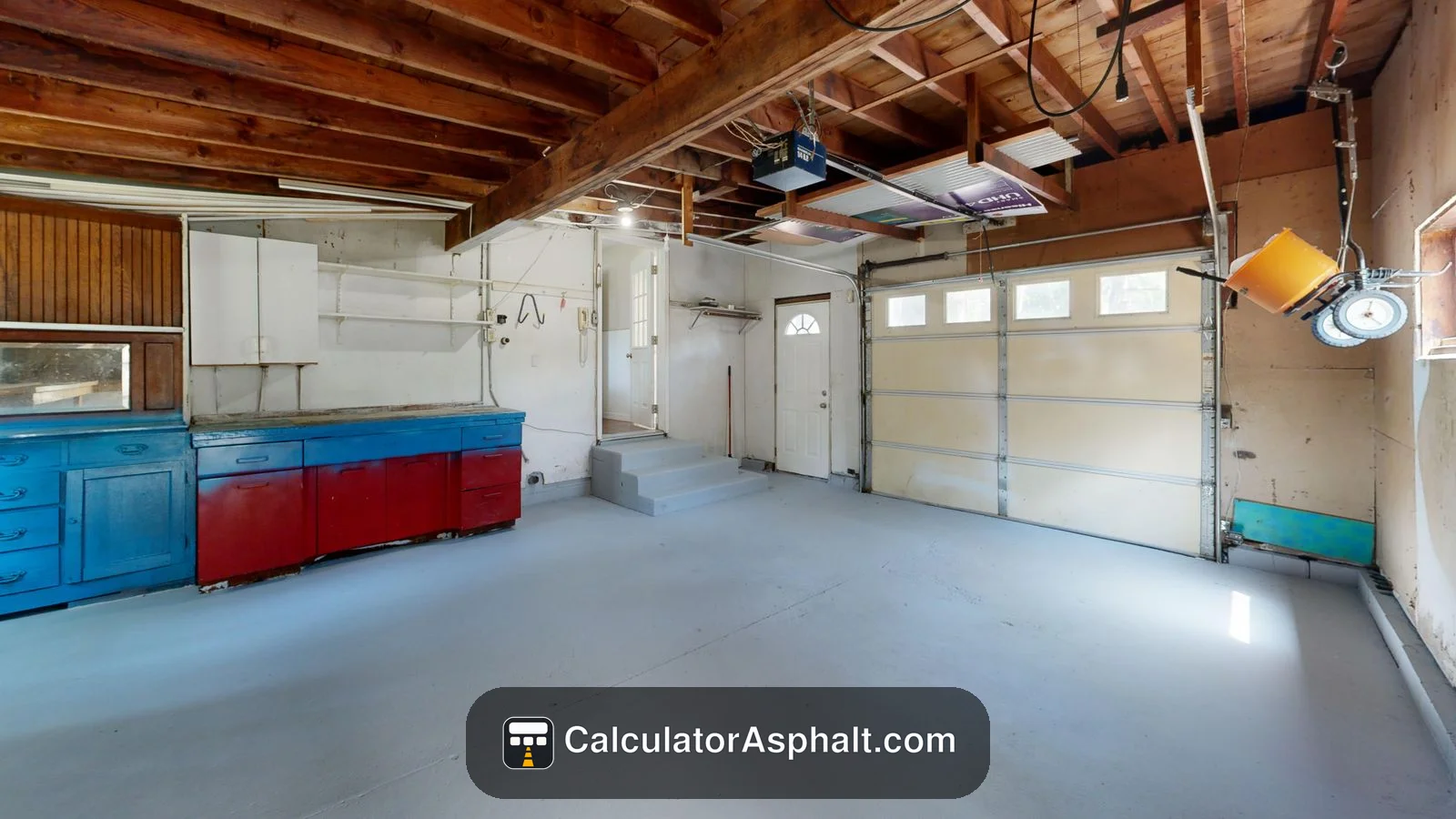
Every garage looks fine with the door shut. Open it, and the truth comes out: boxes stacked where the car should go, a floor nobody has swept in a year, walls the colour of old dust. This guide is for the homeowner who is embarrassed by the garage and short on time, and it makes one promise: one weekend is enough to change how the garage looks and works, if you spend it in the right order.
The makeover is not a renovation. You clear, you clean, you paint the walls, and you treat the floor, done in two days. This guide works through one example with real arithmetic, compares the order of the jobs, and gives an hour-by-hour checklist.
The decision first
Do the makeover in this order: clear first, clean second, paint the walls third, treat the floor last. The order matters more than the effort: paint does not stick to dust and grease, drips land on a new floor, and clearing last means painting around boxes you meant to move.
Why the garage looks like a dump
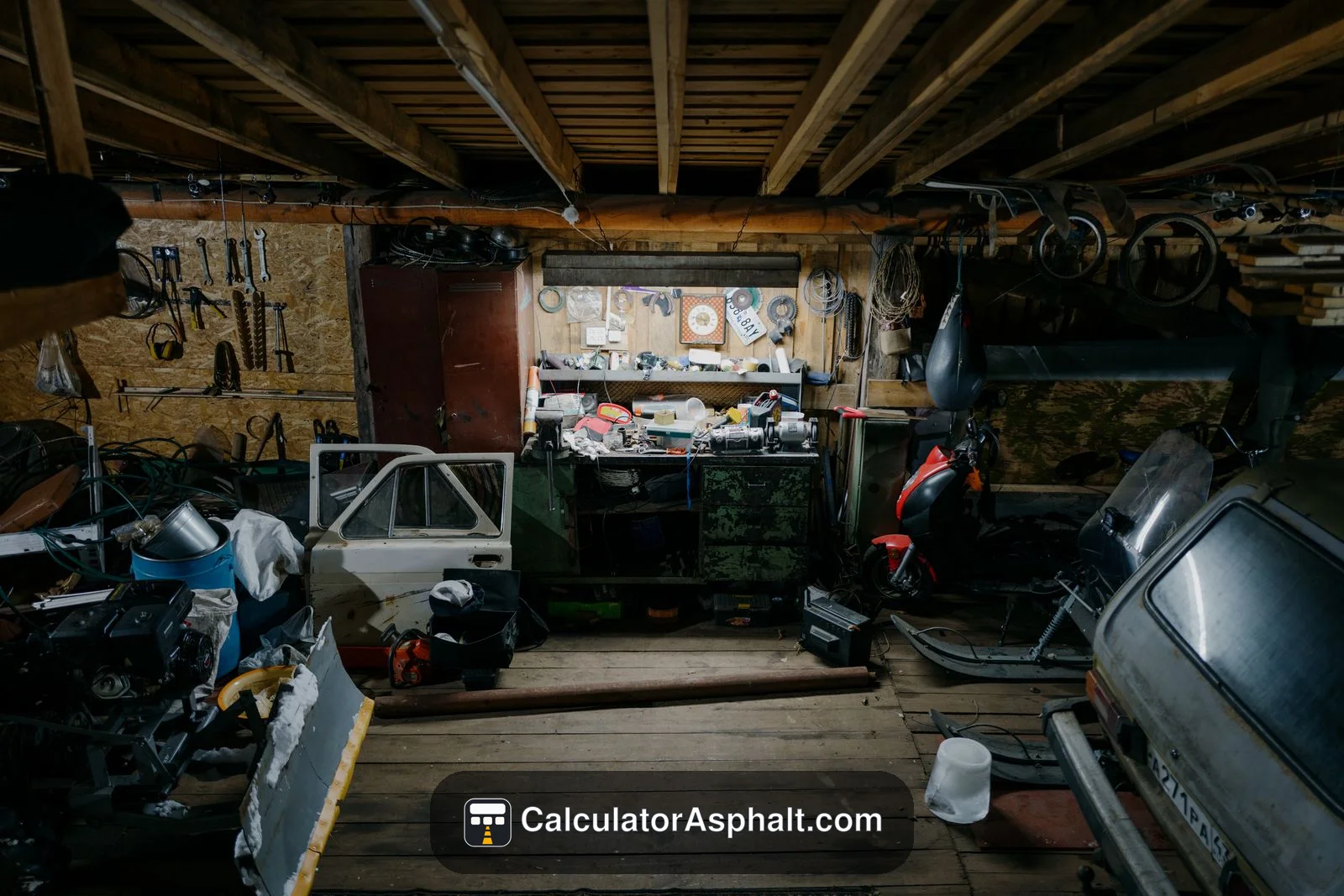
A garage looks like a dump for three reasons, and only one of them is the stuff in it. The first is the floor: concrete collects dust, stains, and tyre marks, and a dirty floor makes the whole room look dirty even when the shelves are tidy. The second is the walls: bare block or drywall goes grey with dust, and every scuff and cobweb shows. The third is the clutter, which is usually less than it feels like: a dozen boxes and a few things leaning against the wall can fill a garage visually because nothing has a place.
Worked example: one garage, one weekend
Every number here comes from the assumptions below, and every step shows its arithmetic. Measure your own garage before you buy anything.
Assumptions: garage 20 ft by 20 ft, walls 8 ft high. One garage door 16 ft wide by 7 ft high, one side door 3 ft wide by 7 ft high. Two people working, Saturday and Sunday. Paint coverage is a label assumption: 350 sq ft per gallon per coat for wall paint, 300 sq ft per gallon per coat for floor paint. Check the label on the paint you buy. These are assumptions, not facts about your garage.
The floor and the split
Floor area: 20 ft x 20 ft = 400 sq ft. The car bay takes one side: 12 ft x 20 ft = 240 sq ft. The storage strip takes the other side: 8 ft x 20 ft = 160 sq ft. Check: 240 sq ft + 160 sq ft = 400 sq ft. The split matters because the makeover treats the two zones differently: the car bay gets a clean, clear floor, and the storage strip gets the bins and shelves in one straight line, not scattered across the room.
The hours: eleven and a half
Saturday: clear and sort 4 hours, clean 1.5 hours, patch and tape 1 hour. Saturday total: 4 + 1.5 + 1 = 6.5 hours. Sunday: paint the walls 3 hours, treat the floor 2 hours. Sunday total: 3 + 2 = 5 hours. Weekend total: 6.5 + 5 = 11.5 hours. That is a full Saturday and a half Sunday, with the rest of Sunday free. If you work alone, add half again: 11.5 hours x 1.5 = 17.25 hours, which is two full days. The two-person version is the one to plan for, because a second pair of hands halves the clearing and doubles the painting speed.
The walls: how much paint
Wall area first. Perimeter: 20 ft + 20 ft + 20 ft + 20 ft = 80 ft. Wall area: 80 ft x 8 ft = 640 sq ft. Subtract the garage door: 16 ft x 7 ft = 112 sq ft. Subtract the side door: 3 ft x 7 ft = 21 sq ft. Paintable wall: 640 sq ft – 112 sq ft – 21 sq ft = 507 sq ft.
Paint per coat: 507 sq ft / 350 sq ft per gallon = 1.45 gallons, so 2 gallons per coat. Two coats: 2 gallons x 2 = 4 gallons. Buy 4 gallons of wall paint for two coats. One coat would use 2 gallons and would look thin on bare walls, which is why the plan uses two.
The floor: how much paint
Floor area: 400 sq ft. Floor paint per coat: 400 sq ft / 300 sq ft per gallon = 1.33 gallons, so 2 gallons per coat. The plan uses one coat of floor paint after cleaning, so 2 gallons. Two coats would be 4 gallons, but one coat over a cleaned floor is enough for a makeover, and the second coat can wait for a later weekend if the floor needs it.
The clutter: twelve bins
The example garage holds 12 bins and boxes. Sorting rule: keep 7, move 3 to a better home elsewhere, toss or donate 2. Check: 7 + 3 + 2 = 12. Sorting time: 12 boxes at 20 minutes each is 12 x 20 = 240 minutes, or 4 hours, which is the Saturday clearing time above. Count your boxes before the weekend starts, not during it.
Run the same steps for your garage: divide your floor into a car bay and a storage strip, work out your wall area minus the doors, divide by the coverage on your paint label, and count your boxes at 20 minutes each.
Paint first, floor first, or storage first
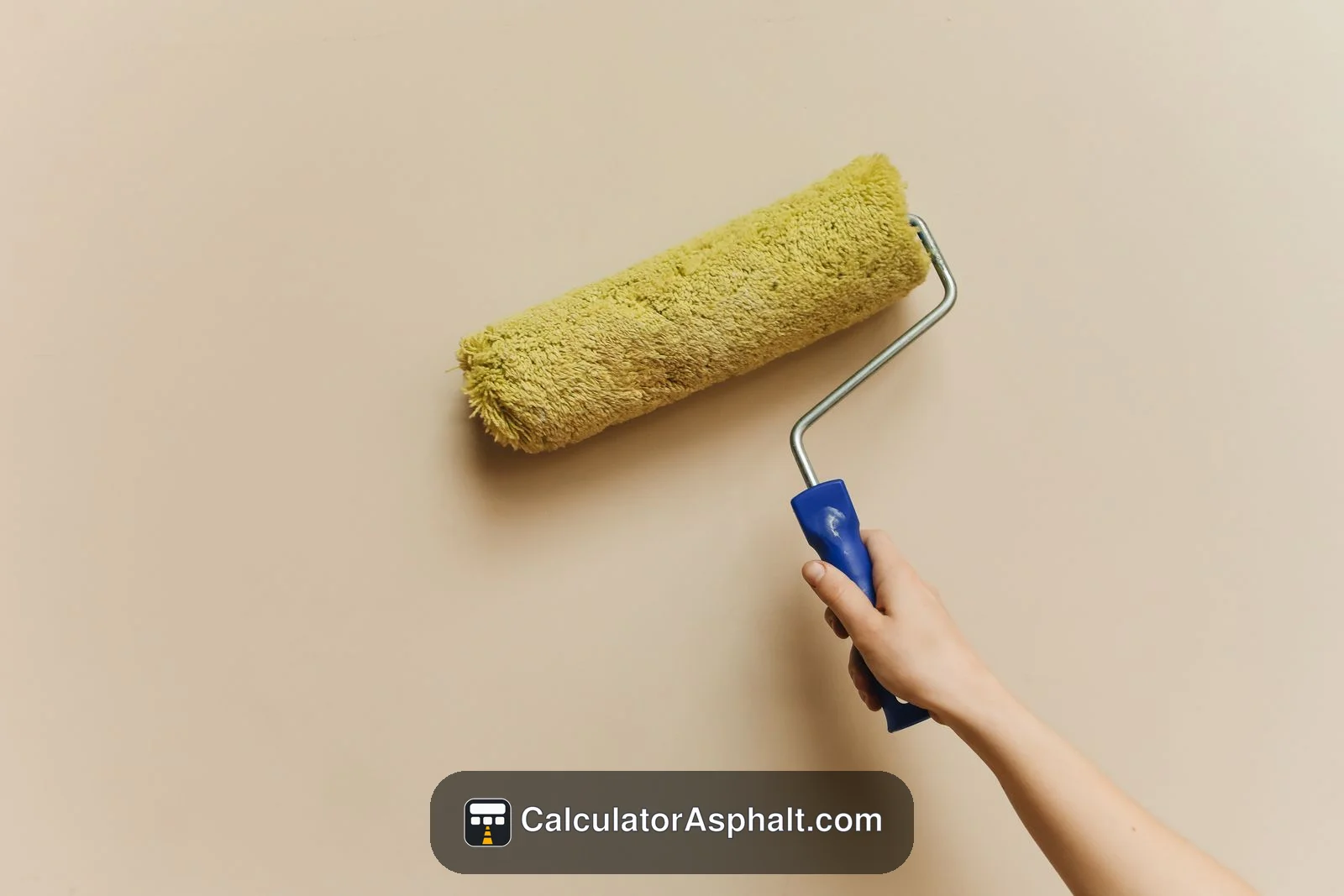
The order of the jobs is the decision that decides whether the weekend works.
| Choice | What happens | Best for | Watch out for |
|---|---|---|---|
| Paint the walls first, floor last | Drips land on the old floor, and the floor treatment covers them | Almost every garage | The walls must be clean and dry before you paint |
| Treat the floor first | Drips from the wall paint land on the new floor | A garage whose walls are already painted | You will spend Sunday fixing drips on the floor |
| Sort storage first, paint around it | The boxes stay where they are and the paint goes around them | No garage: this is the trap to avoid | You paint around boxes you meant to move, and the wall behind them stays dirty |
| Clear everything out first | The garage is empty, and every surface is reachable | Every makeover | You need somewhere to put the boxes for two days: the driveway, with a cover if rain is coming |
The right order is clear everything out, clean, paint the walls, treat the floor, and bring back only what you kept. Storage goes back last, in one straight line along the storage strip, so the car bay stays open.
How to run the weekend without regret
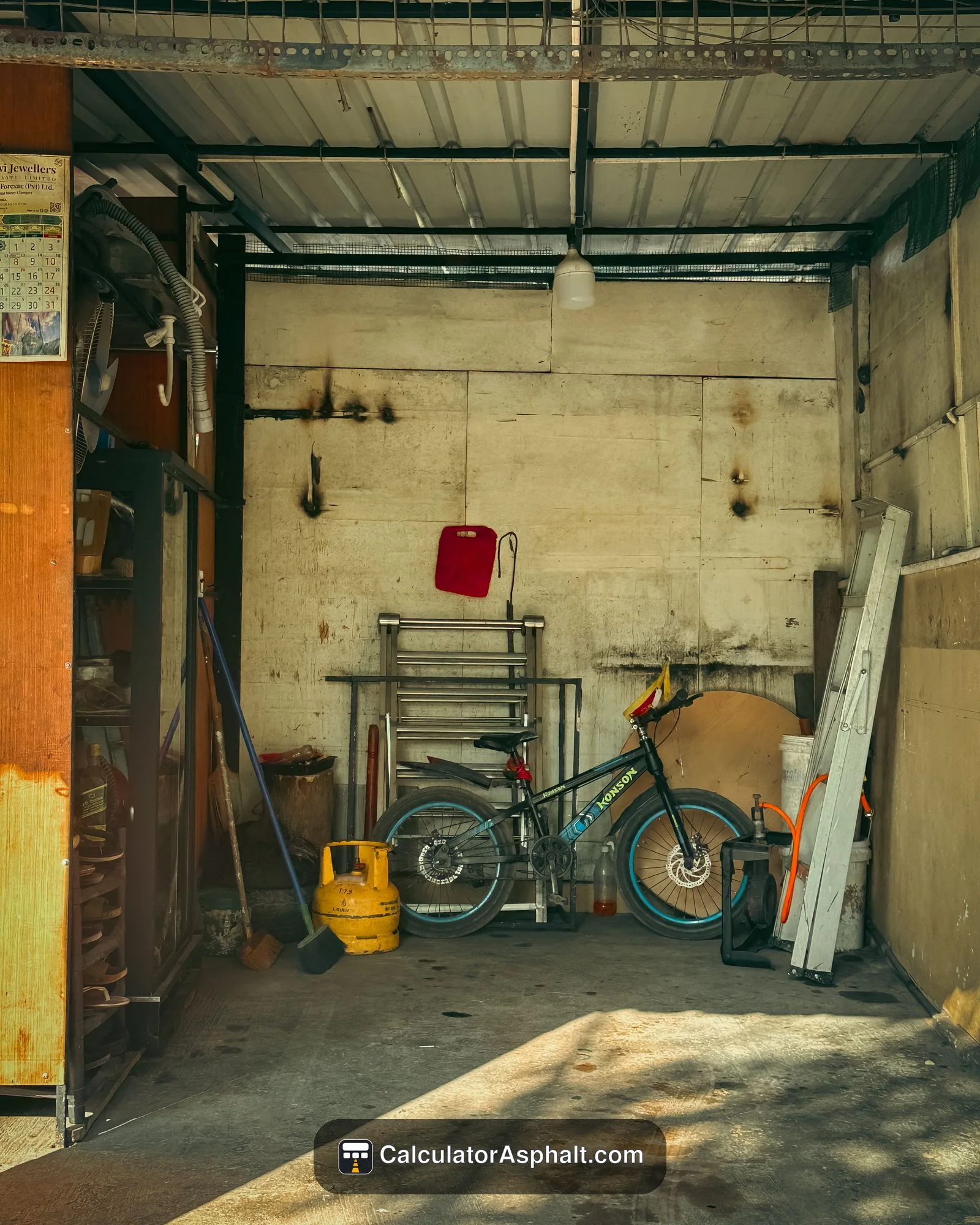
Start on Friday evening, not Saturday morning. Move the car out, lay a cover on the driveway, and put the boxes you already know are leaving by the kerb or in the car boot. Buy the paint on Friday evening: 4 gallons of wall paint and 2 gallons of floor paint in the example, plus brushes, rollers, tape, and a broom if you do not own one.
Saturday morning is clearing and sorting. Work box by box, keep the three piles separate, and do not open a box and start reading old letters. Twenty minutes per box is the budget.
Saturday afternoon is cleaning and patching. Sweep the whole floor, then mop it, then let it dry while you patch the walls. Fill holes and cracks, let the filler dry, sand it flat, and tape the edges of the doors and any fittings you are not painting.
Sunday morning is the walls. Two coats, with drying time between them. Start with the wall behind the storage strip, because that is the wall nobody sees first, and finish with the wall opposite the door. Sunday afternoon is the floor: sweep again, one coat of floor paint, and keep the car out until the label says it can return. Then bring the kept bins back, in one straight line, labels facing out.
Field checklist: before the weekend starts
Use this checklist in order.
- Measure the garage: length, width, wall height, and the size of each door.
- Work through the worked example with your own numbers, and buy the paint it gives you.
- Count the boxes and bins, and write the number down.
- Decide where the cleared boxes will sit for two days, and lay a cover if rain is coming.
- Move the car out on Friday evening, not Saturday morning.
- Buy paint, brushes, rollers, tape, filler, a broom, and a mop on Friday evening.
- Agree the rule with everyone in the house: keep, move, or toss, decided in 20 minutes per box.
- Charge the light or the radio, because a dark garage is a slow garage.
- Check the weather: paint and floor treatment need dry air and the temperature on the label.
- Keep the car out until the floor label says it can return.
Mistakes that turn a weekend into a month
Painting over a dirty wall is the first mistake. Paint does not stick to dust, grease, or cobwebs. It peels in sheets, and the wall looks worse than before you started. Clean first, every time.
Skipping the second coat is the second mistake. One coat over bare or grey walls looks patchy, and the patchiness shows worst in the evening light. Two coats is the plan, and the paint quantity in the worked example already allows for it.
Treating the floor before the walls is the third mistake. Wall paint drips, and drips on a new floor are permanent. Floor last is not a suggestion, it is the order that works.
Sorting without a time limit is the fourth mistake. Twenty minutes per box, then decide; if you cannot decide, it goes in the move pile, and the decision happens somewhere else.
Bringing everything back is the fifth mistake. A makeover that ends with the same twelve boxes in the same places has changed the paint and nothing else. The keep pile is seven boxes in the example, not twelve. The other five leave the garage, and the car bay stays open.
Frequently asked questions
Can one person do this in a weekend?
It is possible, but the hours grow: 11.5 hours with two people, 17.25 hours alone. If you work alone, split the job across two weekends: clear and clean on the first, paint and floor on the second.
What if the walls are damp?
Do not paint over damp walls: find where the damp comes from first, fix it, let the wall dry, and then paint. Paint over damp peels within weeks.
Do we need to empty the garage completely?
Yes, for the weekend. Paint needs bare walls, and the floor needs a bare surface. Everything comes out on Saturday morning and only the keep pile comes back on Sunday afternoon. A half-empty garage is a half-painted garage.
What should the car bay look like when we finish?
A bare rectangle, 12 ft by 20 ft in the example, with nothing stored in it. The car parks there, the doors open, and nobody has to move a box to get in. Storage lives in the 8 ft strip, in one straight line, and nowhere else.