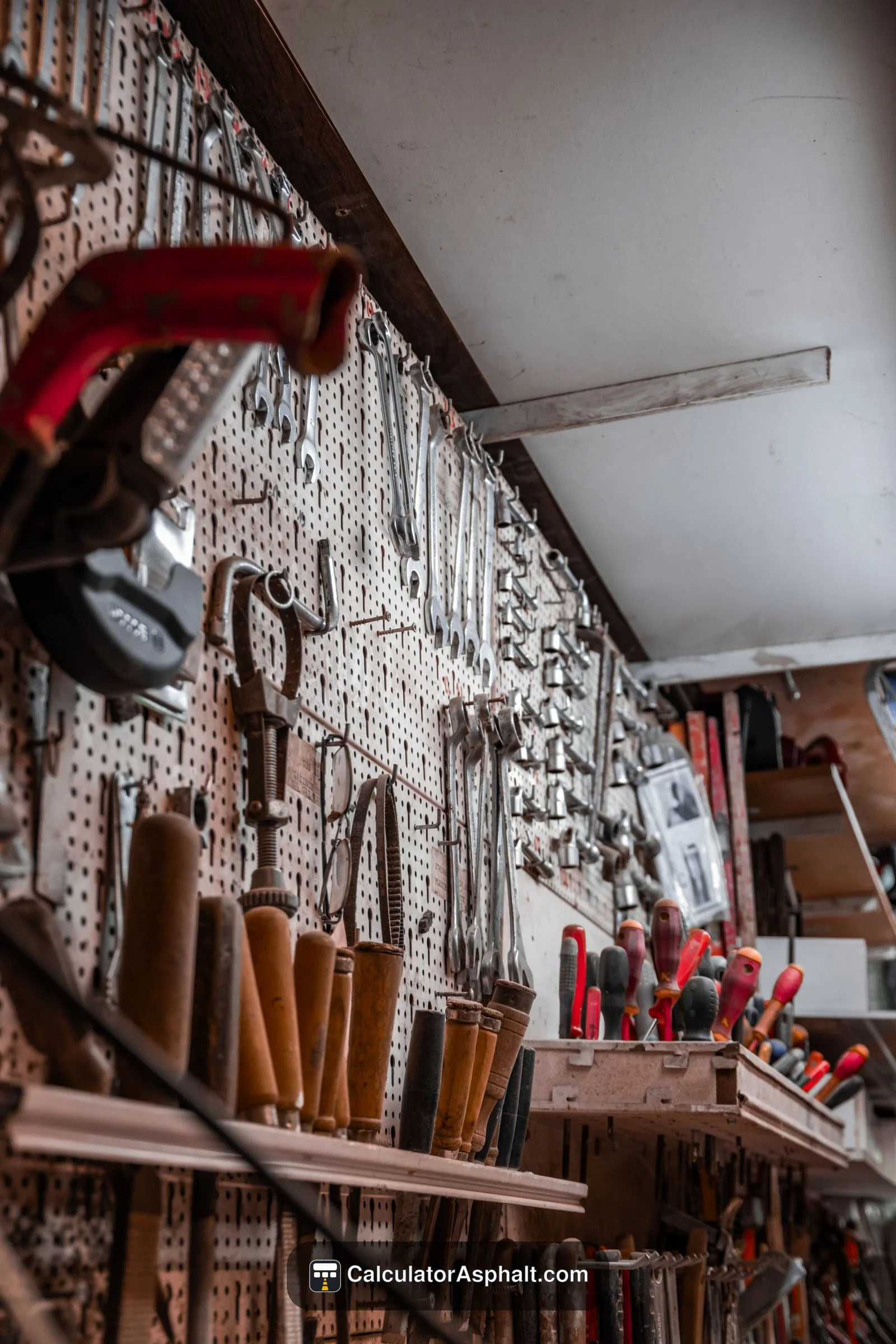
The project was supposed to take an hour. Two hours later the shelf is still half built, because most of the evening went on finding things: the drill was under a box, the square was behind the paint cans, and the screws were in a drawer you had already searched twice. The tools were all in the garage, and none of them was where you could see it. This guide is for the DIY beginner whose tools are all present and none findable, and it makes one promise: put the tools you grab on one wall, and the hunting stops.
The fix is one tool wall, not a bigger toolbox. This guide works through one example with real arithmetic, compares a pegboard wall with shelves, toolboxes, and the pile, and gives a step-by-step plan for hanging thirty tools where you can see them.
The decision first
Hang every tool you reach for during a project on the wall where you work, at eye level, with its outline drawn behind it. Tools you use once a year can live in a drawer or a box. Tools you use every project cannot. The wall is for the working set, and the working set is the tools that decide whether the evening is building or hunting.
Why the pile grows
A tool pile grows for one reason: every tool lands where it was last used, and nobody ever puts it back in a fixed place. The drill lands on the bench, the saw lands on the floor, the tape measure lands on top of the paint cans, and by the next project the garage holds every tool you own in places you cannot remember. The pile looks small, because tools are small, but a pile of thirty tools hides all thirty of them at once.
The pile also costs you twice: the evening, because every search takes five minutes and a project needs six searches, and duplicates, because the third time you cannot find the square you buy another one. The wall fixes both, because a tool you can see is a tool you do not buy twice.
Worked example: thirty tools on one wall
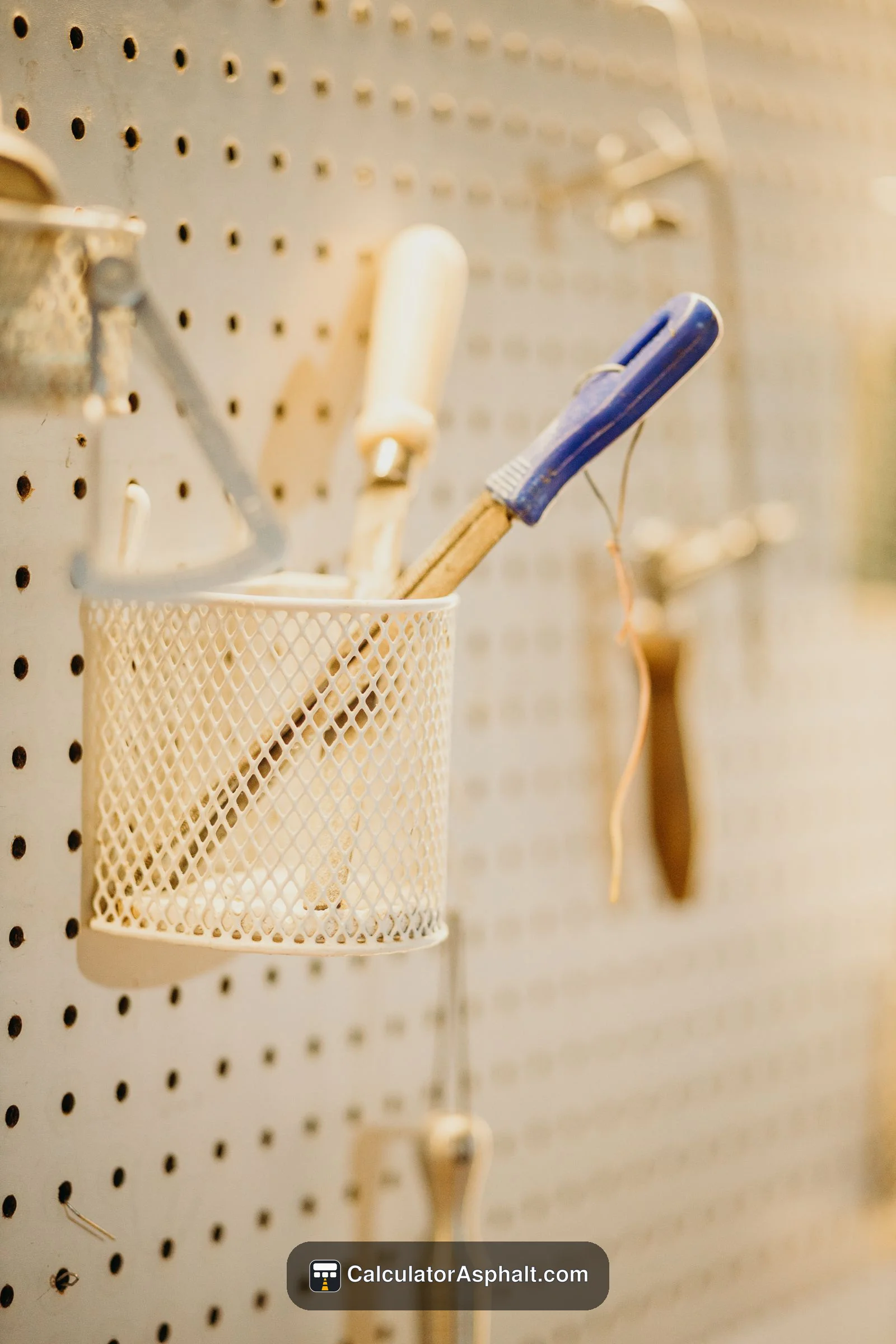
Every number here comes from the assumptions below, and every step shows its arithmetic. Count your own tools before you buy anything.
Assumptions: thirty tools in the working set, from a tape measure to a cordless drill. One pegboard panel, 4 ft by 8 ft, fixed to an 8 ft section of garage wall beside the workbench. Hooks at 6 in centres. These are assumptions, not facts about your garage.
The wall: 32 square feet, 64 hook positions
One panel: 4 ft x 8 ft = 32 sq ft. Hooks run along the 8 ft length at 6 in centres: 8 ft = 96 in, and 96 / 6 = 16 hooks per row. Rows run down the 4 ft height at 12 in centres: 4 ft = 48 in, and 48 / 12 = 4 rows. Total hook positions: 16 x 4 = 64. Thirty tools need thirty positions, which leaves 64 – 30 = 34 spare positions for the tools you buy next. One panel holds the whole working set with room to grow, and it takes 32 sq ft of wall that was holding nothing.
The sort: sixty minutes of decisions
Sorting thirty tools takes 30 tools x 2 minutes = 60 minutes. Two minutes per tool is enough to ask three questions: do I use this in most projects, does it hang safely, and where do I reach for it. Tools that pass all three go on the wall. Tools that fail the first go in a drawer, because a wall full of tools you never use is a wall you stop looking at. In the example, all thirty pass, because the example set is the working set.
The hang: ninety minutes, one afternoon
Hanging takes 30 tools x 1 minute = 30 minutes, plus the sort at 60 minutes, for a total of 60 + 30 = 90 minutes, or one and a half hours. Fix the panel first, then hang the most used tools at eye level, between 48 in and 60 in from the floor. Heavy tools go lower, between 24 in and 48 in, so a dropped tool falls a short distance. Light tools go higher, between 60 in and 72 in. Draw the outline of each tool behind it, so an empty outline shows which tool is out and where it goes back.
Run the same steps for your garage: count the working set, measure the wall beside the bench, and check the eye-level band against your own height.
The hunting: thirty minutes a project down to three
Without a wall, finding tools takes about 5 minutes per search, and a project needs about 6 searches: 6 x 5 = 30 minutes of hunting per project. With a wall, finding a tool takes about 30 seconds, because you look at the wall and reach: 6 x 30 seconds = 180 seconds, or 3 minutes per project. The saving is 30 – 3 = 27 minutes per project. Twenty projects a year: 27 x 20 = 540 minutes, which is 540 / 60 = 9 hours a year. Nine hours of evenings back, for ninety minutes of hanging. The wall pays for itself six times over in the first year, and every year after that is pure saving.
Pegboard or shelf
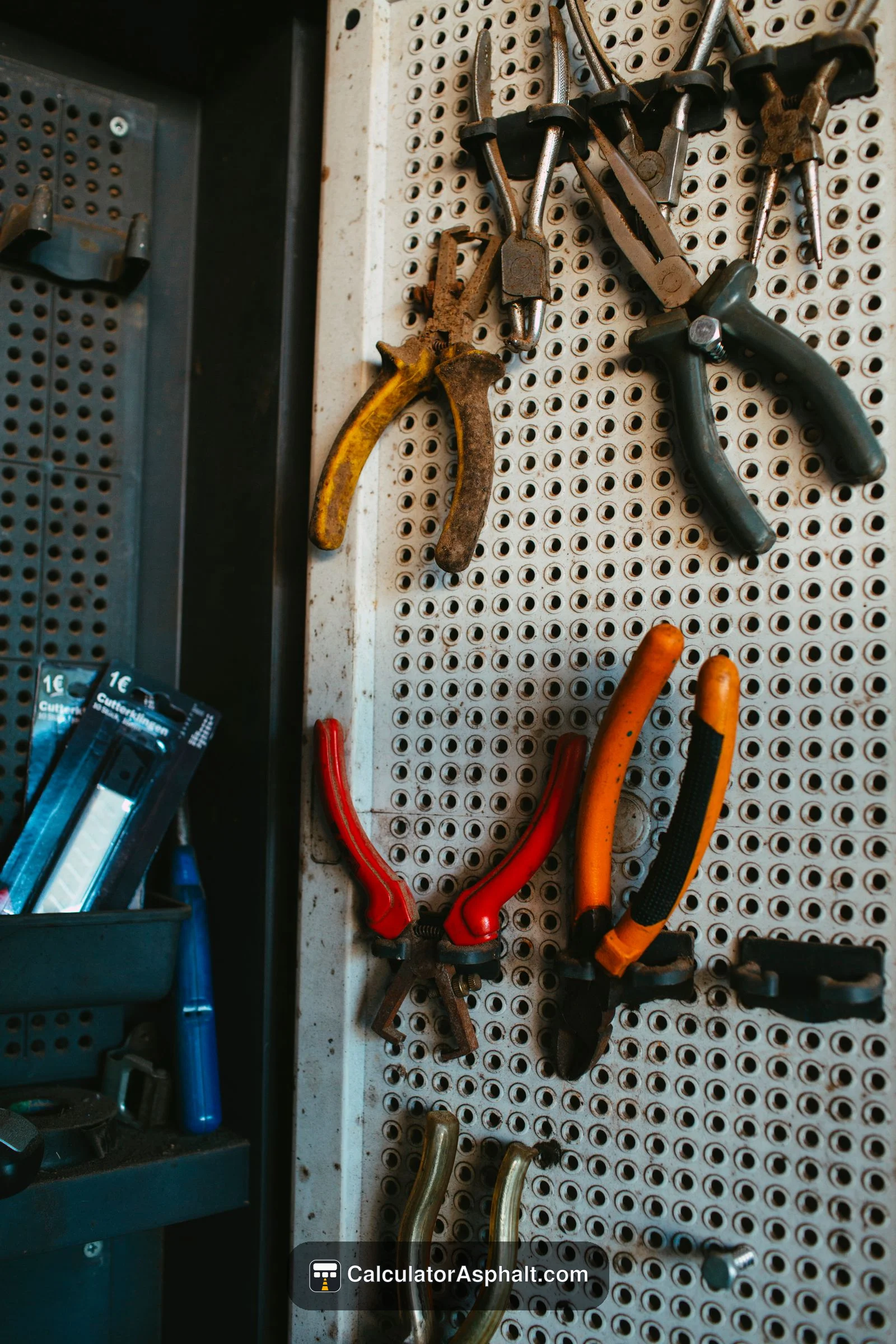
The choice is not which one looks tidier. It is which one lets you see the tool.
| Choice | What happens | Best for | Watch out for |
|---|---|---|---|
| Pegboard wall | Every tool is visible at once, and an empty outline shows what is missing | The working set you grab in every project | The panel must be fixed solidly, and heavy tools need proper hooks |
| Open shelves | Tools sit in rows and stay easy to reach | Tools that do not hang well, such as boxes and tins | Shelves hide the tools behind the front row, and the back row is forgotten |
| Toolbox | Tools travel to the job and stay together | Tools you carry out of the garage | A closed box hides everything, and finding one tool means opening the whole box |
| The pile | Tools land where they were last used | Nothing: this is the trap to avoid | The pile hides all thirty tools at once, and you buy duplicates of the ones you cannot find |
| Wall plus drawer | Working set on the wall, rarely used tools in a drawer | Every garage with more than twenty tools | The drawer must hold only the rarely used tools, or it becomes a second pile |
The right answer is the wall for the working set and a drawer for the rest. Two homes, no pile, and every tool visible or deliberately stored.
How to hang the wall without regret
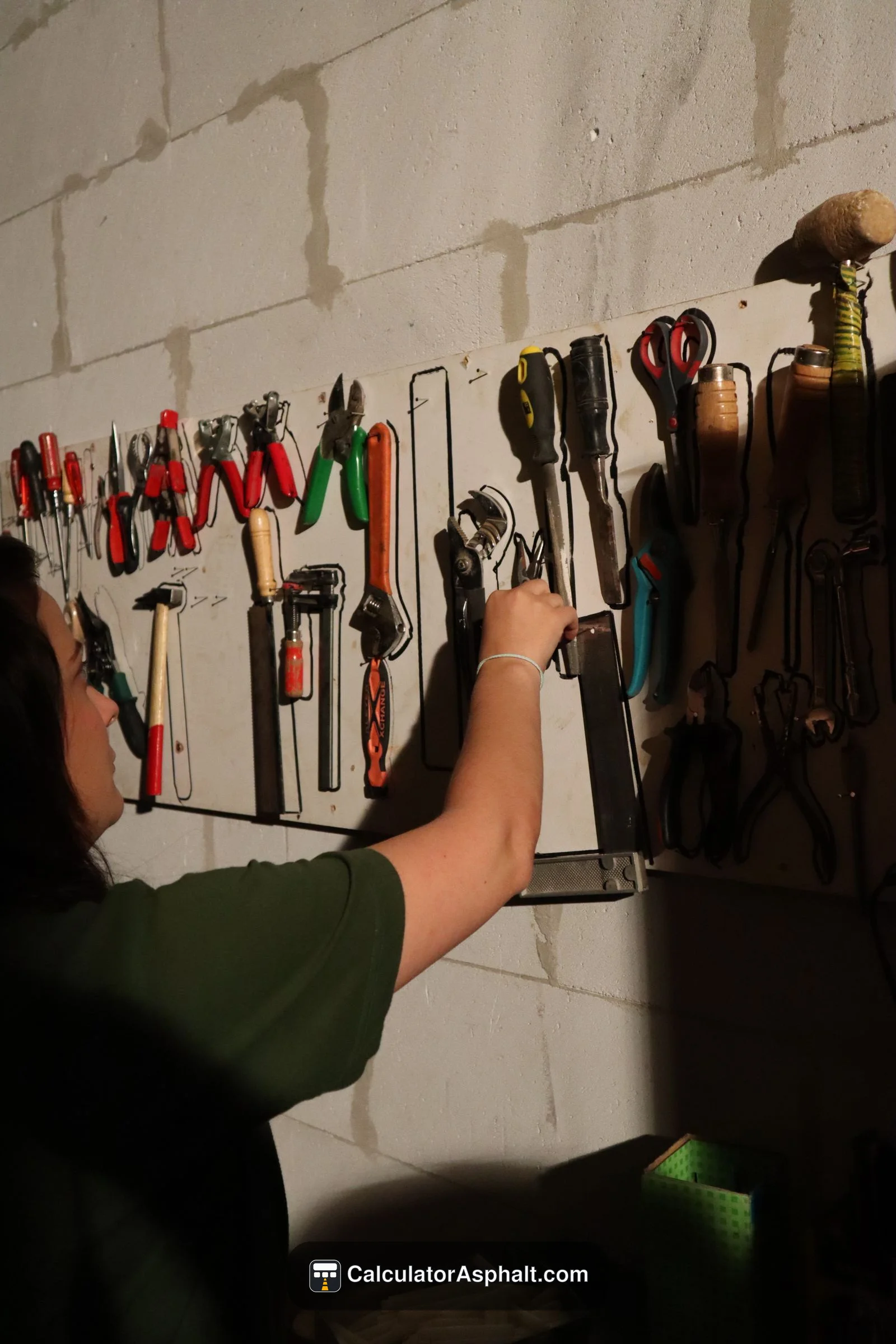
Start by sorting, not by shopping. Lay every tool on the bench and sort into three piles: wall, drawer, and out. Wall is the working set. Drawer is the rarely used. Out is anything broken, doubled, or never used. In the example, thirty tools sort into thirty wall tools.
Fix the panel before you hang a single tool. A pegboard panel fixed to the wall with proper fixings holds the whole set without sagging. Fix it solidly, check it is level, and then hang.
Hang by grab order, not by size. The tools you reach for first in a project go nearest the bench and at eye level. The tape measure, the pencil, the square, and the drill live within one step of where you stand. Tools you reach for once per project go further along the wall.
Draw the outline of every tool once it is hung. An outline takes ten seconds to draw and saves a search every time the tool is missing, because the empty outline tells you which tool is out and where it goes back.
Field checklist: before you hang anything
Use this checklist in order.
- Count the tools in the working set, and write the number down.
- Measure the wall beside the bench, and check an 8 ft section is free.
- Sort the tools into wall, drawer, and out, and count each pile.
- Choose the panel size from the count, one 4 ft by 8 ft panel per thirty tools.
- Fix the panel solidly to the wall, and check it is level before loading it.
- Hang the most used tools at eye level, between 48 in and 60 in.
- Hang heavy tools lower, between 24 in and 48 in, so a drop is short.
- Hang light tools higher, between 60 in and 72 in, where they stay visible.
- Draw the outline of every tool on the panel behind it.
- Agree the rule with everyone in the house: a tool goes back on its outline.
Mistakes that rebuild the pile
Hanging every tool you own is the first mistake. A wall crowded with one-a-year tools hides the everyday ones. The wall is for the working set only. The drawer takes the rest.
Skipping the outlines is the second mistake. Without outlines, tools go back on any free hook, and within a month you are hunting again. The outline is the system, and it costs ten seconds per tool.
Hanging heavy tools high is the third mistake. A heavy tool hung above eye level falls on your head when the hook slips. Heavy goes low, every time.
Fixing the panel weakly is the fourth mistake. A panel held by two screws sags, leans, and eventually falls, dropping thirty tools at once. Fix it solidly, with fixings into the wall itself.
Putting the wall far from the bench is the fifth mistake. A tool wall on the far side of the garage saves no steps, and a tool you have to walk for is a tool you leave on the bench. The wall goes beside the bench, within one step.
Frequently asked questions
What if I have more than thirty tools?
Count them first. One panel holds thirty tools with 34 spare positions. Sixty tools need two panels, and ninety need three. If the count keeps growing past sixty, the problem is sorting, not wall space: a working set of ninety usually means thirty belong in the drawer.
Does the wall work if I share the garage?
Yes, and it works better, because the outlines are a system anyone can read. A shared garage without a wall is a garage where everyone hunts. The wall and the outlines end the argument about who moved what.
What about tools that do not hang?
Some tools do not hang well: tins, boxes, and anything round that rolls off a hook. Those go on a shelf beside the wall, not in a pile on the bench. The shelf holds the unhangable, the wall holds the hangable.
How do I keep the wall working?
Check it once a month, for one minute. A tool on the wrong hook goes back on its outline, a missing outline gets redrawn, and a new tool gets a hook and an outline the day it arrives. A wall checked monthly stays a wall.