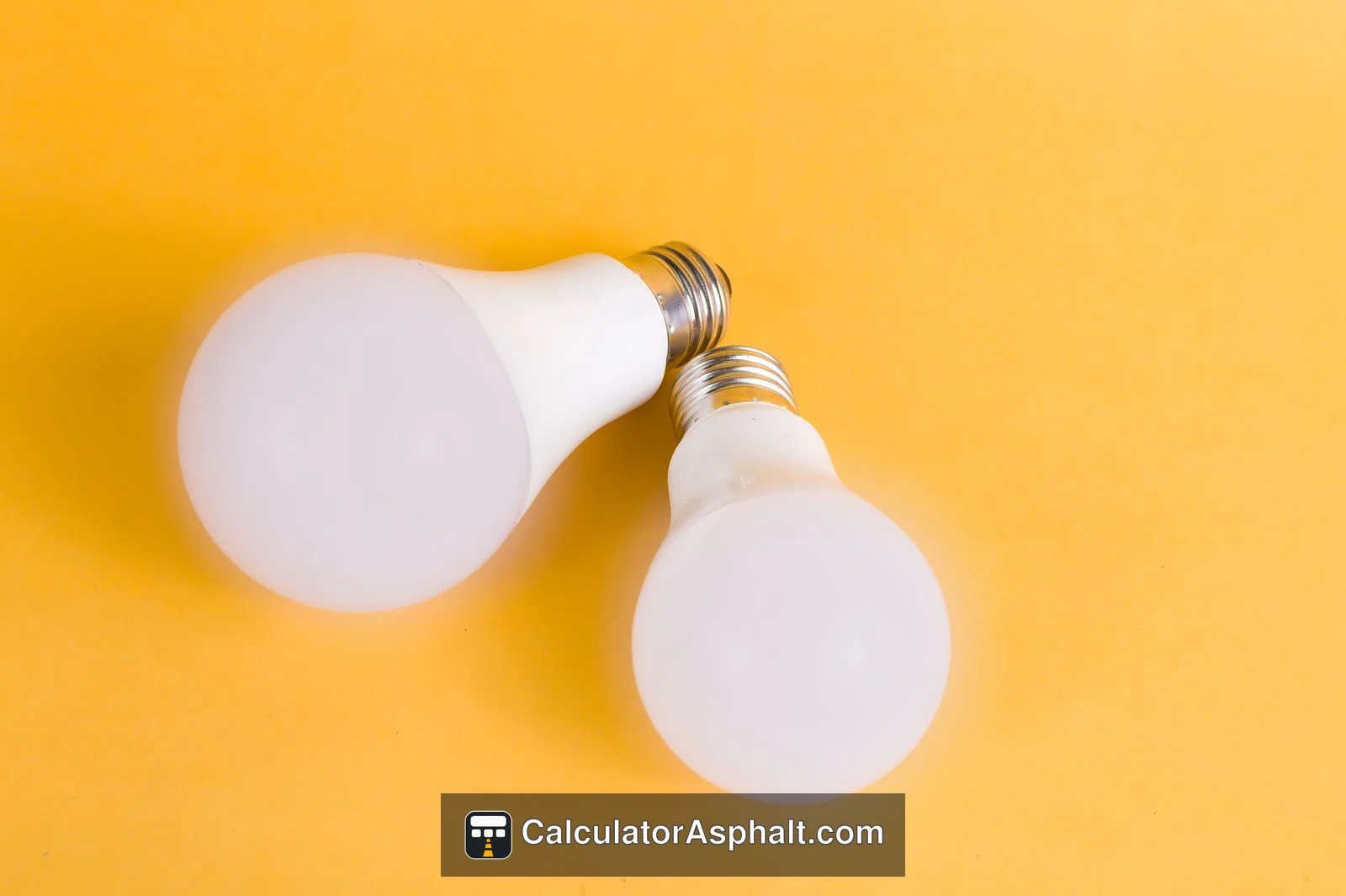
An old bulb already in the socket feels free. It cost nothing today, it still lights up, and replacing it means spending money on something that already works. The trouble is that the bulb is not free: it charges rent every hour it burns, in electricity, and an old incandescent bulb charges four to six times as much as an LED for the same light. The purchase price is paid once. The electricity is paid every day the bulb is on.
The fix is to price lighting by hours and rates, the same way you price anything that runs on electricity: multiply the watts by the hours, convert to kilowatt-hours, and multiply by the rate on your bill. That calculation turns "the bulbs are already there" into a number, and the number usually says to replace them.
The decision first: watts times hours times rate
Lighting cost has three parts. First, the watts: how much power the bulbs draw together. An old 60-watt incandescent draws 60 watts; the LED that replaces it draws about 9 watts for the same 800 lumens. Second, the hours: how long the bulbs burn each day. Four hours a day is a common planning figure for a living room; a kitchen or a hallway runs longer, a spare bedroom shorter. Third, the rate: what your utility charges per kilowatt-hour, read off your own bill.
The arithmetic is straightforward. Watts times hours gives watt-hours; divide by 1,000 to get kilowatt-hours; multiply by the rate to get the cost. A room with six 60-watt bulbs burning four hours a day uses 6 × 60 × 4 = 1,440 watt-hours, or 1.44 kilowatt-hours a day. At an example rate of $0.15 per kilowatt-hour — labelled as an example to check on your bill — that is 1.44 × 0.15 = $0.22 a day, or about $79 a year, for one room. The same room with six 9-watt LEDs uses 6 × 9 × 4 = 216 watt-hours, or 0.22 kilowatt-hours a day, which is $0.03 a day, or about $12 a year. The difference is $67 a year, from one room, for bulbs that were already in the sockets.
Why old bulbs cost so much: heat, not light
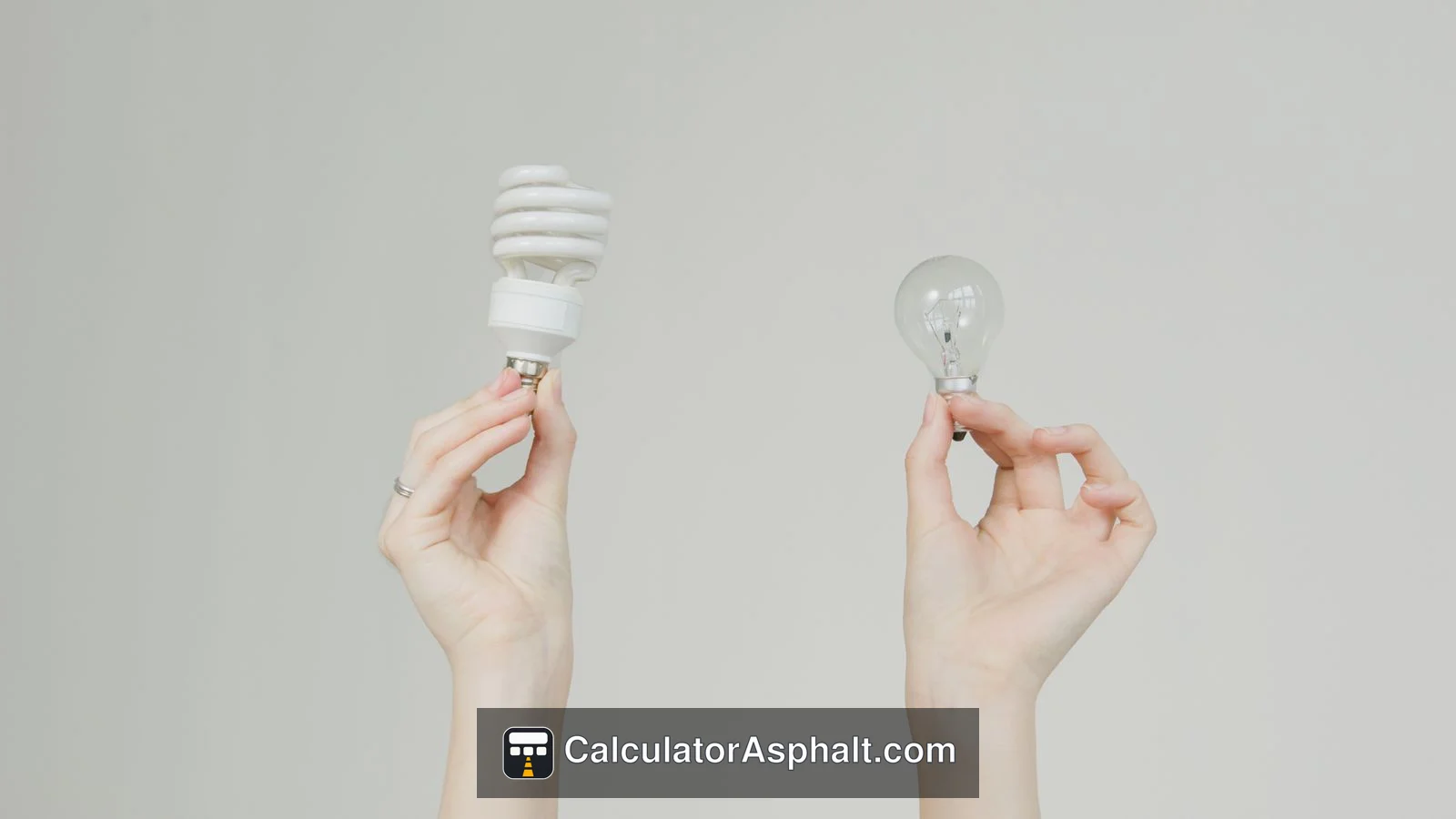
An incandescent bulb turns most of its electricity into heat, not light. About 90 percent of the energy goes out as heat, and about 10 percent comes out as light — which is why an incandescent bulb is hot to touch and why a room full of them feels warmer in summer. An LED turns most of its electricity into light, and the heat it makes is a fraction of the incandescent's.
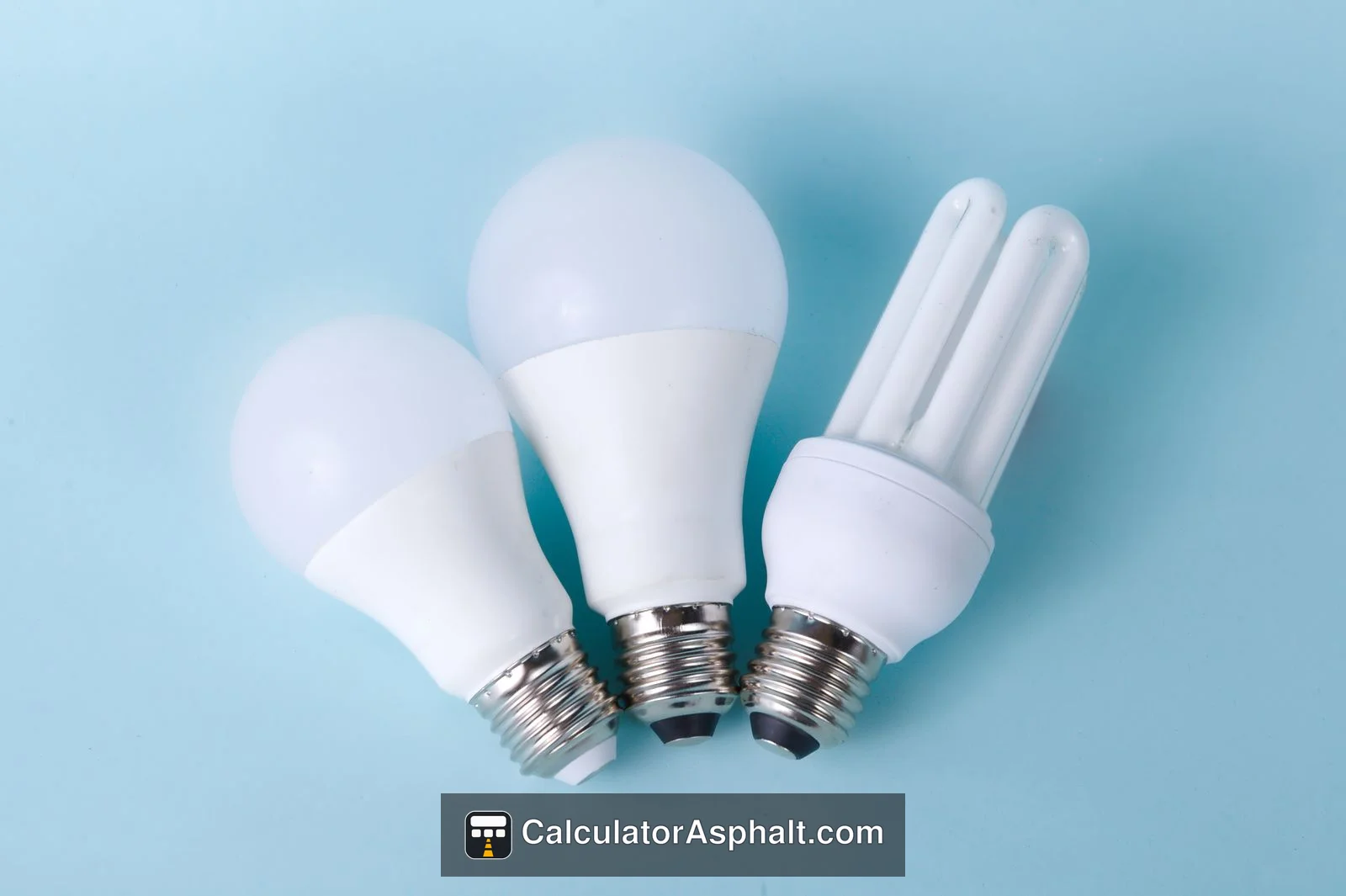
That difference is the whole cost story. A 60-watt incandescent and a 9-watt LED both give about 800 lumens, but the incandescent draws 60 watts to do it and the LED draws 9. The ratio is 60 ÷ 9 = 6.7, so the old bulb costs nearly seven times as much per hour for the same light. Halogen bulbs sit between the two: a 43-watt halogen gives about 800 lumens, so it costs about five times the LED. Compact fluorescents are closer to LEDs at about 13 watts, but they are slower to reach full brightness and contain mercury, which makes disposal harder.
Bulb life matters too, and it is stated as a label assumption to check on the box. An incandescent lasts about 1,000 hours, a halogen about 2,000, a compact fluorescent about 8,000, and an LED about 25,000. At four hours a day, an incandescent lasts 1,000 ÷ 4 = 250 days, while an LED lasts 25,000 ÷ 4 = 6,250 days, or about 17 years. The old bulb is not only more expensive to run; it also needs replacing 25 times as often.
Worked example: one room, then the whole house
Take a living room with six bulbs, burning four hours a day, at an example electricity rate of $0.15 per kilowatt-hour. Then scale the same arithmetic to a house with thirty bulbs.
Step 1: the room on incandescent bulbs. Six bulbs at 60 watts each draw 6 × 60 = 360 watts. Four hours a day gives 360 × 4 = 1,440 watt-hours, or 1.44 kilowatt-hours a day. At $0.15 per kilowatt-hour, that is 1.44 × 0.15 = $0.22 a day. Over a year, $0.22 × 365 = $79 a year, for one room.
Step 2: the room on LED bulbs. Six bulbs at 9 watts each draw 6 × 9 = 54 watts. Four hours a day gives 54 × 4 = 216 watt-hours, or 0.22 kilowatt-hours a day. At $0.15 per kilowatt-hour, that is 0.22 × 0.15 = $0.03 a day. Over a year, $0.03 × 365 = $12 a year. The saving for the room is $79 − $12 = $67 a year.
Step 3: the house on incandescent bulbs. Thirty bulbs at 60 watts each draw 30 × 60 = 1,800 watts. Four hours a day gives 1,800 × 4 = 7,200 watt-hours, or 7.2 kilowatt-hours a day. At $0.15 per kilowatt-hour, that is 7.2 × 0.15 = $1.08 a day. Over a year, $1.08 × 365 = $394 a year.
Step 4: the house on LED bulbs. Thirty bulbs at 9 watts each draw 30 × 9 = 270 watts. Four hours a day gives 270 × 4 = 1,080 watt-hours, or 1.08 kilowatt-hours a day. At $0.15 per kilowatt-hour, that is 1.08 × 0.15 = $0.16 a day. Over a year, $0.16 × 365 = $59 a year. The saving for the house is $394 − $59 = $335 a year.
Step 5: the payback. The saving is $335 a year for the whole house, and it starts the day the bulbs are swapped. Even if each LED costs several dollars, the set pays for itself in weeks at these example rates, and then saves $335 every year after. The bulbs that felt free were charging $394 a year; the replacements charge $59.
Step 6: check the hours. The saving scales with the hours. A bulb that burns one hour a day saves a quarter as much as a bulb that burns four, so swap the longest-burning bulbs first: the living room, the kitchen, the hallway. A spare bedroom bulb that burns twenty minutes a day saves little, and it can wait until it fails.
Decision table: bulb types for the thirty-bulb house
| Bulb type | Watts per bulb | House watts | Yearly cost at $0.15/kWh | Bulb life at 4 hours a day |
|---|---|---|---|---|
| Incandescent | 60 W | 1,800 W | $394 | 250 days |
| Halogen | 43 W | 1,290 W | $283 | 500 days |
| Compact fluorescent | 13 W | 390 W | $85 | 2,000 days |
| LED | 9 W | 270 W | $59 | 6,250 days, about 17 years |
| LED, 10 longest-burning bulbs only | 9 W | 90 W | $20 | 6,250 days, about 17 years |
The table shows the same lesson three ways: the old bulb is the most expensive to run, the LED is the cheapest by a wide margin, and swapping the longest-burning bulbs first captures most of the saving.
Where lighting costs go wrong
Counting the purchase price and ignoring the electricity. A bulb that costs nothing today because it is already in the socket still charges $394 a year for the house in the example. The purchase price is a one-off; the electricity is a daily charge, and the daily charge is the bigger number within weeks.
Swapping the wrong bulbs first. A spare bedroom bulb burning twenty minutes a day saves almost nothing when swapped, while the living room bulbs burning four hours a day save $67 a year per room. Swap the longest-burning bulbs first and the saving arrives fastest.
Comparing bulbs by watts. A 60-watt incandescent and a 9-watt LED give the same 800 lumens, so comparing them by watts makes the LED look dim. Compare by lumens, and the LED is the equal of the incandescent at a seventh of the running cost.
Forgetting the rate. The saving scales with the rate on your bill. At $0.10 per kilowatt-hour, the house saving in the example is $223 a year instead of $335; at $0.25, it is $558. Read the rate off your own bill before deciding how fast to swap.
Field checklist: before you swap bulbs
- Every bulb in the house counted, room by room
- Hours per day noted for each room, longest-burning first
- Wattage read off each existing bulb
- Lumens noted: about 800 for a 60-watt incandescent
- Electricity rate read off your own bill, per kilowatt-hour
- Yearly cost calculated for the house as it stands
- Yearly cost calculated for the house on LEDs
- Longest-burning rooms swapped first
- Old bulbs disposed of properly, and compact fluorescents taken to a recycling point
Mistakes that keep the old bulbs burning
The most expensive mistake is leaving old bulbs in because they feel free, when the house in the example pays $394 a year for them against $59 for LEDs — a $335-a-year difference for bulbs that were already there. The second is swapping the spare bedroom first, where the saving is pennies, instead of the living room, where it is $67 a year. The third is comparing bulbs by watts and concluding the LED is dim, when lumens are the measure of light and the LED matches the incandescent. The fourth is using a national average rate instead of the rate on your own bill, which understates or overstates the saving by the same percentage. Every one is a pricing mistake, fixed by multiplying watts by hours by your own rate before deciding.
Frequently asked questions
How much does one LED save over an incandescent?
At the example rate of $0.15 per kilowatt-hour and four hours a day, one 60-watt incandescent costs 60 × 4 ÷ 1,000 × 0.15 × 365 = $13.14 a year, and one 9-watt LED costs 9 × 4 ÷ 1,000 × 0.15 × 365 = $1.97 a year. The saving is $11.17 a year per bulb, and it scales with the hours: eight hours a day doubles it.
Should I replace bulbs that still work?
Yes, for the longest-burning ones. A living room bulb burning four hours a day saves $11.17 a year when swapped, so it pays for itself in weeks. A spare bedroom bulb burning twenty minutes a day saves about $0.93 a year, so it can wait until it fails. Swap by hours, not by age.
Do LEDs really last 25,000 hours?
That is the label figure, stated as a label assumption to check on the box. At four hours a day, 25,000 hours is 6,250 days, or about 17 years. Real life is shorter if the bulb runs hot in an enclosed fixture, so check the box for enclosed-fixture ratings and keep the vents clear.
Why is my lighting bill still high after swapping to LEDs?
Because the bulbs were not the whole bill. Lighting is one slice of the electricity bill, and the water heater, the heating, and the appliances take the rest. Check the hours too: a bulb left on all night costs six times as much as one burning four hours, even as an LED.