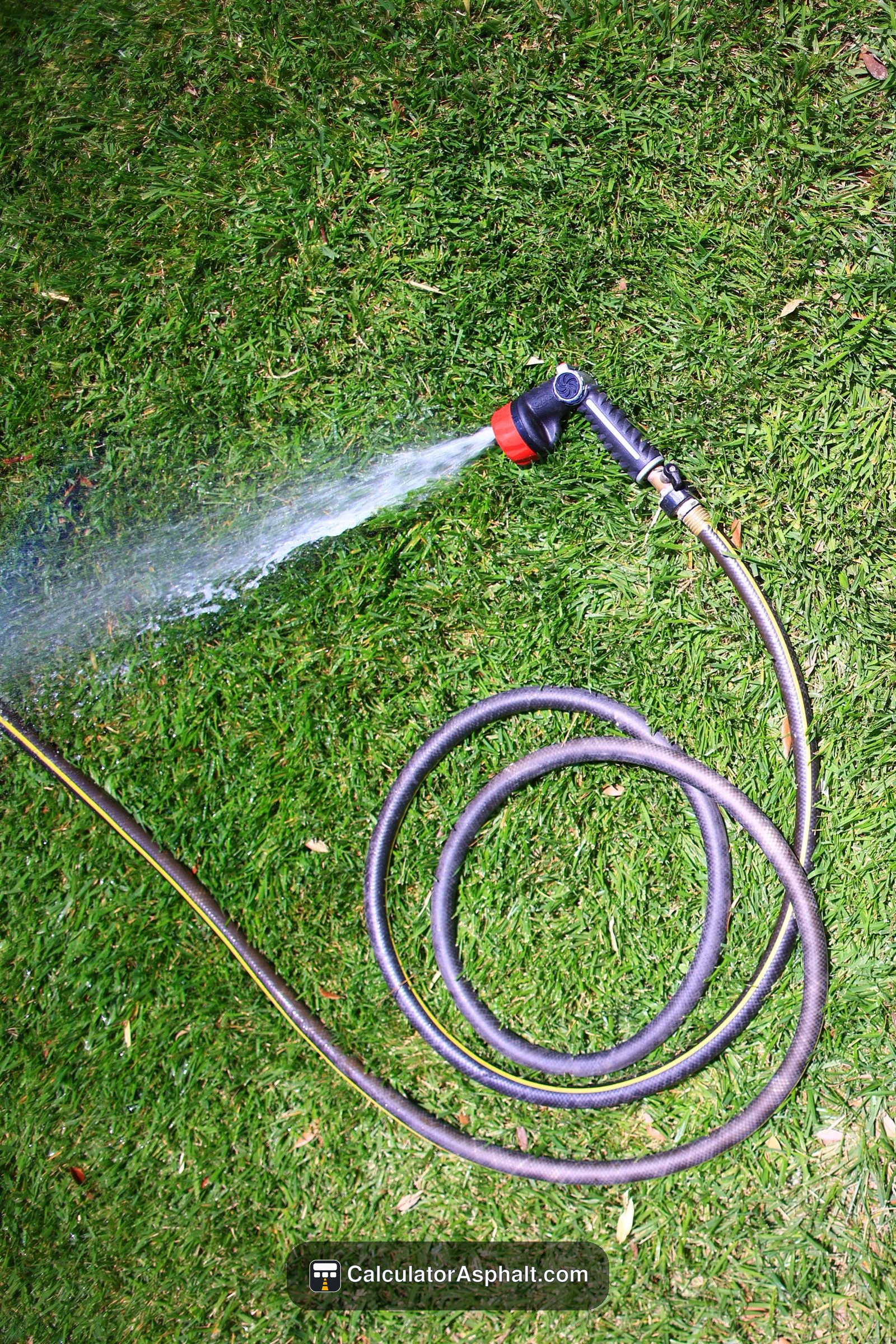
A pool filling job is planned as a Saturday afternoon, and it ends on Monday because the hose delivers half the water the owner assumed. The same error ruins a system flush, a tank fill, and a wash-down. The job is always longer than the guess, because the guess is based on the tap, and the tap is not the hose. The hose is narrower, longer, and slower — and the difference is measured in hours.
The fix takes two minutes: a bucket and a timer. Fill a five-gallon bucket from the end of the hose and time it: the flow rate falls out of one division. That number decides how long the job takes.
The decision first: measure at the end of the hose
Flow is measured where the water comes out, not where it goes in. The tap might deliver 10 gallons per minute, but a 100-foot hose delivers less: friction steals pressure, and less pressure means less flow. A longer hose steals more, a narrower hose steals more, and a hose with a kink steals the most of all.
So test at the business end: bucket under the hose outlet, tap fully open, timer running. Five gallons in 40 seconds means 7.5 gallons per minute, because 5 gallons in two-thirds of a minute divides out to 7.5 in a full minute. Five gallons in 60 seconds means 5, and in 30 seconds means 10.
Do the test the way the job will run: with the nozzle on if the job uses one, because a nozzle cuts the flow; with both hoses running if it runs two from a splitter, because the splitter halves what each hose gets; with the washing machine running if it will be running during the fill, because the house shares the supply. The number that matters is the flow during the job.
What decides flow: diameter, length, and pressure
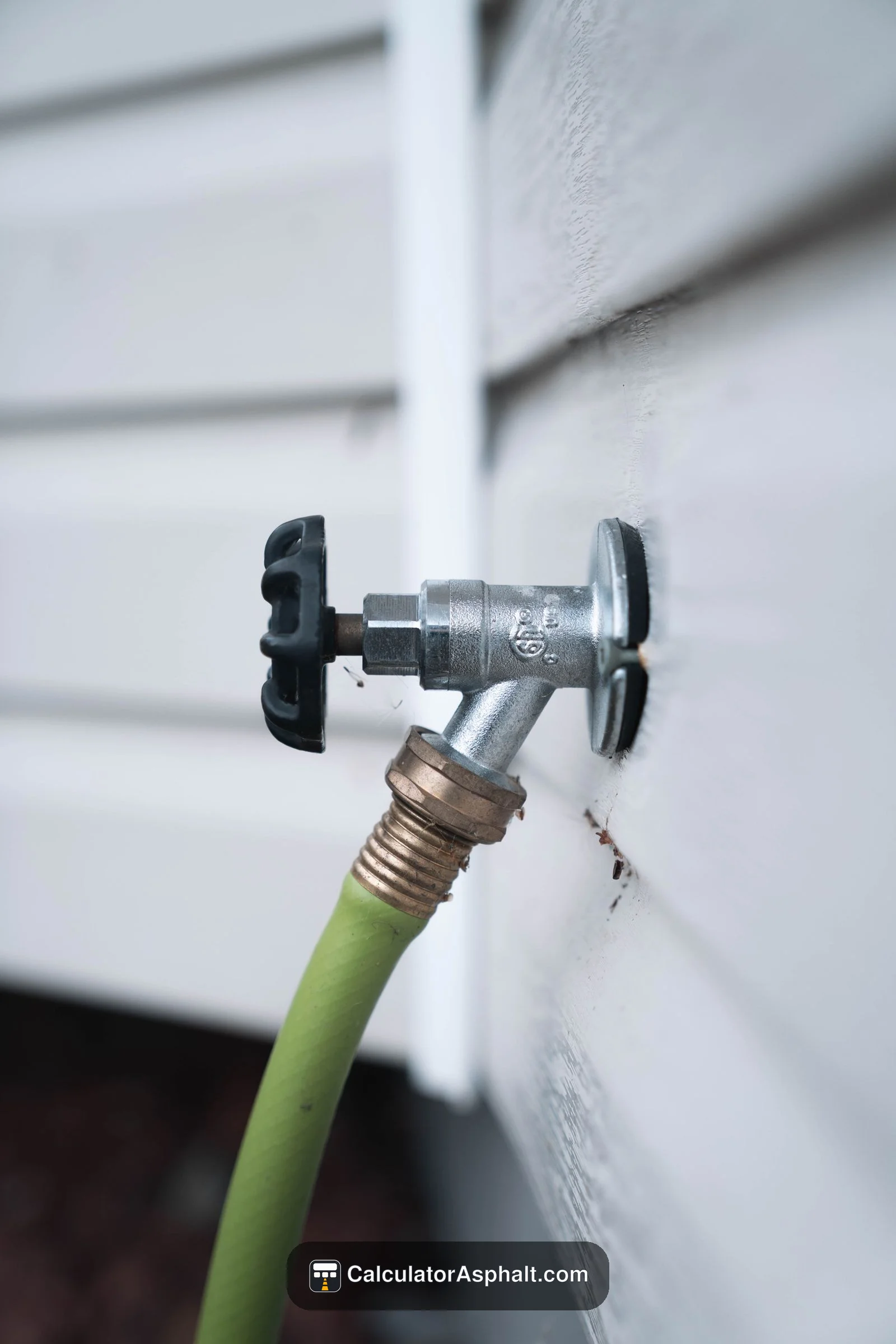
Three things decide how fast a hose delivers water. The first is diameter: a 3/4-inch hose carries more than a 5/8-inch hose at the same pressure, because its cross-section is about 44 percent larger — area grows with the square of the diameter. A 1-inch hose carries more again, so for a big job a wider hose is the cheapest way to buy speed.
The second is length: every foot adds friction, and friction costs pressure. A 25-foot hose loses little; a 100-foot hose loses a lot. Two 50-foot hoses joined together lose more than one 50-foot hose, because the coupling adds its own restriction. For a long reach, the answer is a wider hose, not a longer narrow one.
The third is pressure: household pressure is usually 40 to 60 pounds per square inch, highest at night, when nobody else is using water, and lowest in the morning, when the whole street showers at once. A pool filled overnight runs faster than the same pool filled at 7 a.m., so test at the time the job will run.
The arithmetic: volume divided by flow
Every filling job is one division: volume divided by flow rate equals time. Volume in gallons, flow in gallons per minute, answer in minutes. A 10,000-gallon pool at 7.5 gallons per minute takes 10,000 ÷ 7.5 = 1,333 minutes, or 22.2 hours. A 500-gallon tank at 5 takes 500 ÷ 5 = 100 minutes, and a 50-gallon water heater drained at 7.5 takes 50 ÷ 7.5 = 6.7 minutes.
The same arithmetic runs backwards: if the pool must be full by Saturday evening and there are 12 hours available, the job needs 10,000 ÷ 720 = 13.9 gallons per minute. A single garden hose cannot deliver that, so the plan needs two hoses, a wider hose, or more time. Working backwards from the deadline is how a job gets planned honestly, instead of hopefully.
Pipe volume: how much water the pipe itself holds
Flushing a system needs a second number: the volume of water already sitting in the pipes. A flush is not done when clean water appears at the outlet, but when the entire volume has been replaced — usually twice over, so the flush volume is two or three times the pipe volume.
The volume of a pipe is its cross-section times its length. A 3/4-inch hose has a radius of 0.375 inches, so its cross-section is 3.14 × 0.375 × 0.375 = 0.44 square inches. A hundred feet of that hose is 1,200 inches long, so it holds 0.44 × 1,200 = 530 cubic inches; a gallon holds 231, so the hose holds 530 ÷ 231 = 2.3 gallons. A 1-inch pipe 50 feet long has a radius of 0.5 inches, a cross-section of 3.14 × 0.5 × 0.5 = 0.785 square inches, and a length of 600 inches, so it holds 0.785 × 600 = 471 cubic inches, or 471 ÷ 231 = 2.04 gallons. Small numbers for a hose and a short pipe, but they grow quickly with diameter and length — and a flush planned without them stops too early.
Worked example: filling a 10,000-gallon pool
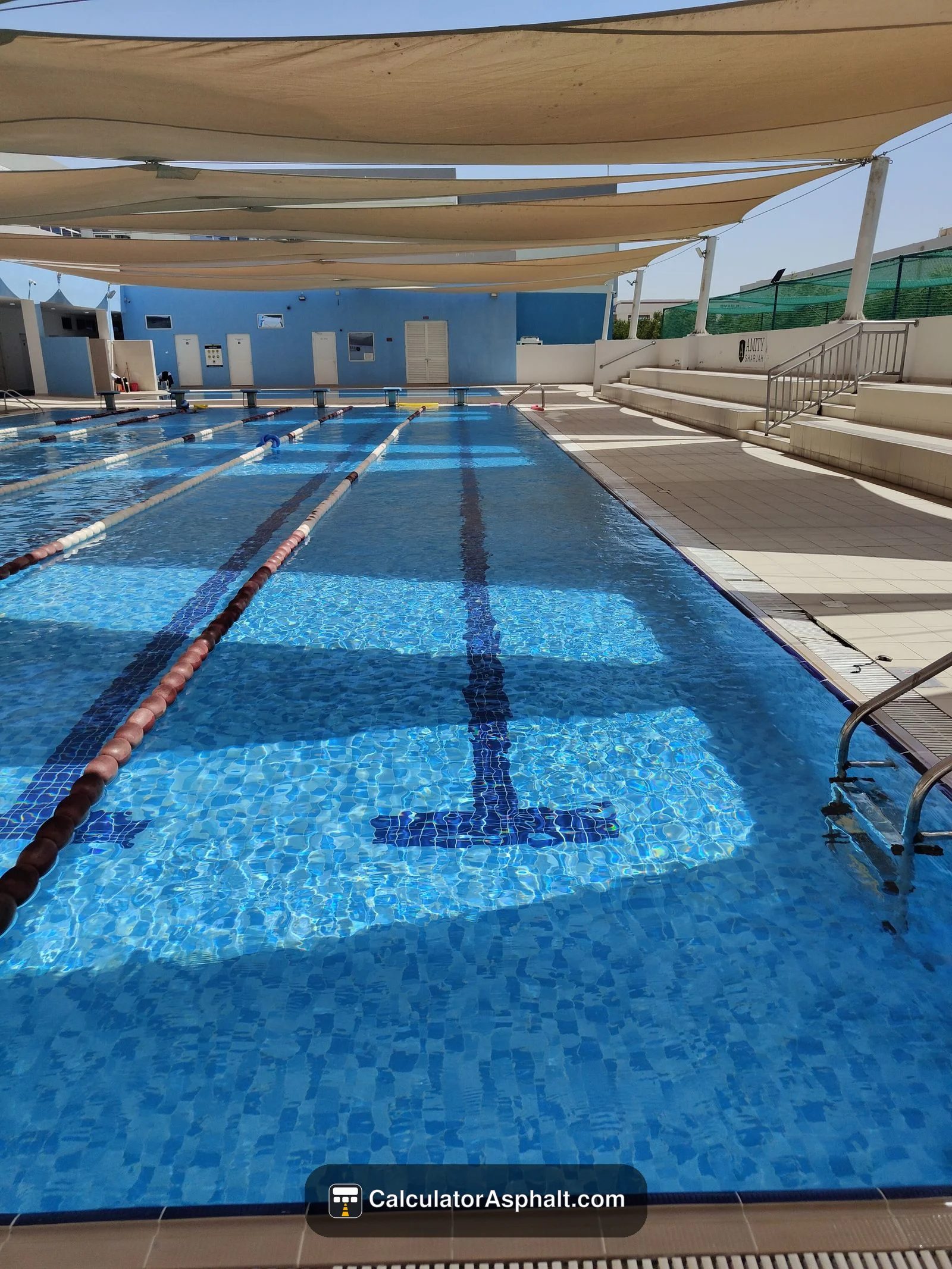
Take a 10,000-gallon above-ground pool and a 100-foot garden hose. The bucket test fills five gallons in 40 seconds at the end of the hose, with nothing else running.
Step 1: work out the flow rate. Five gallons in 40 seconds means the hose delivers 5 ÷ (40 ÷ 60) = 5 ÷ 0.667 = 7.5 gallons per minute.
Step 2: work out the fill time. The pool holds 10,000 gallons at 7.5 gallons per minute, so the fill takes 10,000 ÷ 7.5 = 1,333 minutes, or 22.2 hours. Started Saturday morning, the pool is full Sunday morning, not Saturday evening.
Step 3: check the deadline backwards. If the pool must be full in 12 hours, the job needs 10,000 ÷ 720 = 13.9 gallons per minute. One hose delivers 7.5, so two hoses from two taps deliver 15 — enough, with a little margin — provided the taps are on different supply lines, because two hoses on one splitter share the same flow and deliver no more than one hose alone.
Step 4: check the wider hose. A 3/4-inch hose delivers about 44 percent more water at the same pressure, because its cross-section is 44 percent larger. At the same tap, the flow rises from 7.5 to about 7.5 × 1.44 = 10.8 gallons per minute, and the fill time falls from 22.2 hours to 10,000 ÷ 10.8 = 926 minutes, or 15.4 hours. Still not a single afternoon, but a full day.
Step 5: check the overnight run. Pressure is highest at night, when the street is not using water. A bucket test at 10 p.m. might show five gallons in 33 seconds, which is 5 ÷ (33 ÷ 60) = 9.1 gallons per minute. At that rate the fill takes 10,000 ÷ 9.1 = 1,099 minutes, or 18.3 hours. Starting at 6 p.m. finishes it at midday the next day.
Decision table: hose choices for a 10,000-gallon fill
| Setup | Flow rate | Fill time | Verdict |
|---|---|---|---|
| One 5/8-in hose, 100 ft, daytime | 7.5 gpm | 22.2 hours | Works, but not in one day |
| One 3/4-in hose, 100 ft, daytime | 10.8 gpm | 15.4 hours | Works: a day and a night |
| Two hoses, two separate taps | 15 gpm | 11.1 hours | Works: inside a long day |
| Two hoses on one splitter | 7.5 gpm | 22.2 hours | Fails: a splitter shares, not doubles |
| One hose, overnight run | 9.1 gpm | 18.3 hours | Works: start 6 p.m., done by noon |
| One hose, morning peak, 7 a.m. | 6 gpm | 27.8 hours | Fails: the street is showering too |
A wider hose buys hours, a second tap buys hours, and a splitter buys nothing. The time of day matters as much as the hose, because the whole street shares the supply in the morning.
Where filling jobs go wrong
Guessing the flow. The most common error is assuming the hose delivers what the tap delivers. It does not, and the gap is usually a third or more. A bucket and a timer take two minutes and replace the guess with a number.
Counting a splitter as a second hose. A splitter divides one tap's flow between two hoses: each gets half, and the total stays the same. Two hoses help only from two separate taps on different supply lines.
Forgetting the flush volume. A flush that stops when the water runs clear has replaced only the water near the outlet; the water in the far pipes is still the old water. Flush two to three times the pipe volume, and the system is actually clean.
Starting too late. A 22-hour fill started on Saturday morning ends on Sunday morning, not Saturday evening. Work backwards from the deadline — divide the volume by the hours available — and the required flow rate tells you whether the plan is real before the hose is unrolled.
Field checklist: before you start the fill
- Bucket test done at the end of the hose, as the job will run
- Flow rate written down, tested twice
- Volume to fill known in gallons, from the pool, tank, or system spec
- Fill time calculated: volume divided by flow rate, in hours
- Deadline checked backwards: required flow against measured flow
- Hose diameter and length noted, kinks and couplings checked
- Second tap identified if one hose cannot meet the deadline
- Pipe volume calculated for a flush, flush volume set at twice the pipe volume
- Timer set, because a 22-hour fill will overflow if forgotten
Mistakes that cost a weekend
The most expensive mistake is starting a 22-hour fill on Saturday morning and expecting to swim that evening. The second is buying a splitter instead of a second tap, and finding the total flow did not change. The third is flushing a system once through and calling it clean, when the far pipes still hold the old water. The fourth is testing the flow with the nozzle off and running the job with it on, which cuts the flow by a third and adds hours nobody planned for. Every one is fixed by a bucket and a timer before the job starts.
Frequently asked questions
How do I measure flow without a bucket?
Use any container of known volume — a one-gallon jug, a five-gallon bucket, or a marked barrel. Time the fill and divide the volume by the time in minutes. A one-gallon jug that fills in 8 seconds means 7.5 gallons per minute, because 60 ÷ 8 = 7.5.
Does a longer hose really slow the fill that much?
Yes. Friction grows with length, and a 100-foot hose can lose a third of the tap's flow compared with a 25-foot hose. If the tap is far from the pool, a wider hose recovers more flow than a shorter narrow one.
Why is the flow faster at night?
The street shares the water main: in the morning every house showers and runs appliances at once, and the pressure drops; at night demand falls, pressure rises, and every tap runs faster. Test at the hour the job will run, or the number will mislead you.
How much water does my hose hold?
A 100-foot 3/4-inch hose holds about 2.3 gallons, and a 100-foot 5/8-inch hose about 1.6. The number matters for flushing, where the flush must replace the pipe volume twice over, and for draining, where the hose must be emptied before winter or the water inside will freeze and split it.