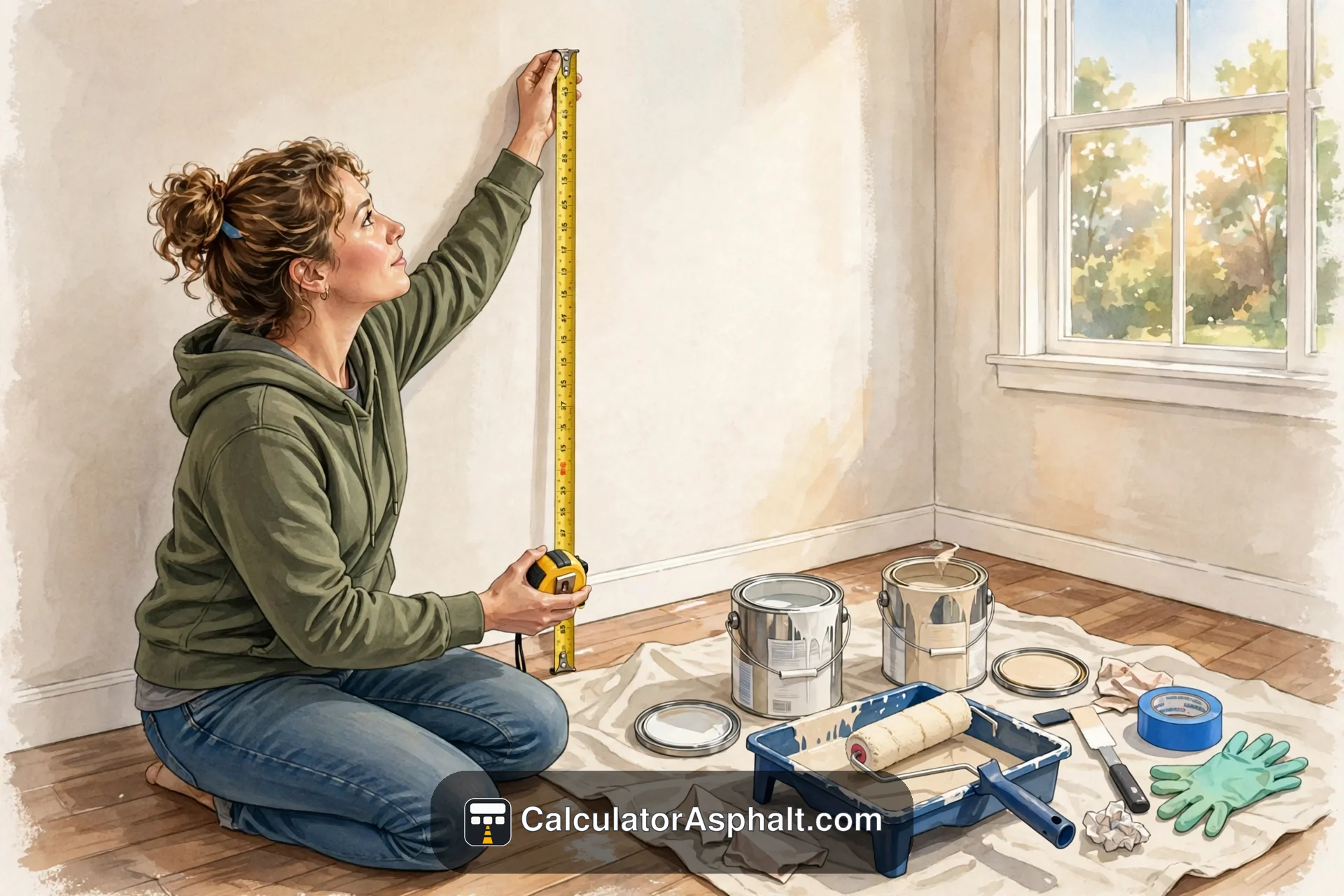
The most common paint mistake is not picking the wrong color. It is buying the wrong amount. A first-time homeowner walks into the store, guesses two gallons per room, and comes home with either a half-empty can that will sit in the garage for five years or a half-painted wall and a second trip. Both cost money. The first wastes it; the second wastes an evening and risks a visible difference between batches.
The fix is not a better guess. It is a ten-minute count. Measure the walls, subtract the parts you will not paint, multiply by the number of coats, and divide by the coverage on the can. That is the whole method. This article walks through it with one real room, shows the arithmetic line by line, and flags the five places where estimates usually go wrong.
The decision first: buy by the count, not by the room
Paint is sold by the gallon, but rooms are not sold by the gallon. A "one gallon per room" rule fails because rooms differ in three ways that matter more than floor size: ceiling height, the number and size of openings, and how many coats the color change needs. A small bedroom with eight-foot ceilings and one door needs far less paint than the same bedroom with nine-foot ceilings, two windows, and a dark-to-light color change.
So decide this before you shop: count first, buy second. Write down the wall area, the openings, the coats, and the coverage from the label of the paint you actually intend to buy. If the number says three gallons, buy three. If it says one gallon and a quart, buy that, not two gallons "to be safe." Extra paint is not insurance. It is money on a shelf, and it does not keep forever.
What to measure
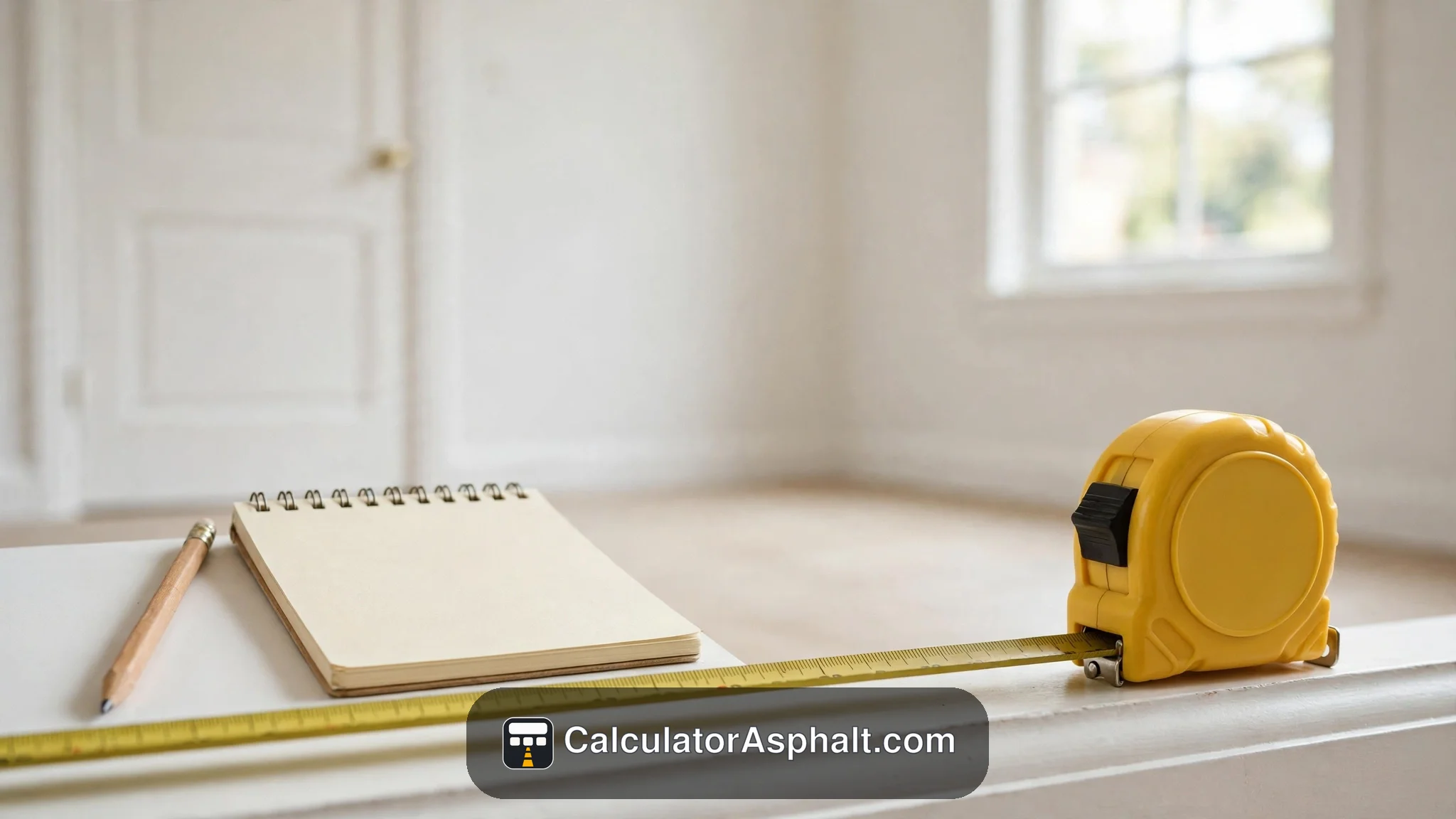
You need a tape measure, a notepad, and five numbers per room:
- Wall length. Measure each wall at the baseboard, in feet and inches. Add the four walls together for the perimeter.
- Ceiling height. Measure floor to ceiling in one spot. Do not assume eight feet; older houses often run eight feet six inches or nine feet, and that extra height adds paint on every wall.
- Openings. Measure each door and window you will not paint. A standard interior door is about three feet by seven feet, or 21 square feet. A typical window is about three feet by five feet, or 15 square feet. Measure yours rather than trusting those figures.
- Coats. Decide how many coats each surface needs before you count. One coat covers a same-color refresh on a sound surface. Two coats cover a color change, a dark color, or a surface that has never been painted.
- Coverage. Read the label of the paint you plan to buy. Coverage is printed as square feet per gallon, and it changes with the product and the surface. This article's worked example assumes 350 square feet per gallon, which is a common label figure for interior wall paint on smooth drywall. Your can may say something different. Use your can's number, not this article's.
Do not measure the floor and multiply by a rule of thumb. Floor area tells you nothing about wall height or openings, and it is the reason most rough estimates are wrong.
Worked example: a 12-by-14-foot bedroom
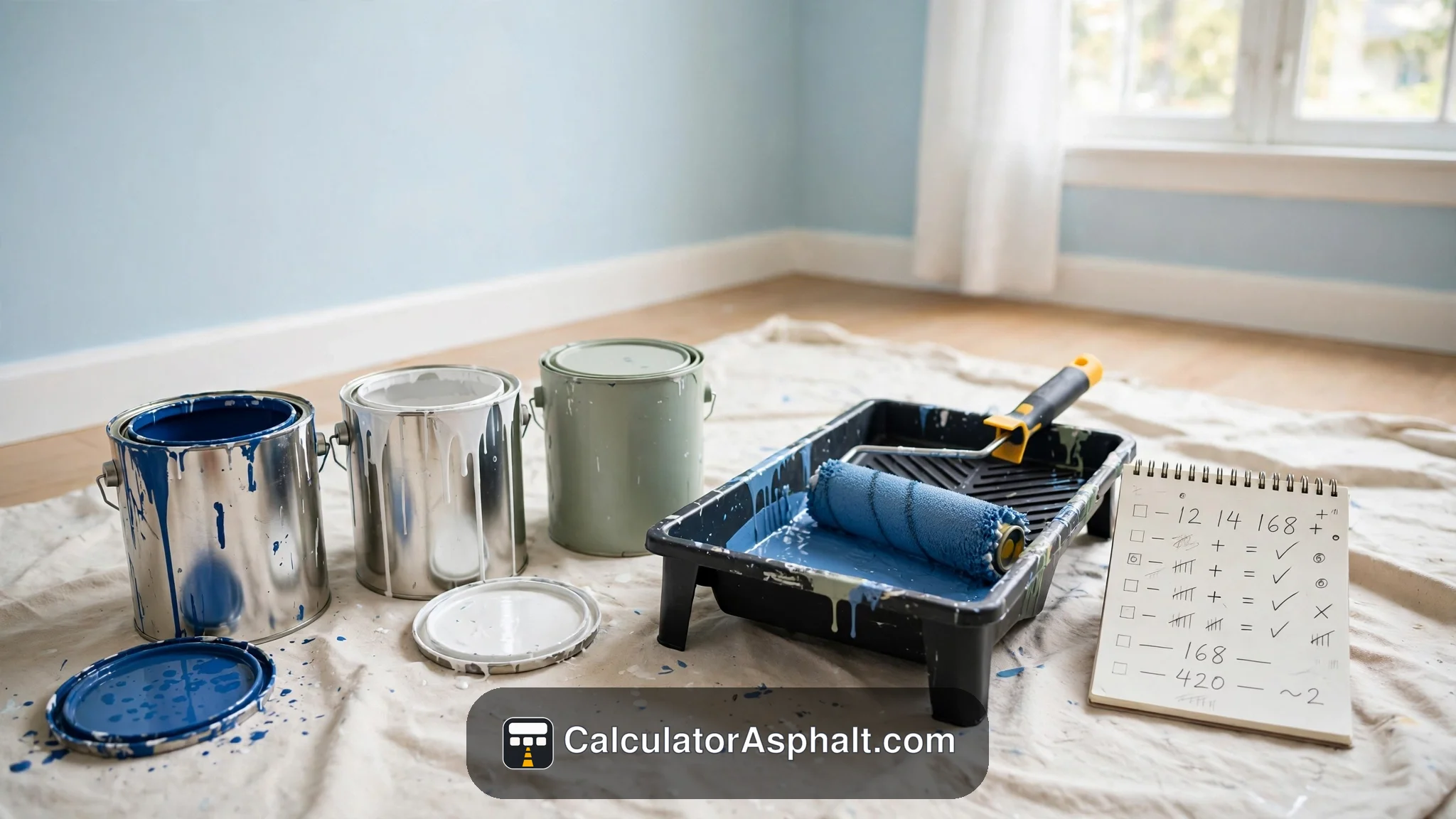
Take a bedroom 12 feet wide and 14 feet long, with eight-foot ceilings, one door, and one window. The homeowner is changing from a mid-tone beige to a light warm white, so two coats are needed on the walls and one coat on the ceiling.
Step 1: wall area. The perimeter is 12 + 14 + 12 + 14 = 52 feet. Multiply by the ceiling height: 52 × 8 = 416 square feet of wall.
Step 2: subtract openings. The door is 3 × 7 = 21 square feet. The window is 3 × 5 = 15 square feet. Openings total 21 + 15 = 36 square feet. Paintable wall area is 416 − 36 = 380 square feet.
Step 3: multiply by coats. Two coats on the walls means 380 × 2 = 760 square feet of painting.
Step 4: divide by coverage. At the assumed 350 square feet per gallon, 760 ÷ 350 = 2.17 gallons. Round up to whole cans: buy 3 gallons for the walls. The extra 0.83 gallon is not waste. It covers the roller and brush load, the paint that stays in the tray, and touch-ups later.
Step 5: the ceiling. The ceiling is 12 × 14 = 168 square feet. One coat at 350 square feet per gallon is 168 ÷ 350 = 0.48 gallon. Round up to 1 gallon of ceiling paint.
Total for the room: 3 gallons of wall paint and 1 gallon of ceiling paint. The same room estimated by "two gallons per room" would have left the second coat short by more than a gallon, and the ceiling unpainted.
Notice what changed the answer. If the ceilings were nine feet instead of eight, the wall area would be 52 × 9 = 468 square feet, minus 36 for openings, giving 432 square feet per coat, or 864 square feet for two coats — 2.47 gallons, still 3 gallons after rounding, but with almost no margin left. If the color change needed only one coat, the walls would need 380 ÷ 350 = 1.09 gallons, or 2 gallons after rounding.
Decision table: how the count changes
| Situation | Paintable wall area per coat | Coats | Total to cover | Gallons to buy (at 350 sq ft/gal) |
|---|---|---|---|---|
| Same color refresh, 12 × 14 room, 8 ft ceilings | 380 sq ft | 1 | 380 sq ft | 2 |
| Color change, same room | 380 sq ft | 2 | 760 sq ft | 3 |
| Color change, 9 ft ceilings | 432 sq ft | 2 | 864 sq ft | 3 |
| Color change plus an accent wall in a second color | 380 sq ft main + 112 sq ft accent | 2 + 2 | 984 sq ft | 3 main + 1 accent |
| Bare drywall, first coat soaks in | 380 sq ft | 2 + primer | 760 sq ft + primer | 3 + primer Bare Drywall Drinks Primer: Stop Paying for a Second Coat You Did Not Need |
The table shows a useful pattern: in a room this size, the answer is almost always two or three gallons for the walls. The expensive mistake is not the difference between two and three gallons. It is buying five because nobody counted, or buying one because somebody guessed.
Where estimates go wrong
Counting the floor instead of the walls. Floor area ignores ceiling height entirely. A 12-by-14 room has 168 square feet of floor and 416 square feet of wall. Any rule built on floor area is guessing at the wrong surface.
Forgetting the openings, or forgetting them twice. Doors and windows are real area. In the example they remove 36 square feet, nearly ten percent of the wall. But do not subtract trim you will paint, such as door casing and baseboards, if you plan to paint them with the wall paint. Decide what gets painted first, then subtract only what does not.
Treating one coat as enough for a color change. A dark wall under a light color will show through one coat almost every time. A light wall under a dark color usually needs two as well, because the first coat goes on thin over a slick surface. If you are unsure, plan for two coats and be pleasantly surprised, rather than planning for one and making a second trip.
Using the coverage on the wrong can. Coverage differs between flat, eggshell, satin, and semi-gloss, and between brands. It also differs between a smooth wall and a textured one. A heavily textured wall can take twenty percent more paint than a smooth one at the same square footage, because the texture adds surface area you cannot see in a flat measurement. If your walls are textured, add a margin after the division rather than pretending the label figure already includes it.
Doors, trim, and ceilings: count them separately
Trim paint is a different product in most houses — usually a semi-gloss in a different color — so count it on its own. Measure the linear feet of baseboard and door casing, and estimate trim coverage from the label. A typical room has about 50 linear feet of baseboard and 35 linear feet of door casing. At roughly 100 linear feet of trim per quart for one coat, a room's trim often takes one quart per coat. Doors themselves are usually painted with trim paint: a standard door is 21 square feet per side, so one door, both sides, is 42 square feet per coat.
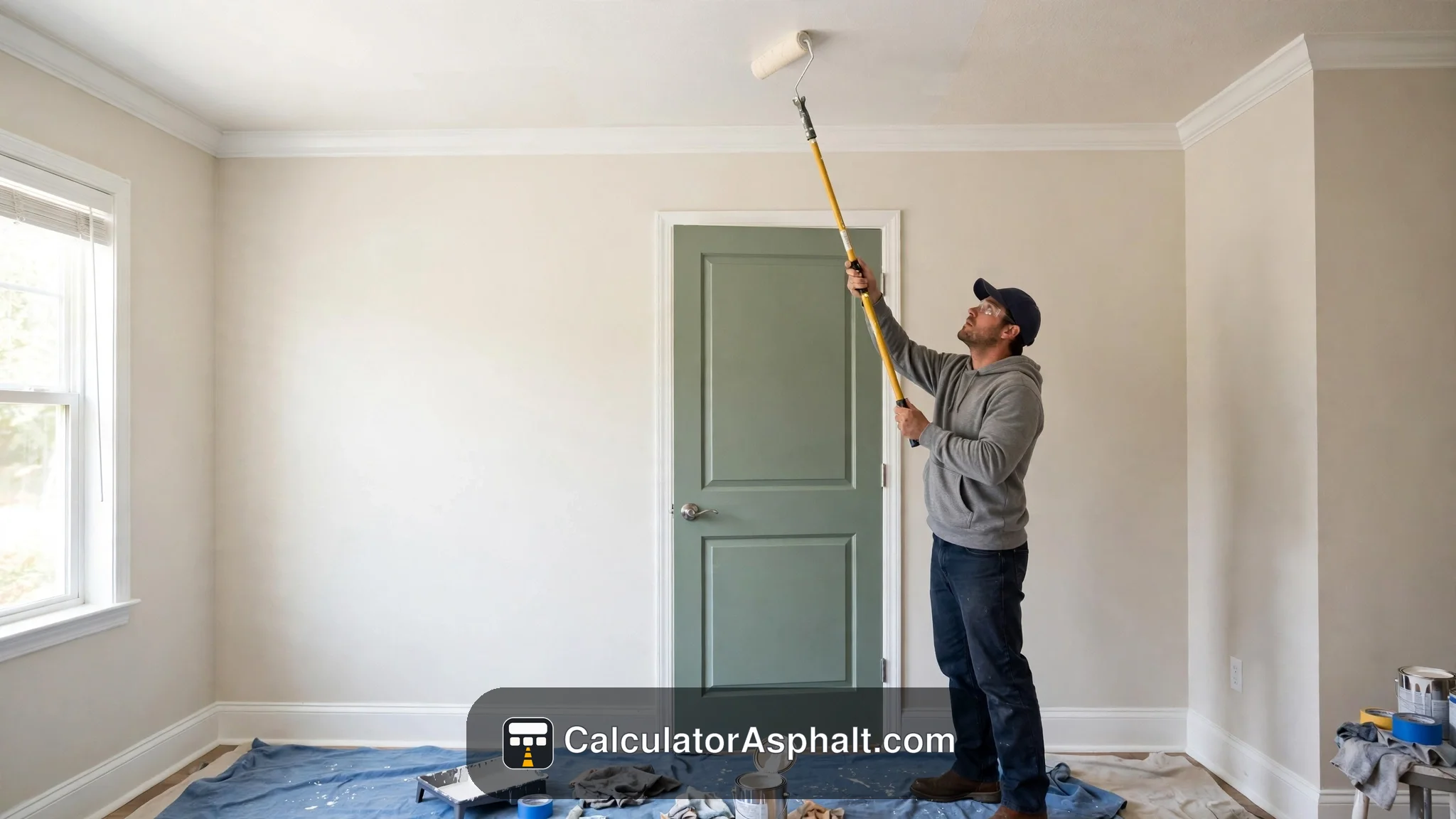
Ceilings take flat paint, not wall paint, and they take it at a different rate because you are rolling overhead and the surface is often textured. Count the ceiling as its own item, as the worked example does, and do not fold it into the wall total.
Field checklist: before you leave for the store
- Perimeter of the room measured and written down
- Ceiling height measured, not assumed
- Every door and window measured and subtracted
- Number of coats decided per surface, not guessed in the aisle
- Coverage read from the label of the paint you will actually buy
- Wall gallons, ceiling gallons, and trim quarts listed as three separate numbers
- One quart set aside in the plan for touch-ups if the color is custom
- Paint already at home checked first — an opened can from the last room may cover the touch-up coat
Mistakes that cost a second trip
The most expensive mistake is starting the second coat and discovering the can is empty with one wall left. The second is discovering that the new can is a different batch and the last wall dries a shade lighter. The third is painting over a stain or a patch without primer and watching it bleed through two coats of finish paint, which means buying primer after all and repainting. The fourth is skipping the ceiling because the wall paint ran out, leaving a room that looks unfinished from every chair in it. Every one of these is a counting mistake, not a painting mistake, and every one is fixed before the store, not after.
Frequently asked questions
How much paint do I need for one wall, not a whole room?
Measure that wall's length times its height, subtract any door or window on it, multiply by coats, and divide by the label coverage. A 14-foot wall at eight feet high is 112 square feet, minus a 15-square-foot window leaves 97 square feet per coat. At 350 square feet per gallon, one coat needs 0.28 gallon and two coats need 0.55 gallon — one gallon covers it, with touch-up paint left over.
Does the second coat really use as much paint as the first?
No, usually a little less, because the first coat seals the surface and the second goes on more evenly. The calculation still uses the full area for both coats, because the difference is small and unpredictable, and rounding up to whole cans absorbs it. Do not plan on the second coat using half as much.
Should I buy extra for touch-ups?
One quart of the exact wall color is usually enough for a room, and it is worth buying if the color is mixed to order. Mark the can with the room, the date, and the finish. Store it indoors, lid sealed, away from freezing temperatures. If you have leftover paint from a previous room in the same color, use that for touch-ups first.
What if my walls are textured?
Add about twenty percent to the paintable area before dividing by coverage. In the worked example, 380 square feet becomes 456 per coat, or 912 for two coats — 2.6 gallons, still 3 after rounding, but with less spare paint.
Save this project on Pinterest
Stop Buying Paint You Will Never Use
Count Every Wall Before You Buy Paint