By Steve Axton, PE — Licensed Civil Engineer · Updated November 2026
Count past or planned event scenarios and record usage separately from the quote. One storm count is an assumption, not a prediction.
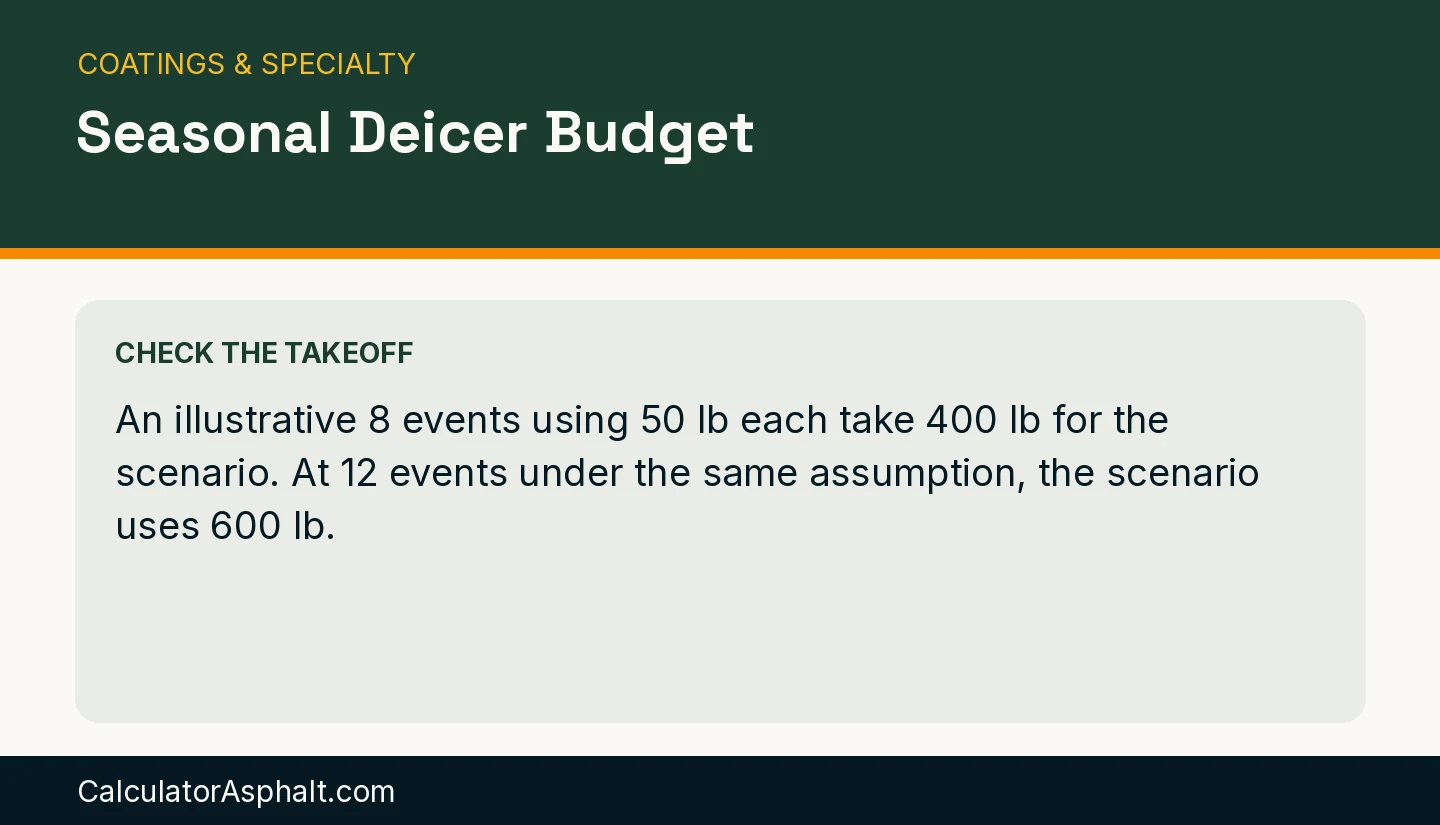
Illustrative result. An illustrative 8 events using 50 lb each take 400 lb for the scenario. At 12 events under the same assumption, the scenario uses 600 lb.
List the treated surfaces and their conditions
Map the surfaces the selected product or treatment actually addresses. Compare like conditions before choosing a common worksheet rate. The same recorded area can require a separate preparation scope or treatment schedule. Identify dry versus wet conditions, transitions and adjacent materials when relevant. Keep any problem areas on their own rows so they can be assessed directly.
Keep the inputs beside the Seasonal Deicer Budget calculator so its quantities can be checked against the original measurement. For an existing example of a clearly marked work scope, see painted concrete patio finish checklist. Use its boundary or measurement practice only where the conditions match.
Read the intended product or inspection basis
Keep the quantity basis close to the product information. A coverage, treatment rate, label condition or inspection count only applies when its defined input still matches. For a product purchase, check the exact container and whether the seller reports the quantity before or after a stated preparation step. For an inspection, note where and when the observation was made.
Review carryover, damaged stock and purchase increments. Keep event types separate where use differs substantially.
Identify whether the value describes a count, a rate, a measured dimension or a ratio. Preserve the units and work out which entries can be added. If the basis changes, apply the alternate conversion anew and compare the results on a common basis. For items sold in bundles or lengths, count the amount of the order the physical pieces can actually cover. Record any package or quote total independently of your calculation.
Put a sketch or item schedule next to the arithmetic. Make a mark at each reported location or use one line for each labeled product. Check which inputs are known from the exact items and which represent a proposed alternative. If the plan calls for separate orders, retain the individual pieces or products on their own lines until you have verified availability and compatibility.
Build a seasonal salt allowance
Carry existing usable stock into the same scenario as expected purchases. Keep the opening inventory separate from the estimated season’s use before asking what quantity to order.
| Worksheet entry | What to record | When to revise |
|---|---|---|
| Measurement or scope | The measured limits and units | A drawing or field dimension changes |
| Product or rate | Exact model, coverage, quote or authority | The product, basis or conditions change |
| Calculated subtotal | Original result and any conversion | An input units check or independent reading changes |
| Order or reviewed amount | Selling increment or reviewed scope | Availability, review findings or inclusions change |
Worked example
- Identify the scope. Count past or planned event scenarios and record usage separately from the quote. One storm count is an assumption, not a prediction.
- Set the example inputs and calculate. An illustrative 8 events using 50 lb each take 400 lb for the scenario. At 12 events under the same assumption, the scenario uses 600 lb.
- Check the result against the plan or quote. Review carryover, damaged stock and purchase increments. Keep event types separate where use differs substantially.
- Write down the basis for the next person. Request the product price, delivery minimum and permitted storage conditions from the responsible parties.
Keep labor and treatment decisions in context
Separate the arithmetic from the choice of method. Check the preparation and follow-up scope with the responsible professional before treating a low estimate as interchangeable with a higher one. Quote lines should identify products or inspection scope, the actual area, the observed conditions and any unresolved changes. Record which observations or requirements would invalidate the estimate.
Use the deicing material estimate and the deicer exposure inventory to keep connected quantities in view. A project can need each of those estimates without allowing their outputs to be summed. Identify the unit and purpose on every line.
For a separate quantity on the same project, see how much epoxy floor coating do i need. A built example in wall paint coverage and coat count shows why defining the finished area or work scope is more useful than estimating from a single outside dimension.
Set the conversion or layout basis before comparing alternatives
Keep a column for the number of units physically required and a separate column for what arrives. Write package size and the remainder beside the order total. Before comparing a second product, make sure the package can satisfy the same input and use the second product's stated coverage or dimensions.
Preserve the assumptions for the second estimate
File the marked-up drawing and product data with the estimate. If the alternative uses a different measurement or basis, remove the old value before entering the new one. Write down why the revision was made and whether another line depends on it. When financial assumptions are involved, retain the original dated quote and distinguish its actual terms from the numbers used in an example.
The example only calculates inventory and does not select application rates or predict weather.
Where this work connects to existing or planned asphalt, record the paving scope separately using the asphalt paving guide. Keep the location and work boundary in the estimate so any interface changes can be reviewed before purchase or construction.
Run your project numbers. Run the project inputs in the calculator for seasonal deicer budget. To check a connected line item, use deicing material estimate or deicer exposure inventory. Transfer the quantities and units back to the same plan or quote before comparing totals.
Frequently asked questions
What should I measure first?
Count past or planned event scenarios and record usage separately from the quote. One storm count is an assumption, not a prediction.
Can I use this figure for a different product or layout?
Only if the changed input is tested on the same dimensional and product basis. When the coverage, rate, rating or physical layout differs, recompute the affected lines and check the actual order item.
Which assumption deserves a second check?
Review carryover, damaged stock and purchase increments. Keep event types separate where use differs substantially.
What should I give the supplier or reviewer?
Request the product price, delivery minimum and permitted storage conditions from the responsible parties.
Calculation method reviewed November 2026. Use the CalculatorAsphalt worksheet and its stated inputs to reproduce the example.