By Steve Axton, PE — Licensed Civil Engineer · Updated November 2026
Separate the shelter package from delivery, assembly, foundation and access work. A kit quote and an installed quote cover different work even if they describe the same footprint.
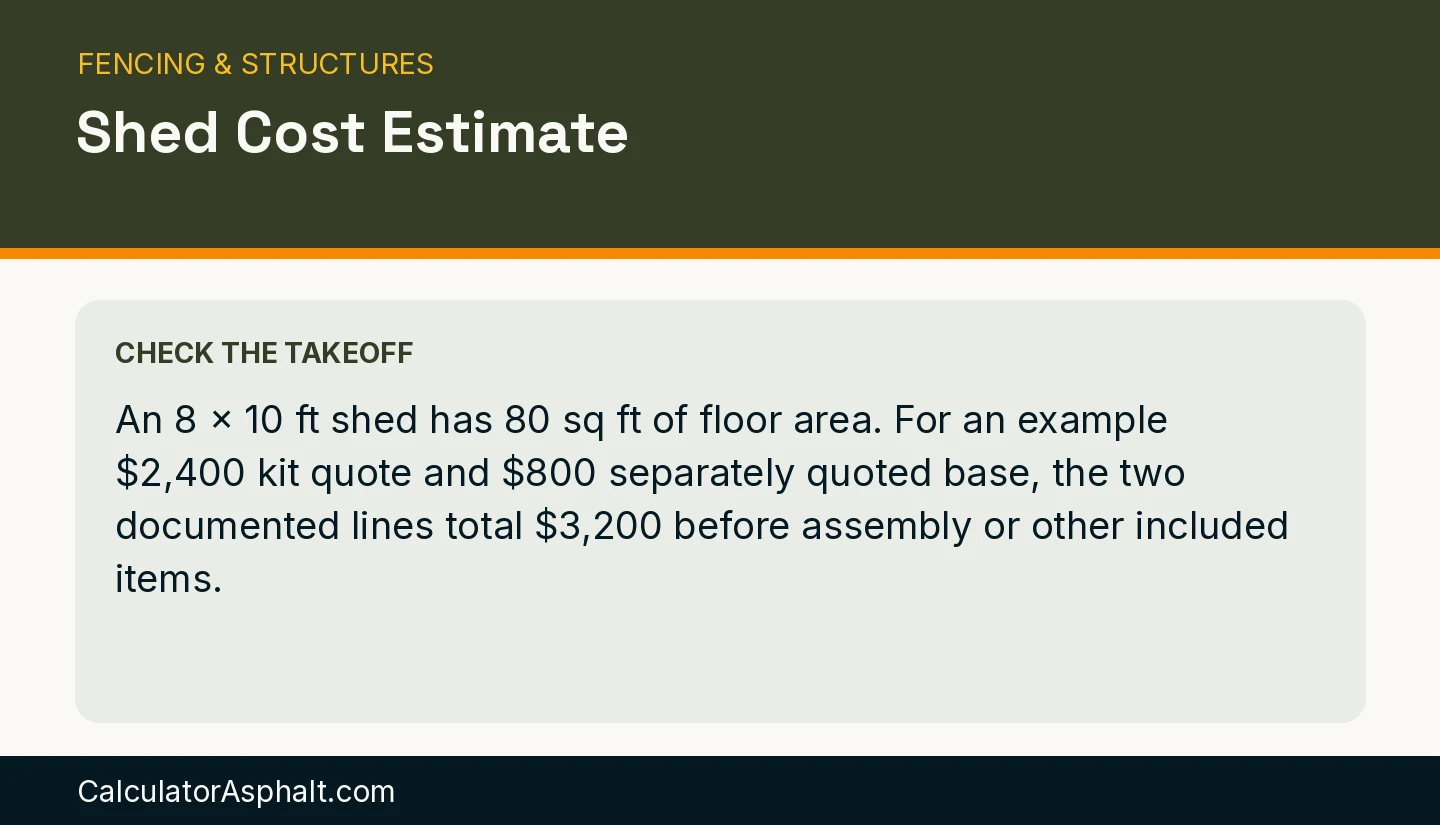
Illustrative result. An 8 × 10 ft shed has 80 sq ft of floor area. For an example $2,400 kit quote and $800 separately quoted base, the two documented lines total $3,200 before assembly or other included items.
Plot each independently measured run
Give every run or assembly an identifier and put its limits on the sketch. Gates, corners, changes in grade and transitions to existing work are useful dividing points. List the general material once, then record the different terminal or support conditions at their own locations. A row with no matching drawing reference is difficult for a second person to check.
Keep the inputs beside the Shed Cost Estimate calculator so its quantities can be checked against the original measurement. For an existing example of a clearly marked work scope, see deck to paver patio landing. Use its boundary or measurement practice only where the conditions match.
Match the detail to the location
Count pieces that have actually been specified. A repeated module makes a good initial count, but it says little about the equipment, support, adjustments and fittings at boundaries. Check the orientation of corners and ends and note pieces that must be ordered as part of a matched system. Keep the quantities for field pieces separate from the details that need approval.
Identify where the delivery vehicle can stop and how components move to the building location. Surface prep and building support may be quoted by different trades.
Read the written inclusions before calculating a rate. If a bidder used an allowance, keep that amount visible as a conditional line until the scope is confirmed. A fixed price and an allowance can have the same figure and still carry different risk. For an estimate using two quantities or alternatives, state which price attaches to each line before summing. A cost per unit is only meaningful for the amount and work actually included.
Create a comparison sheet with a row for each physical item. Place identical scope on the same row, place optional work below it, and note which amounts are conditional. Leave absent prices blank, or label them excluded where the bidder says so. A zero implies there is no cost, which is a different statement. Keep the original gross total so a difference can be traced to a line rather than to informal rounding.
Break the quote into parts
Check whether the proposed package includes a floor and what condition it assumes beneath that floor. A foundation item can remain necessary even when a vendor advertises a complete shell package.
| Worksheet entry | What to record | When to revise |
|---|---|---|
| Measurement or scope | The measured limits and units | A drawing or field dimension changes |
| Product or rate | Exact model, coverage, quote or authority | The product, basis or conditions change |
| Calculated subtotal | Original result and any conversion | An input units check or independent reading changes |
| Order or reviewed amount | Selling increment or reviewed scope | Availability, review findings or inclusions change |
Worked example
- Identify the scope. Separate the shelter package from delivery, assembly, foundation and access work. A kit quote and an installed quote cover different work even if they describe the same footprint.
- Set the example inputs and calculate. An 8 × 10 ft shed has 80 sq ft of floor area. For an example $2,400 kit quote and $800 separately quoted base, the two documented lines total $3,200 before assembly or other included items.
- Check the result against the plan or quote. Identify where the delivery vehicle can stop and how components move to the building location. Surface prep and building support may be quoted by different trades.
- Write down the basis for the next person. Request a schedule with the base system, doors, floors, roof covering, hardware and labor. Record the specific exclusions and delivery conditions.
Check access and package increments
A stock length, unit or kit may be too large to carry along the stated access route even when its price is attractive. Confirm packaging, delivery and storage before counting one large unit as interchangeable with multiple small ones. If a proposal includes field alteration, ask whether that work belongs to the chosen system and who will provide the necessary detail.
Use the pole barn estimate and the garage quote comparison to keep connected quantities in view. A project can need each of those estimates without allowing their outputs to be summed. Identify the unit and purpose on every line.
For a separate quantity on the same project, see deck cost estimate. A built example in privacy trees fence plan drawing shows why defining the finished area or work scope is more useful than estimating from a single outside dimension.
Compare the same work in the price column
Write the measured quantity beside each quoted fixed cost and each unit rate, then reconcile the arithmetic with the actual quote. Keep dated scope notes and any alternative clearly identified. If the price is still an estimate, state which known line is firm and who will resolve the contingent one.
Review a recorded observation before revising everything
A real measurement may differ from a drawing, and an observation can apply to only the part of the site that was inspected. Mark the location and the conditions of the check, then determine which line needs revision. Bring a change in scope to the appropriate reviewer. Keep quantities that are actually comparable separate from values derived under different conditions.
Example amounts are hypothetical quote inputs. Site and building requirements should be checked for the intended use and locality.
Where this work connects to existing or planned asphalt, record the paving scope separately using the asphalt paving guide. Keep the location and work boundary in the estimate so any interface changes can be reviewed before purchase or construction.
Run your project numbers. Run the project inputs in the calculator for shed cost estimate. To check a connected line item, use pole barn estimate or garage quote comparison. Transfer the quantities and units back to the same plan or quote before comparing totals.
Frequently asked questions
What should I measure first?
Separate the shelter package from delivery, assembly, foundation and access work. A kit quote and an installed quote cover different work even if they describe the same footprint.
What changes the price without changing the measured amount?
Scope exclusions, delivery, preparation and order increments can change the charge without changing the measured amount. Compare the same quantities and terms and identify which extras remain unpriced.
Which assumption deserves a second check?
Identify where the delivery vehicle can stop and how components move to the building location. Surface prep and building support may be quoted by different trades.
What should I give the supplier or reviewer?
Request a schedule with the base system, doors, floors, roof covering, hardware and labor. Record the specific exclusions and delivery conditions.
Calculation method reviewed November 2026. Use the CalculatorAsphalt worksheet and its stated inputs to reproduce the example.