By Steve Axton, PE — Licensed Civil Engineer · Updated November 2026
Count modules that fit a proposed layout, then convert the count and rating into DC nameplate capacity. Energy generation requires different inputs.
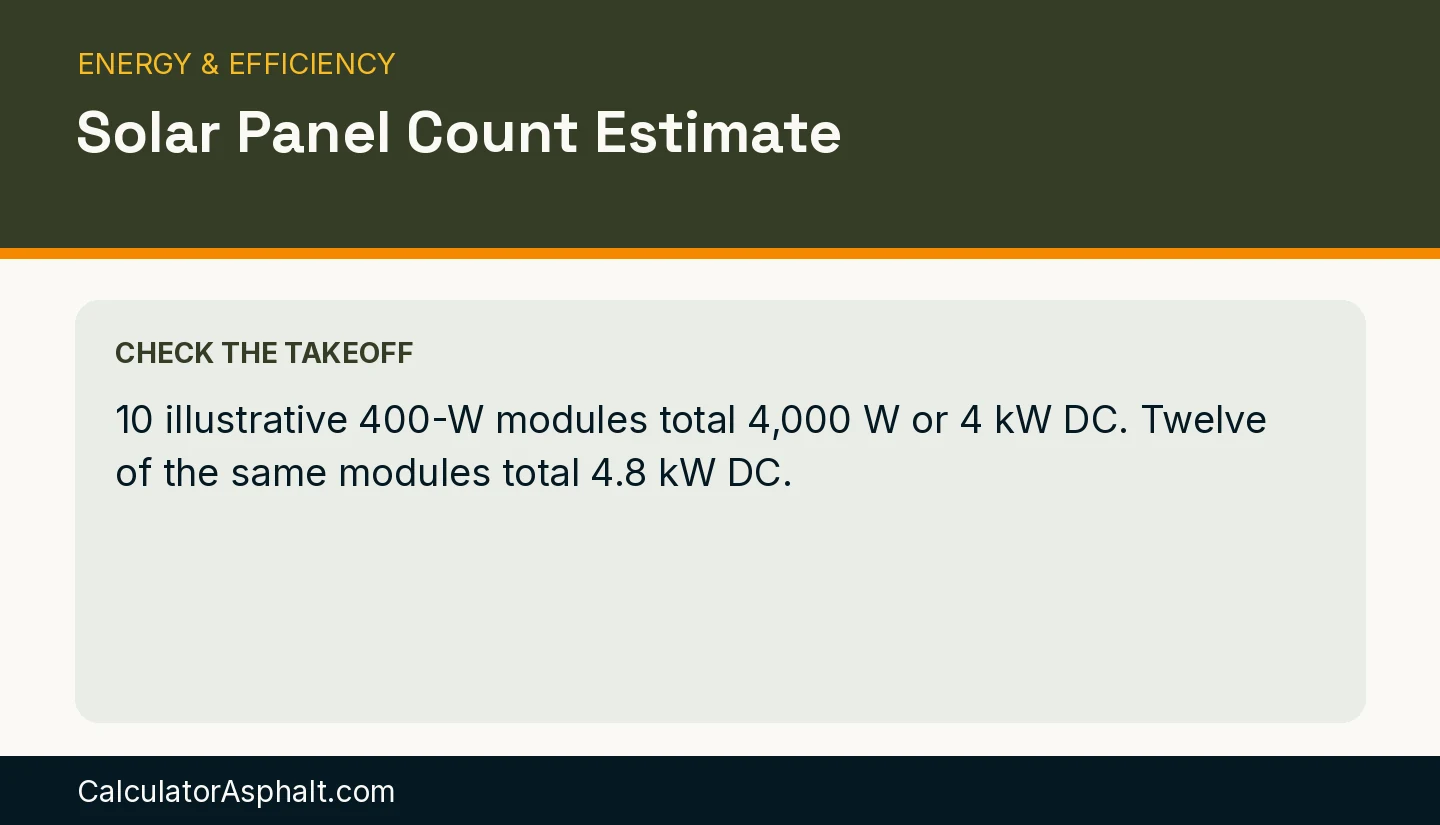
Illustrative result. 10 illustrative 400-W modules total 4,000 W or 4 kW DC. Twelve of the same modules total 4.8 kW DC.
State the units, boundary and operating assumptions
Write down what the estimate represents and what it leaves for a separate analysis. A nameplate figure, modeled value, energy use or unit of installed material needs a clear basis. Identify the time window or assembly it applies to. Adjust only the relevant input when testing an alternate scenario so the resulting change can be traced to its cause.
Keep the inputs beside the Solar Panel Count Estimate calculator so its quantities can be checked against the original measurement. For an existing example of a clearly marked work scope, see solar pv systems with roofing materials. Use its boundary or measurement practice only where the conditions match.
Distinguish modeled inputs from field conditions
Keep product rating, designed performance and recorded operating conditions as different entries. For an estimate that depends on observed use, retain the data period and scope. Where the same product is proposed for a different location or operating pattern, revisit the assumptions that changed before treating a single number as transferable.
Check obstructions and available layout area with the installer. A higher-rated module can have different dimensions.
Identify whether the value describes a count, a rate, a measured dimension or a ratio. Preserve the units and work out which entries can be added. If the basis changes, apply the alternate conversion anew and compare the results on a common basis. For items sold in bundles or lengths, count the amount of the order the physical pieces can actually cover. Record any package or quote total independently of your calculation.
Put a sketch or item schedule next to the arithmetic. Make a mark at each reported location or use one line for each labeled product. Check which inputs are known from the exact items and which represent a proposed alternative. If the plan calls for separate orders, retain the individual pieces or products on their own lines until you have verified availability and compatibility.
Compare panel nameplate size
Ask for the layout diagram showing the number and model of proposed modules on each roof face. Count those modules again after any site constraint removes a row from the installation.
Check the change in nameplate size
For the same ten-module example, a change from 400 to 420 W per module increases the DC nameplate sum by 200 W. Verify the physical dimensions and layout before assuming the alternate module fits. A larger nameplate sum also does not establish the value of the modeled generation.
| Worksheet entry | What to record | When to revise |
|---|---|---|
| Measurement or scope | The measured limits and units | A drawing or field dimension changes |
| Product or rate | Exact model, coverage, quote or authority | The product, basis or conditions change |
| Calculated subtotal | Original result and any conversion | An input units check or independent reading changes |
| Order or reviewed amount | Selling increment or reviewed scope | Availability, review findings or inclusions change |
Worked example
- Identify the scope. Count modules that fit a proposed layout, then convert the count and rating into DC nameplate capacity. Energy generation requires different inputs.
- Set the example inputs and calculate. 10 illustrative 400-W modules total 4,000 W or 4 kW DC. Twelve of the same modules total 4.8 kW DC.
- Check the result against the plan or quote. Check obstructions and available layout area with the installer. A higher-rated module can have different dimensions.
- Write down the basis for the next person. Ask for the proposed module specification, DC size, inverter limits and production estimate assumptions in writing.
Ask for a comparable proposal or report
Collect the product identifiers, included work, operating conditions and any rates or incentives applied to a comparison. Request alternate scenarios when an assumption materially affects the result. Keep the arithmetic and later field verification together so a supplier can identify the value being discussed. Let the qualified design process resolve any safety or installation details.
Use the ev charge time estimate and the insulation pack count to keep connected quantities in view. A project can need each of those estimates without allowing their outputs to be summed. Identify the unit and purpose on every line.
For a separate quantity on the same project, see solar payback worksheet. A built example in choosing the best roof material for solar panels shows why defining the finished area or work scope is more useful than estimating from a single outside dimension.
Set the conversion or layout basis before comparing alternatives
Keep a column for the number of units physically required and a separate column for what arrives. Write package size and the remainder beside the order total. Before comparing a second product, make sure the package can satisfy the same input and use the second product's stated coverage or dimensions.
Review a recorded observation before revising everything
A real measurement may differ from a drawing, and an observation can apply to only the part of the site that was inspected. Mark the location and the conditions of the check, then determine which line needs revision. Bring a change in scope to the appropriate reviewer. Keep quantities that are actually comparable separate from values derived under different conditions.
A nameplate sum is not a production forecast or an electrical design. Confirm applicable requirements with the installer.
Where this work connects to existing or planned asphalt, record the paving scope separately using the asphalt paving guide. Keep the location and work boundary in the estimate so any interface changes can be reviewed before purchase or construction.
Run your project numbers. Run the project inputs in the calculator for solar panel count estimate. To check a connected line item, use ev charge time estimate or insulation pack count. Transfer the quantities and units back to the same plan or quote before comparing totals.
Frequently asked questions
What should I measure first?
Count modules that fit a proposed layout, then convert the count and rating into DC nameplate capacity. Energy generation requires different inputs.
Can I use this figure for a different product or layout?
Only if the changed input is tested on the same dimensional and product basis. When the coverage, rate, rating or physical layout differs, recompute the affected lines and check the actual order item.
Which assumption deserves a second check?
Check obstructions and available layout area with the installer. A higher-rated module can have different dimensions.
What should I give the supplier or reviewer?
Ask for the proposed module specification, DC size, inverter limits and production estimate assumptions in writing.
Calculation method reviewed November 2026. Use the CalculatorAsphalt worksheet and its stated inputs to reproduce the example.