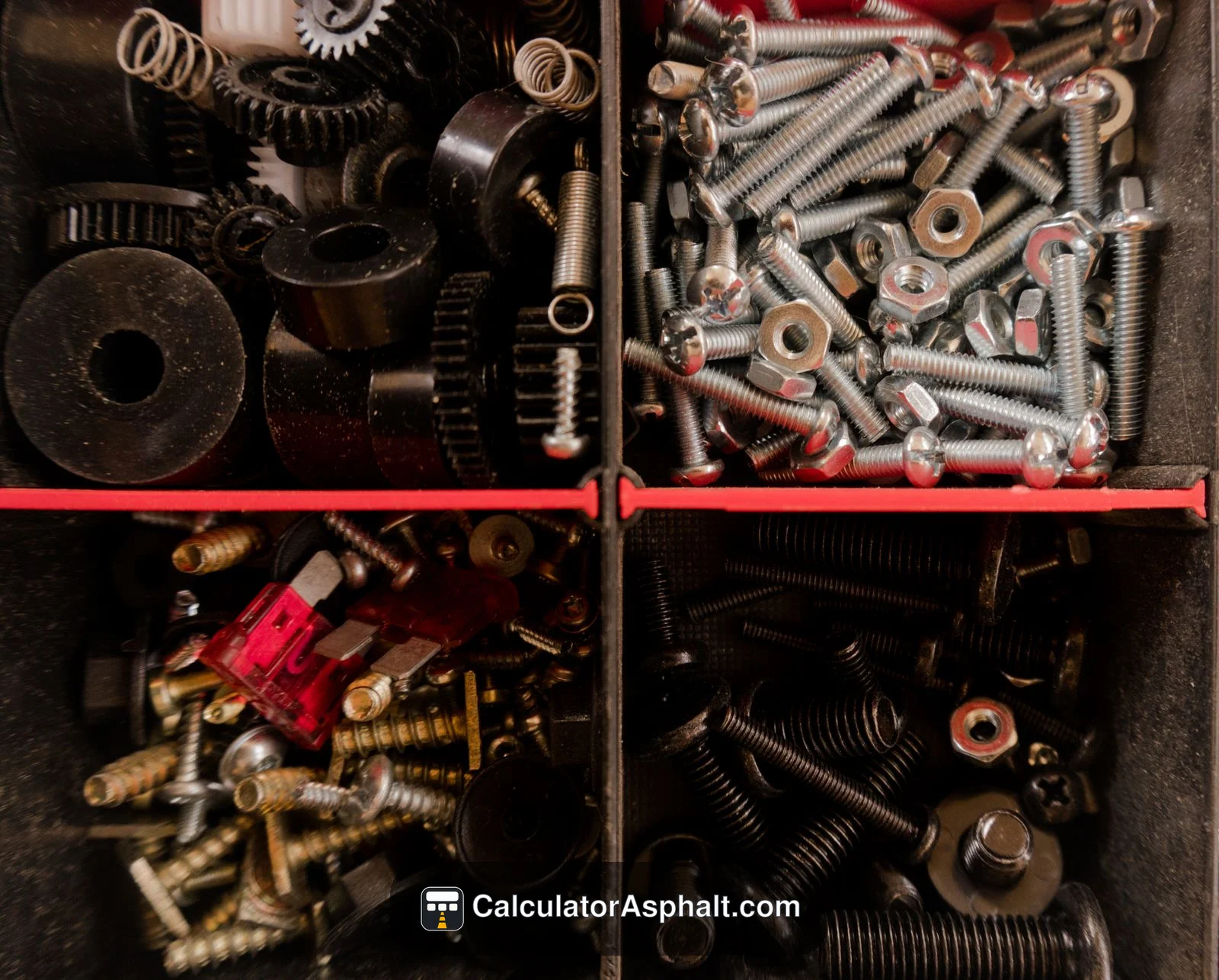
The screw you need is in the drawer. You know it is there: you put it there. You open the drawer: a hundred screws, nails, plugs, washers, and bits, all mixed together, and the screw you need is under all of them. Ten minutes later you have found three screws that are nearly right, and given up on the one that is exactly right. This guide is for the DIY beginner whose small parts live in one junk drawer. It makes one promise: give every kind of part a home of its own, and the search takes thirty seconds.
The fix is twenty small bins, one kind per bin, labelled in plain words, on one shelf beside the bench. This guide works through one example with real arithmetic, compares bins with drawers, jars, and the junk drawer, and gives a fifty-minute sorting plan.
The decision first
Sort small parts by kind, one kind per bin, and label every bin with the kind inside it. A bin holding one kind is a bin you can find in thirty seconds. A drawer holding every kind is one you can search for ten minutes and still fail. The sort is the system, and the label keeps it sorted.
Why the junk drawer wins
A junk drawer wins for one reason: it is the easiest place to put a small part down, and nobody ever takes one back out. A screw left over from a project goes in the drawer. So does a washer. So does a wall plug. Within a year the drawer holds a hundred parts, and a hundred mixed together are a hundred you cannot find, because finding one means moving the other ninety-nine.
The drawer also costs you twice: the search, because every search takes four minutes and you search three times a week, and duplicates, because the fourth time you cannot find the screw you buy a box. The bins fix both, because a labelled bin tells you what is inside before you open it, and a bin you can read is a bin you do not buy twice.
Worked example: a hundred parts, twenty bins
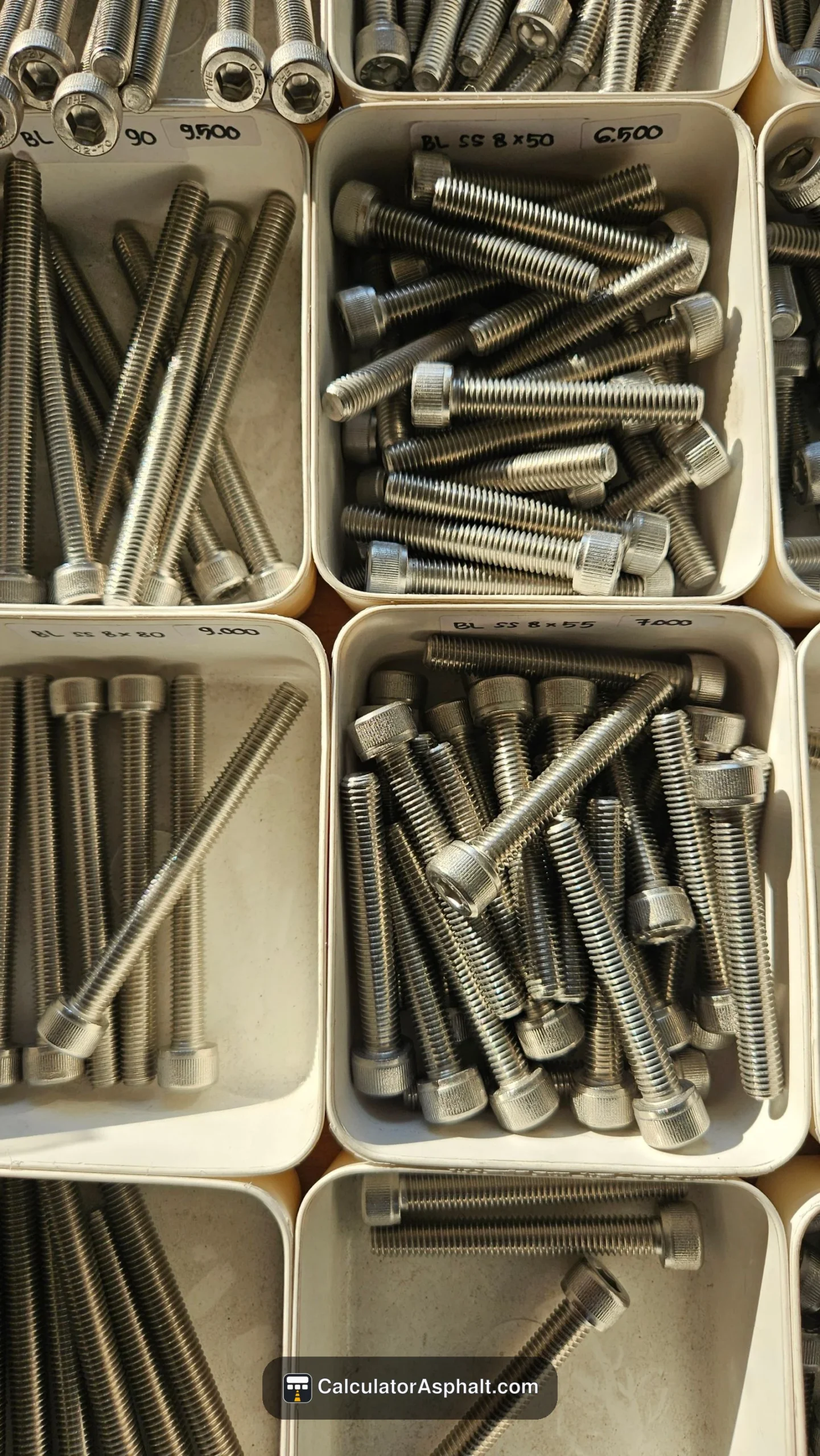
Every number here comes from the assumptions below, and every step shows its arithmetic. Count your own parts first.
Assumptions: one hundred small parts in the junk drawer, in five kinds: screws, nails, wall plugs, washers, and fixings. Twenty bins, one kind per bin, four per kind for the different sizes. One shelf beside the bench, 24 in by 12 in. These are assumptions, not facts about your garage.
The kinds: five kinds, twenty bins
Five kinds of part, four bins per kind: 5 x 4 = 20 bins. Screws get four, one per size. Nails four, one per size. Wall plugs four, one per size. Washers four, one per size. Fixings four, one per kind. Twenty bins, each holding one kind in one size, and every part in the drawer has a bin waiting. A part that fits none of the twenty bins goes in the out pile, because a bin holding two kinds is a bin nobody can read.
The shelf: twenty bins, 240 square inches
One bin: 3 in by 4 in = 12 sq in. Twenty bins: 20 x 12 = 240 sq in. One shelf: 24 in by 12 in = 288 sq in. The bins take 240 sq in of a 288 sq in shelf, leaving 288 – 240 = 48 sq in spare for the next kind you buy. Twenty bins fit on one shelf beside the bench, and the shelf takes no floor: it is on the wall. The bins take one shelf and give you every part in thirty seconds.
The sort: fifty minutes, one session
Sorting one hundred parts takes 100 parts x 30 seconds = 3,000 seconds, which is 3,000 / 60 = 50 minutes. Thirty seconds per part is enough to look at it, name its kind and size, and drop it in the right bin. Work in one session, all twenty bins, and do not stop halfway: ten sorted bins and ten unsorted is a garage where searches still fail half the time.
The hunting: ten hours a year down to one
Without bins, one search takes 4 minutes: open the drawer, move the parts, look, move them back. Three searches a week: 3 x 4 = 12 minutes a week. Twelve minutes a week, 52 weeks: 12 x 52 = 624 minutes, which is 624 / 60 = 10.4 hours, or about 10 hours a year. With bins, one search takes 30 seconds: read the labels, open the right bin. Three searches a week: 3 x 30 seconds = 90 seconds a week, or 1.5 minutes. Ninety seconds a week, 52 weeks: 1.5 x 52 = 78 minutes, which is 78 / 60 = 1.3 hours, or about 1 hour a year. The saving: 10 – 1 = 9 hours a year, for fifty minutes of sorting.
Run the same steps for your garage: count the parts, count the kinds, work out the bins each kind needs, and check the shelf before you buy anything.
Bins or jars
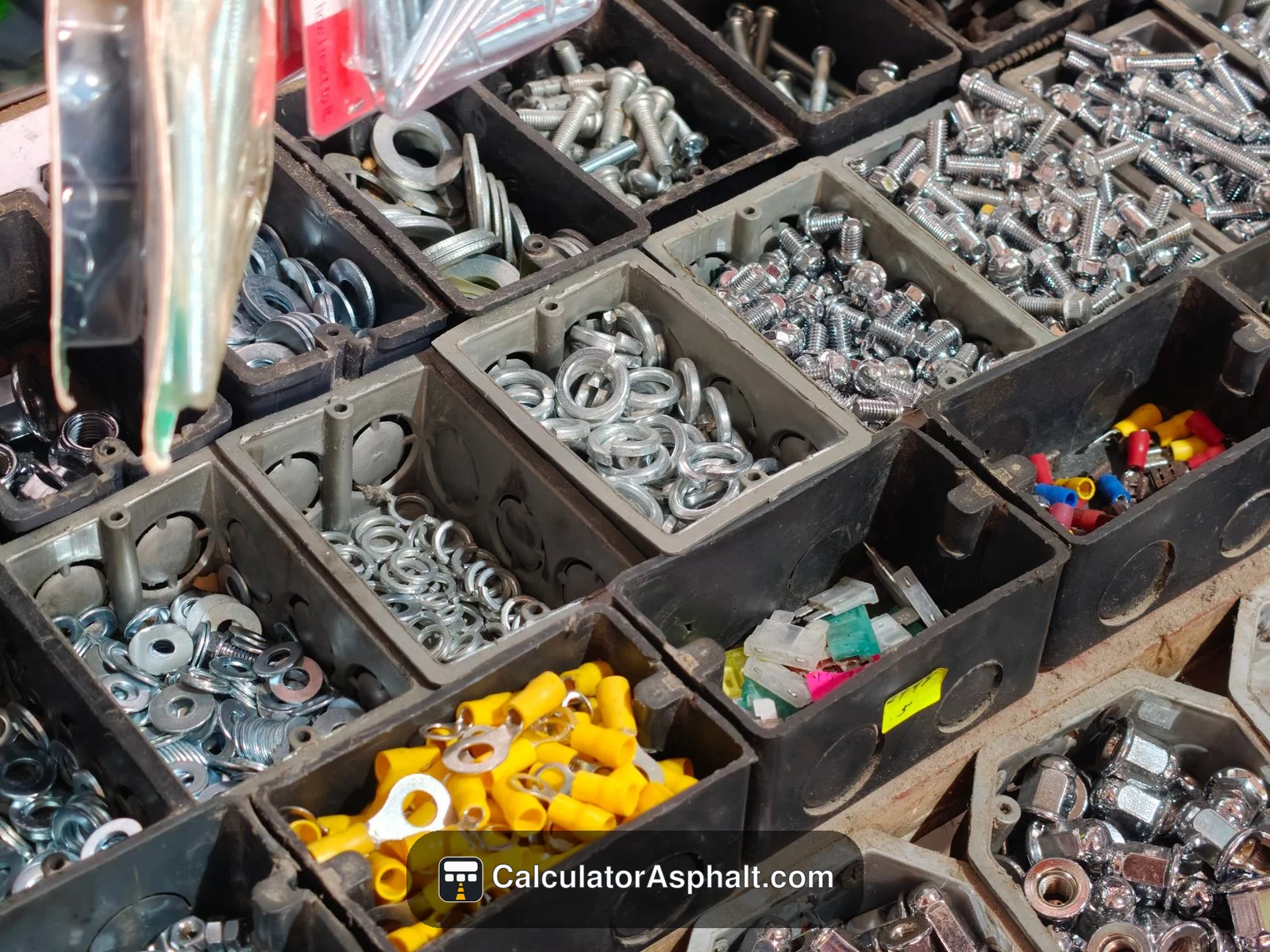
The choice is not which one looks tidier. It is which one lets you find the part.
| Choice | What happens | Best for | Watch out for |
|---|---|---|---|
| Small labelled bins | One kind per bin, labels you can read, all on one shelf | Every garage with more than fifty small parts | The bins must hold one kind each, or they become small junk drawers |
| Glass jars | You can see the parts inside without opening anything | Parts you tell apart by sight, such as screws and nails | Jars roll, break, and take more shelf than bins, and a jar without a label still has to be opened |
| The junk drawer | Every part in one place, mixed together | Nothing: this is the trap to avoid | Finding one part means moving ninety-nine others, and you buy duplicates of the ones you cannot find |
| One big box | Parts sorted by project, not by kind | A single project with its own parts | The next project needs the same parts, buried under the last project |
| Bins plus one drawer | Bins for the working kinds, drawer for the rarely used | Every garage with more than a hundred parts | The drawer must hold only the rarely used kinds, or it becomes a second junk drawer |
The right answer is bins for the working kinds, labelled in plain words, on one shelf beside the bench. One kind, one bin, one label.
How to sort a hundred parts without regret
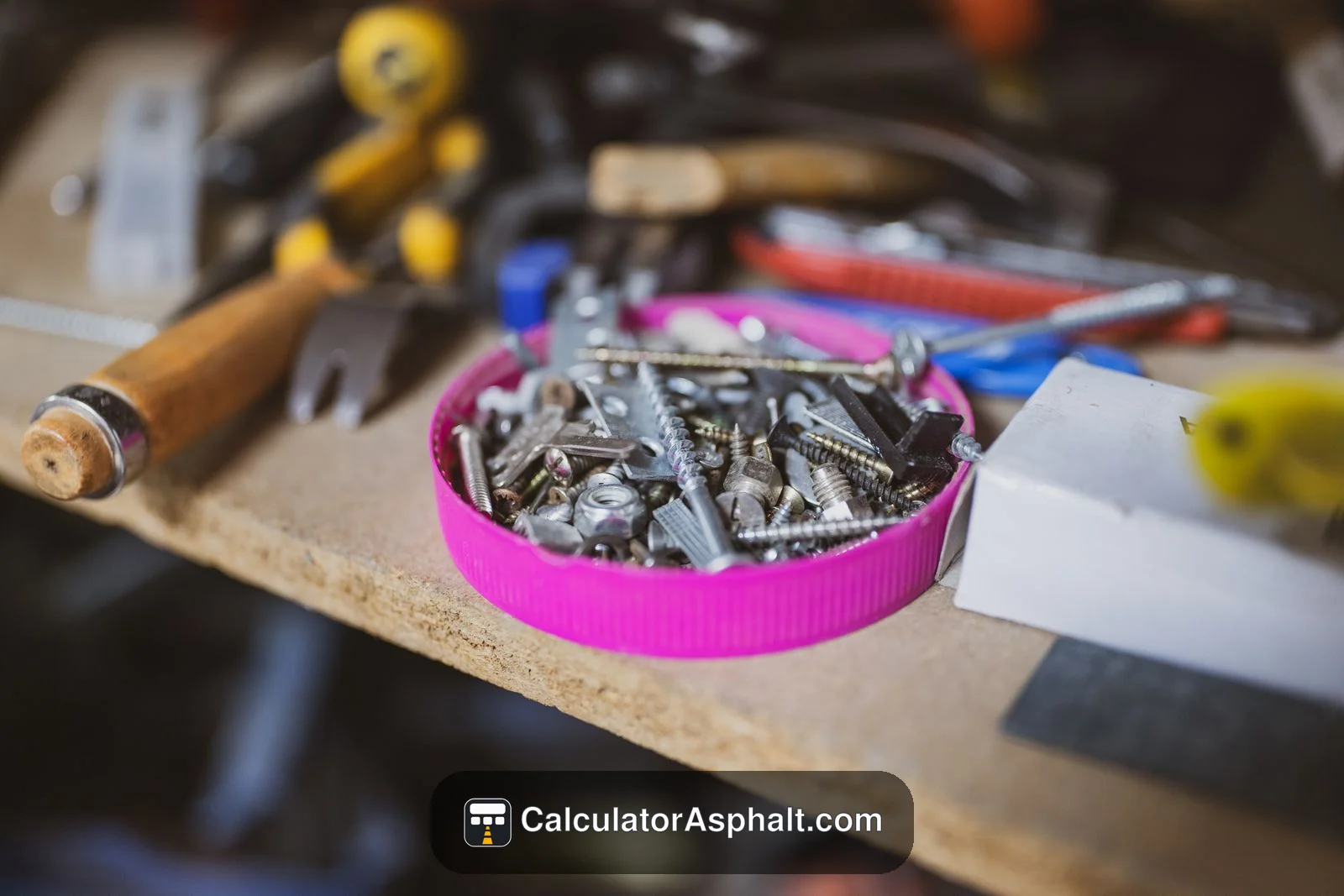
Start by emptying the drawer, not by buying bins. Everything comes out onto the bench, in the open, where you can see it all at once. A sort done inside the drawer keeps the drawer, and the drawer is the problem. Empty it first.
Sort into five piles first, one per kind, then into sizes inside each kind. Screws in one pile, nails in another, wall plugs in a third, washers in a fourth, fixings in a fifth. Then split each pile by size: short screws and long screws, small plugs and large plugs. In the example, five kinds split into twenty bins, four per kind. Count honestly, because a bin holding two kinds is a bin nobody can read.
Buy the bins after the sort, not before. Twenty bins hold a hundred parts in the example, four per kind. If your sort gives three kinds, twelve bins are enough, and eight extra are money spent storing air. If your sort gives seven kinds, twenty-eight bins are needed, and twenty leave a hundred parts homeless. The sort decides the bins.
Label every bin the day you fill it, with the kind and the size in plain words. "Screws, 25 mm" is a label. "Fixings" is not, because fixings could be anything, and a label that could be anything says nothing. A bin labelled the day it is filled stays labelled.
Field checklist: before you sort anything
Use this checklist in order.
- Count the small parts, and write the number down.
- Count the kinds of part, and write each kind down.
- Empty the junk drawer completely onto the bench.
- Sort into piles by kind, then split each pile by size.
- Count the bins each kind needs, four per kind in the example.
- Buy the bins after the sort, one bin per kind and size.
- Put the bins on one shelf beside the bench, labels facing out.
- Label every bin with the kind and the size, in plain words.
- Put one kind of part in each bin, and nothing else.
- Agree the rule with everyone in the house: a part goes back in its bin.
Mistakes that rebuild the junk drawer
Sorting inside the drawer is the first mistake. A sort done inside the drawer keeps the drawer, and the drawer is the problem. Empty it completely, sort on the bench.
Buying the bins first is the second mistake. Bins bought before the sort decide the sort, and a sort decided by the bins leaves parts homeless. Sort first, count the kinds, buy the bins the sort needs.
Labelling vaguely is the third mistake. "Fixings" and "bits" are not labels, because they could mean anything, and a label that could mean anything means nothing. Plain words, one kind, one size.
Stopping halfway is the fourth mistake. Ten sorted bins and ten unsorted is a garage where searches still fail half the time, because the part you need is always in the unsorted half. Fifty minutes, a hundred parts, all of them, in one session.
Letting the bins drift is the fifth mistake. A screw dropped in the nail bin is a screw nobody can find, and a bin with two kinds in it is a small junk drawer. A part goes back in its own bin, every time, or the bins become the drawer with lids.
Frequently asked questions
What if I have more than a hundred parts?
Count them first. Twenty bins hold a hundred parts at five per bin, which is roomy. Two hundred parts need forty bins, or twenty bins filled twice as full, and a bin filled twice as full is one you cannot see into. If the count keeps growing past two hundred, the problem is sorting, not bins: a drawer of three hundred parts usually means a hundred should leave the garage.
What about parts I use once a year?
They go in the drawer, not on the shelf. The shelf holds the working kinds, the ones you search for three times a week. The rarely used kinds go in one drawer, labelled by kind. A shelf crowded with one-a-year parts hides the everyday ones, and a hidden part is one you cannot find.
Do the bins work if I share the garage?
Yes, and they work better, because the labels are a system anyone can read. A shared garage with a junk drawer is one where everyone hunts, because nobody knows what anyone else put where. The bins and labels end the hunt for everyone.
How do I keep the bins sorted?
Check them once a month, for one minute. A part in the wrong bin goes back in its own, a bin that is empty gets its label checked, and a new kind gets a new bin and a label the day it arrives. Bins checked monthly stay sorted.