By Steve Axton, PE — Licensed Civil Engineer · Updated November 2026
Compare the same specified mix, measured pour volume and service terms. Fees and placement arrangements can change the effective unit price.
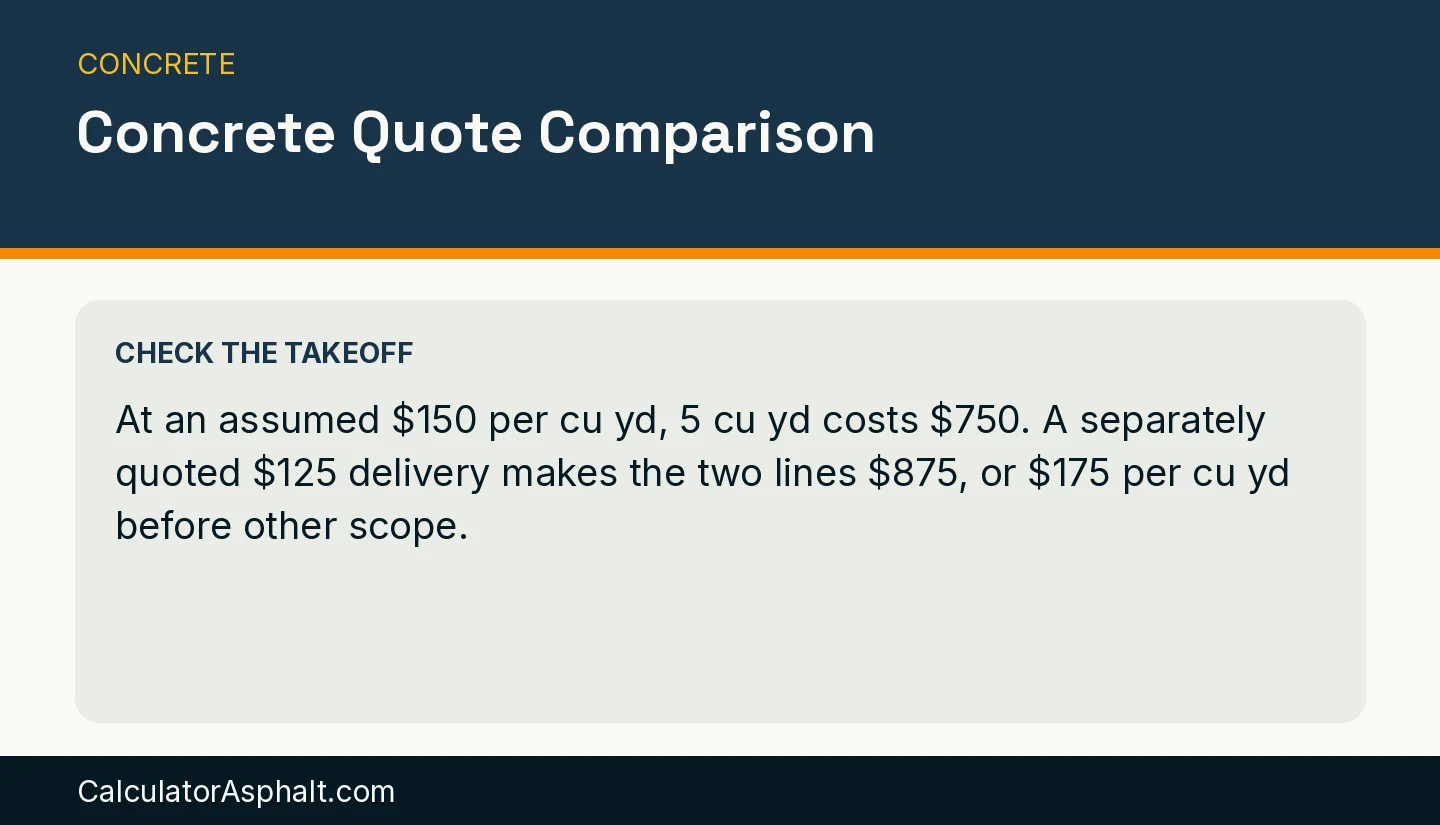
Illustrative result. At an assumed $150 per cu yd, 5 cu yd costs $750. A separately quoted $125 delivery makes the two lines $875, or $175 per cu yd before other scope.
Identify the geometry the form will actually enclose
Use the dimensions of the intended concrete element and group volumes by planned pour. Mark edges, changes in section and locations where components touch. Draw the boundary of each calculated block and mark shared faces. The sum should represent the intended physical volume once. A separately ordered product or change in mix must retain its own line even where the geometry is continuous.
Keep the inputs beside the Concrete Quote Comparison calculator so its quantities can be checked against the original measurement. For an existing example of a clearly marked work scope, see concrete driveway vs asphalt driveway. Use its boundary or measurement practice only where the conditions match.
Preserve the unit basis through the purchase
Take volume into the quote in cubic feet or cubic yards as appropriate. Convert at the end if the drawing uses mixed units and retain the unrounded value. When a prepackaged product is specified, use the published mixed yield. When dispatch supplies a batch, check its ordering units and how the supplier handles quantities that fall between their increments.
Watch for minimum-load charges, separate pumping and time charges. Record exactly what each line covers.
Read the written inclusions before calculating a rate. If a bidder used an allowance, keep that amount visible as a conditional line until the scope is confirmed. A fixed price and an allowance can have the same figure and still carry different risk. For an estimate using two quantities or alternatives, state which price attaches to each line before summing. A cost per unit is only meaningful for the amount and work actually included.
Create a comparison sheet with a row for each physical item. Place identical scope on the same row, place optional work below it, and note which amounts are conditional. Leave absent prices blank, or label them excluded where the bidder says so. A zero implies there is no cost, which is a different statement. Keep the original gross total so a difference can be traced to a line rather than to informal rounding.
Compare concrete quotes
Ask whether a dispatch minimum, travel or unloading allowance is included in one bid and excluded from another. Normalize pricing only after recording these terms.
| Worksheet entry | What to record | When to revise |
|---|---|---|
| Measurement or scope | The measured limits and units | A drawing or field dimension changes |
| Product or rate | Exact model, coverage, quote or authority | The product, basis or conditions change |
| Calculated subtotal | Original result and any conversion | An input units check or independent reading changes |
| Order or reviewed amount | Selling increment or reviewed scope | Availability, review findings or inclusions change |
Worked example
- Identify the scope. Compare the same specified mix, measured pour volume and service terms. Fees and placement arrangements can change the effective unit price.
- Set the example inputs and calculate. At an assumed $150 per cu yd, 5 cu yd costs $750. A separately quoted $125 delivery makes the two lines $875, or $175 per cu yd before other scope.
- Check the result against the plan or quote. Watch for minimum-load charges, separate pumping and time charges. Record exactly what each line covers.
- Write down the basis for the next person. Ask the supplier or contractor for itemized deliverables, current quote terms and fees.
Compare scope before changing the quantity
An estimate can include a measured allowance, but the need must be tied to the formwork, expected tolerances and accepted placement plan. Do not reduce approved dimensions to fit a quote. Record whether access, delivery, pumping, finishing and cleanup are in the price. Ask the contractor to itemize scope that belongs in another bid rather than making it disappear in a single unit rate.
Use the how much concrete do i need and the ready-mix order quantity to keep connected quantities in view. A project can need each of those estimates without allowing their outputs to be summed. Identify the unit and purpose on every line.
For a separate quantity on the same project, see concrete column quantity. A built example in gravel patio with concrete pads shows why defining the finished area or work scope is more useful than estimating from a single outside dimension.
Compare the same work in the price column
Write the measured quantity beside each quoted fixed cost and each unit rate, then reconcile the arithmetic with the actual quote. Keep dated scope notes and any alternative clearly identified. If the price is still an estimate, state which known line is firm and who will resolve the contingent one.
Round at the point where the order is placed
Preserve the unrounded subtotal so another person can reproduce the estimate. Identify the actual selling or billing increment in the quote, and transfer only compatible items to the same order total. Review separately priced boxes, stock lengths, delivery minimums and allowances before interpreting any difference as waste. A rounded purchase and a measured amount serve different purposes and both should remain visible.
Prices are hypothetical. The calculator cannot select mix, quantity reserve, or safe placement methods.
Where this work connects to existing or planned asphalt, record the paving scope separately using the asphalt paving guide. Keep the location and work boundary in the estimate so any interface changes can be reviewed before purchase or construction.
Run your project numbers. Run the project inputs in the calculator for concrete quote comparison. To check a connected line item, use how much concrete do i need or ready-mix order quantity. Transfer the quantities and units back to the same plan or quote before comparing totals.
Frequently asked questions
What should I measure first?
Compare the same specified mix, measured pour volume and service terms. Fees and placement arrangements can change the effective unit price.
What changes the price without changing the measured amount?
Scope exclusions, delivery, preparation and order increments can change the charge without changing the measured amount. Compare the same quantities and terms and identify which extras remain unpriced.
Which assumption deserves a second check?
Watch for minimum-load charges, separate pumping and time charges. Record exactly what each line covers.
What should I give the supplier or reviewer?
Ask the supplier or contractor for itemized deliverables, current quote terms and fees.
Calculation method reviewed November 2026. Use the CalculatorAsphalt worksheet and its stated inputs to reproduce the example.