
A generator that runs the lights, the phone chargers, and the television perfectly, then stalls the moment the fridge compressor kicks in, has not failed. It was sized for the wrong number. The box advertises running watts, which is the power the generator delivers steadily. The fridge, the freezer, and the well pump do not ask for steady power when they start — they ask for a surge two to three times their running watts, for a few seconds, and a generator that cannot deliver that surge trips, stalls, or shuts down.
The fix is to size for startup loads, not running watts: list every load, note its running watts and its startup watts, add up the running total, then add the largest single startup surge on top. That number is the generator size the house actually needs, and it is always bigger than the running total alone.
The decision first: running watts plus the biggest surge
Every electrical load has two numbers. Running watts is the power it uses steadily: a fridge runs at about 700 watts, a freezer at about 500, a well pump at about 1,000, a set of lights at about 300, phone chargers at about 50. Startup watts is the power it draws for the first few seconds when a motor starts: a fridge starts at about 2,100 watts, a freezer at about 1,500, a well pump at about 3,000. The startup multiplier for motors is roughly three times running watts — check the appliance label, because that number comes from the appliance, not the generator.
The sizing rule follows from those two numbers. Add up the running watts of everything that runs at once. Then find the single largest startup surge — the difference between that appliance's startup watts and its running watts — and add it to the running total. That gives the peak the generator must survive. The reason for adding only the largest surge, rather than every surge at once, is that motors rarely start in the same second; but if two large motors can start together, add both surges, because the generator does not get to choose the timing.
Portable or standby: matching the generator to the outage plan
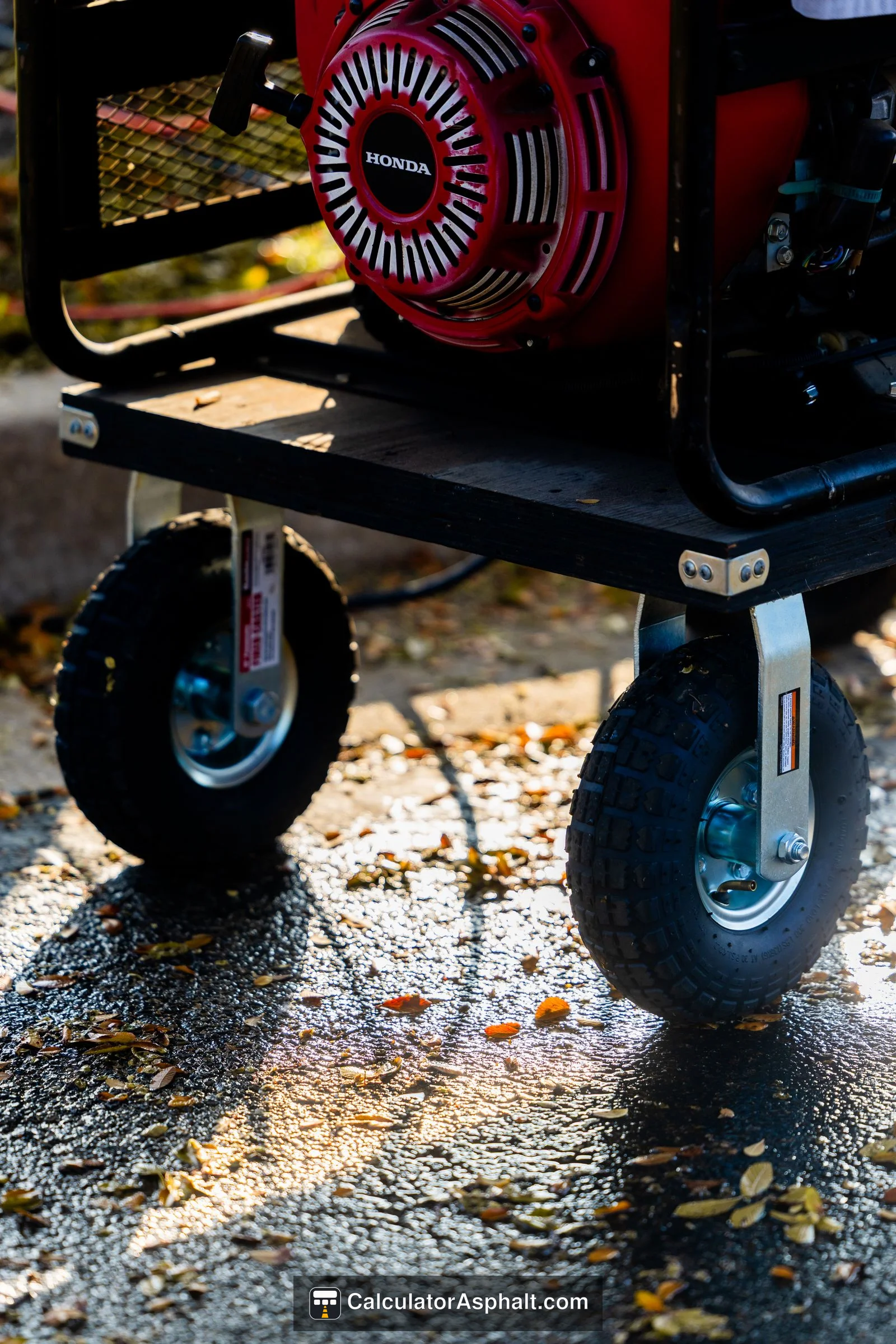
A portable generator is the right choice when outages are short and the loads are few: it costs less, it stores in the garage, and it runs on petrol from a can. A portable unit sized at 5,000 watts covers a fridge, a freezer, lights, and chargers with room for one motor starting — which is the worked example below.
A standby generator is the right choice when outages are long or frequent, or when the loads include a well pump, a sump pump, and heating: it starts itself, it runs on the gas line, and it carries the whole house. It costs far more to buy and install, and it needs a proper transfer switch and a gas supply sized for it.
The connection matters as much as the size. A generator must never feed the house through a backfed outlet, which energises the utility lines and can kill a line worker. Use a transfer switch, installed by a licensed electrician, or run extension cords directly to the appliances. The transfer switch is not optional equipment; it is the part that keeps the generator safe.
Worked example: fridge, freezer, well pump, lights and chargers

Take a house in a storm-prone area running a fridge, a freezer, a well pump, lights, and phone chargers on a portable generator. All wattages below are planning figures — check the appliance labels, because the numbers come from the appliances, not the generator.
Step 1: add up the running watts. Fridge 700, freezer 500, well pump 1,000, lights 300, chargers 50. The running total is 700 + 500 + 1,000 + 300 + 50 = 2,550 watts. That is the power the generator delivers steadily once everything is running.
Step 2: find the startup surges. The fridge starts at 2,100 watts, which is 2,100 − 700 = 1,400 watts above its running draw. The freezer starts at 1,500 watts, which is 1,500 − 500 = 1,000 watts above running. The well pump starts at 3,000 watts, which is 3,000 − 1,000 = 2,000 watts above running. The largest single surge is the well pump's 2,000 watts.
Step 3: size for the worst single start. Running total plus the largest surge is 2,550 + 2,000 = 4,550 watts. A generator must deliver at least 4,550 watts for a few seconds when the pump starts while everything else runs. A 3,500-watt generator cannot do it — the pump start pushes the demand 1,050 watts past its capacity, and it stalls or trips.
Step 4: check the pair that starts together. If the fridge and the pump can start in the same few seconds, the peak is 2,550 + 1,400 + 2,000 = 5,950 watts. A 5,000-watt generator covers the single-start case with 450 watts to spare, but not the double start. The practical fix is to stagger the starts: let the pump finish starting before the fridge cycles, or switch the freezer off for a minute while the pump starts.
Step 5: check the runtime. A 5,000-watt generator running at about half load — 2,550 watts is 51 percent of 5,000 — burns about 0.5 gallons of petrol an hour, as an example figure to check in the generator manual. A 5-gallon tank therefore lasts 5 ÷ 0.5 = 10 hours. An outage longer than 10 hours needs a refuel, and a refuel needs petrol stored safely and the generator cooled before filling.
Step 6: compare the options. A 3,500-watt unit is too small for this house, because the pump start alone exceeds it. A 5,000-watt unit covers the house with staggered starts. A 7,500-watt unit covers even the double start, at 5,950 watts, with 1,550 watts to spare — but it burns more fuel per hour and costs more to buy. Size is a choice between the loads you will run and the fuel you will burn.
Decision table: generator sizes for the worked example
| Generator | Running capacity | Worst single start, 4,550 W | Double start, 5,950 W | Runtime on 5 gallons |
|---|---|---|---|---|
| 3,500 watts | 3,500 W | Fails by 1,050 W | Fails | Check the manual at your load |
| 5,000 watts | 5,000 W | Covers, 450 W spare | Fails by 950 W | About 10 hours |
| 5,000 watts, staggered starts | 5,000 W | Covers, 450 W spare | Avoided by staggering | About 10 hours |
| 7,500 watts | 7,500 W | Covers, 2,950 W spare | Covers, 1,550 W spare | Check the manual at your load |
| 10,000 watts | 10,000 W | Covers easily | Covers easily | Check the manual at your load |
The table shows the same lesson three ways: running watts understate the need, the biggest surge decides the size, and a bigger generator buys margin at the cost of fuel.
Where generator sizing goes wrong
Sizing on running watts alone. The running total in the example is 2,550 watts, which a 3,500-watt generator covers easily — until the well pump starts and the demand jumps to 4,550. Running watts describe the steady state; startup watts describe the moment that actually trips the generator.
Adding every startup surge at once. Adding all three surges gives 2,550 + 1,400 + 1,000 + 2,000 = 6,950 watts, which oversizes the generator and burns extra fuel for a scenario that almost never happens. Add the largest single surge, and add a second only if the two motors can genuinely start together.
Forgetting the well pump. The pump is the largest load in many houses and the one most often left off the list, because it is out of sight in the basement or the yard. It is also the largest startup surge in the example — 2,000 watts — which makes it the load that decides the generator size.
Backfeeding the house. Plugging a generator into a wall outlet to feed the house energises the utility lines outside, which can kill a line worker restoring power. The generator must connect through a transfer switch or by extension cords direct to the appliances, never through a backfed outlet.
Field checklist: before you buy a generator
- Every load listed: fridge, freezer, pump, heating, lights, chargers
- Running watts noted from each appliance label
- Startup watts noted from each motor label, or three times running watts as a planning figure
- Running total added up in watts
- Largest single startup surge identified and added to the running total
- Double-start case checked for the two largest motors
- Generator size chosen above the worst case, with margin
- Transfer switch planned, installed by a licensed electrician
- Fuel stored safely, with a refuel plan for outages longer than the tank
Mistakes that stall a generator
The most expensive mistake is buying a generator sized on running watts and discovering it stalls the first time the fridge or the pump starts, because the startup surge is the number that matters and it is two to three times the running draw. The second is adding every surge at once and buying a generator far larger than the house needs, which burns extra fuel every hour it runs. The third is leaving the well pump off the list, which hides the largest surge in the house. The fourth is backfeeding through a wall outlet, which is not a sizing mistake but a safety one, and it is the mistake that can kill someone outside the house. Every one is fixed by listing the loads, reading the labels, and adding the biggest surge before buying anything.
Frequently asked questions
How do I find an appliance's startup watts?
Check the appliance label or manual for the starting current in amps, then multiply by the voltage: a fridge drawing 17.5 amps at 120 volts on startup is 17.5 × 120 = 2,100 watts. If the label gives only running watts, use three times running watts as a planning figure for motors, and verify against the label before buying.
Can I run the whole house on a portable generator?
Only the loads you choose. A 5,000-watt portable covers the fridge, freezer, lights, and chargers in the worked example, with the pump starting one at a time. A whole house with electric heating, an electric water heater, and air conditioning needs a standby unit sized for the full load, which is a different purchase.
Why does the generator stall only sometimes?
Because motors start at different times. The generator handles the steady 2,550 watts easily; it stalls when a motor starts and the demand jumps past its capacity for a few seconds. If the fridge and the pump happen to start together, the demand reaches 5,950 watts, which a 5,000-watt unit cannot deliver — so the same generator works on one outage and stalls on the next.
How long will a tank of petrol last?
It depends on the load. At about half load, the example 5,000-watt unit burns about 0.5 gallons an hour, so a 5-gallon tank lasts about 10 hours. At full load it burns roughly twice as much, and the tank lasts about 5 hours. Check the burn rate in the generator manual at your actual load, and store enough fuel for the longest outage you expect.