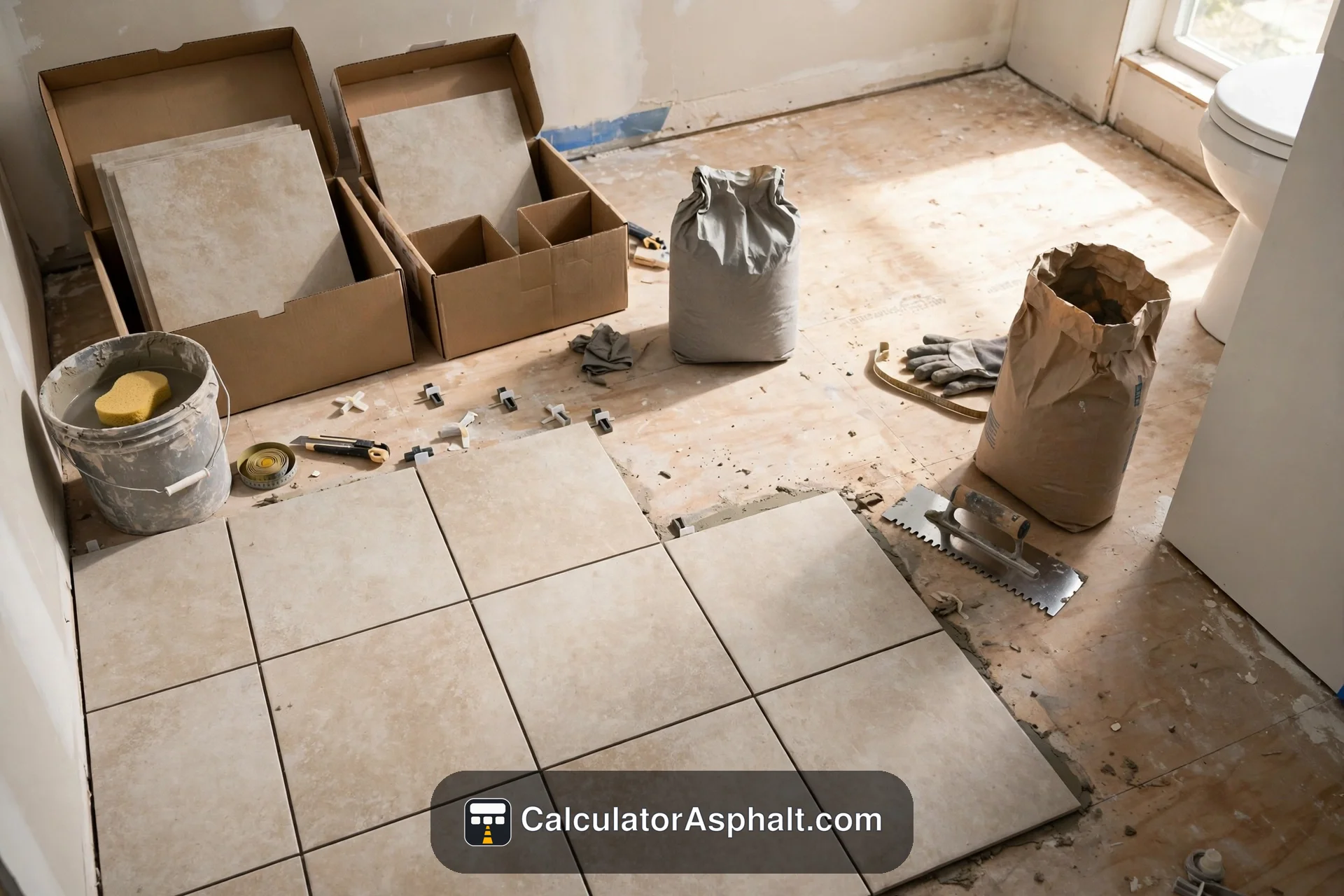
Tile is the least forgiving material in a renovation to under-order. Paint can be matched at the store. Lumber can be bought by the board. Tile comes in dye lots, and a box from a different lot can be visibly different — a shade lighter, a tone warmer — even when the box says the same color and size. Run out with one row left and the fix is either a mismatched floor or a second order that may not match at all.
The second trap is that tile is three orders, not one. The tiles, the grout, and the thinset mortar are counted three different ways, sold in three different packages, and they run out at three different times. This article counts all three for one bathroom floor, shows the arithmetic, and explains why the waste allowance is different for each one.
The decision first: count tile, grout, and mortar separately
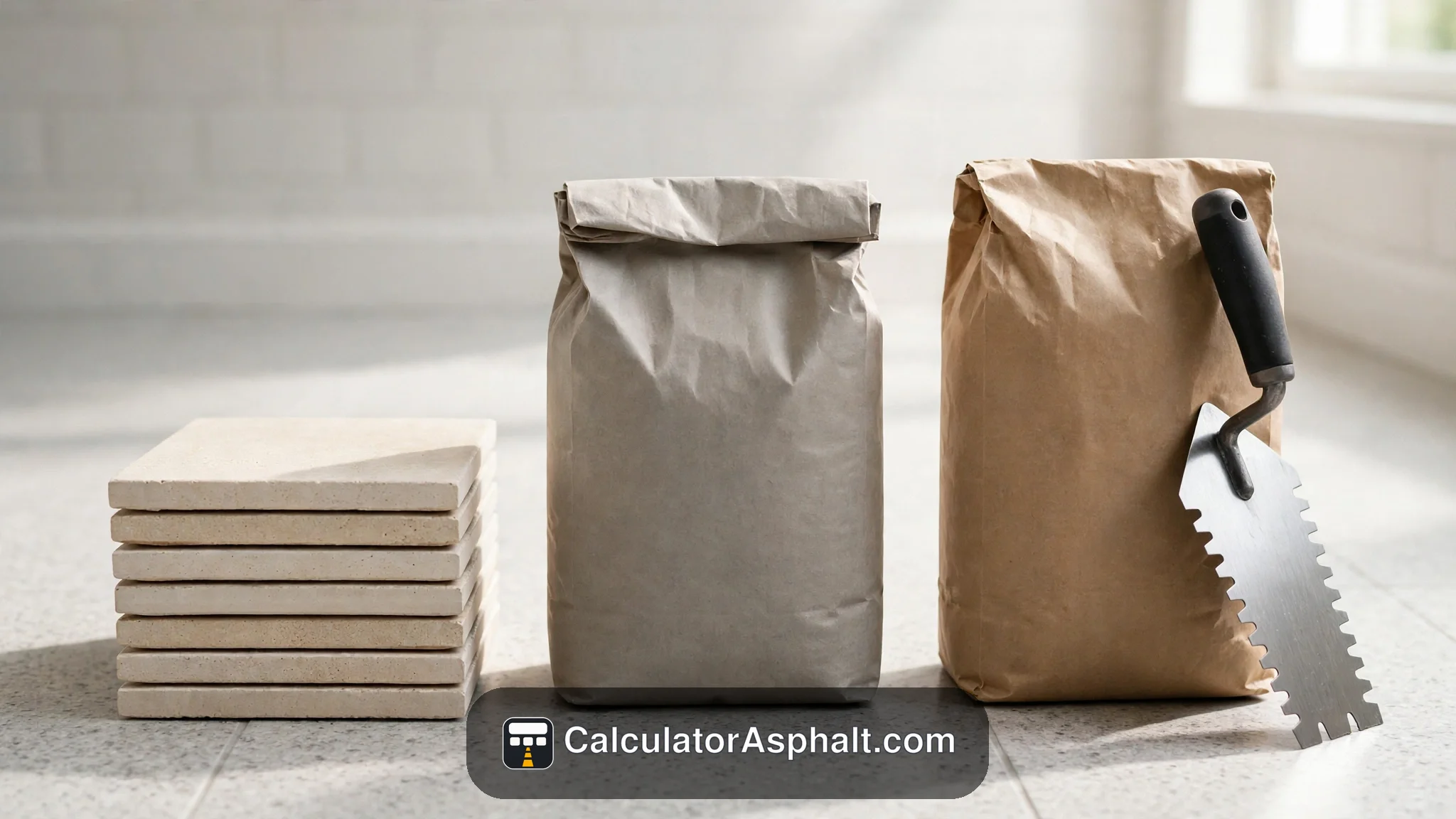
Beginners usually count the tile and forget the rest, then discover at the store that grout is sold by the bag and thinset by coverage, not by the box. Decide the three numbers before you shop:
- Tiles. Area divided by tile size, plus a waste allowance, rounded up to whole boxes.
- Grout. Area divided by the grout coverage for your tile size and joint width, rounded up to whole bags.
- Thinset mortar. Area divided by the mortar coverage for your trowel size, rounded up to whole bags.
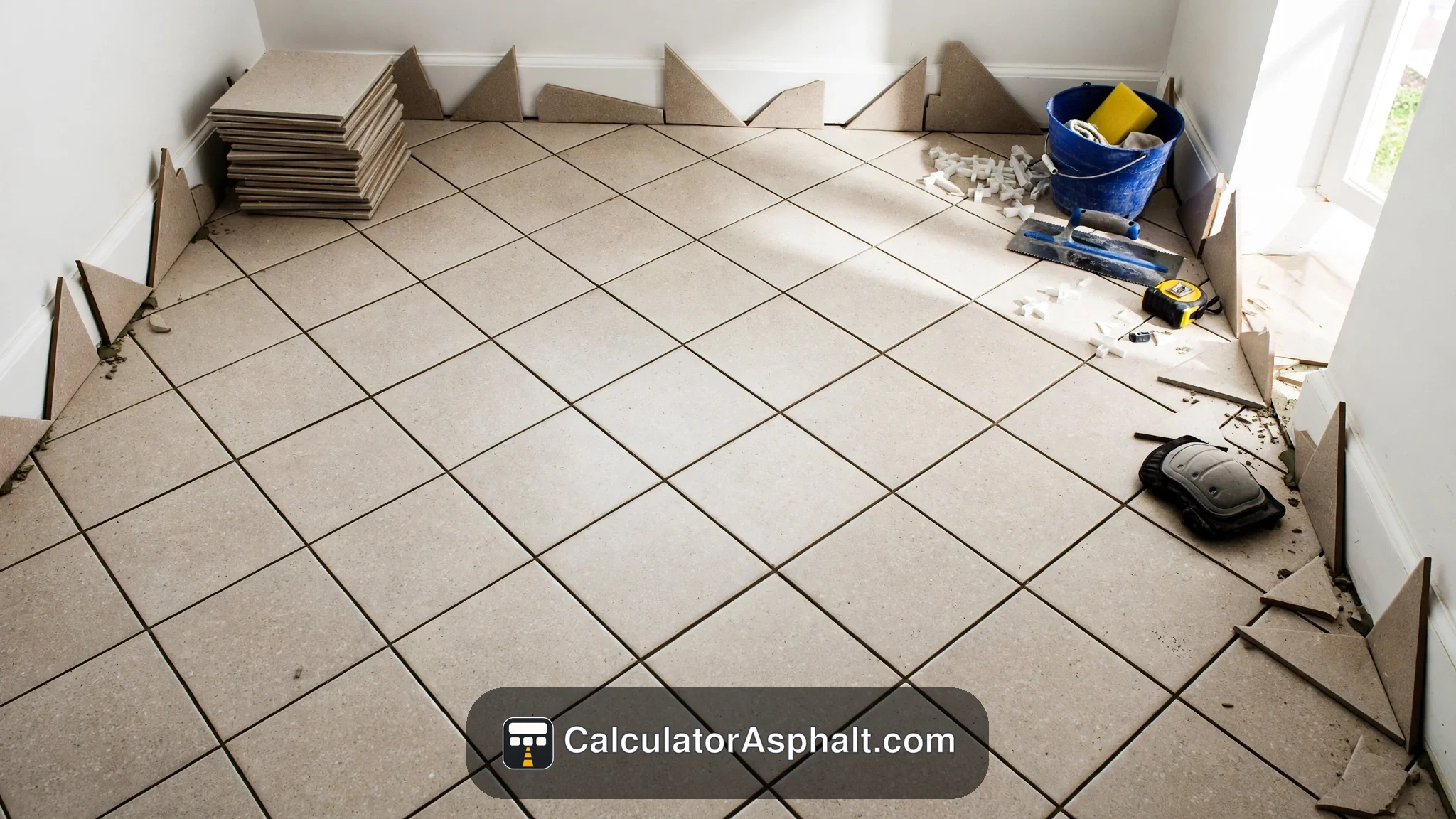
The waste allowance matters most. Ten percent is standard for a straight layout on a rectangular floor, fifteen percent for a diagonal layout or a room with many corners, twenty percent for a first-timer on a diagonal layout. It is the tiles that get cut, chipped, or laid wrong.
What to measure
You need five numbers from the room and three from the products:
- Floor length and width. Measure in feet and inches, wall to wall, at the longest and widest points. Bathrooms are rarely square; measure twice.
- Tile size. The nominal size on the box, for example 12 by 12 inches. Note that the actual size is often slightly smaller — a "12-inch" tile is commonly 11 and 7/8 inches — which matters for the layout but not much for the count.
- Joint width. The gap between tiles, usually 1/8 inch or 3/16 inch for floor tile. Wider joints use more grout.
- Trowel size. The notch size on the trowel you will use, for example 1/4 inch by 3/8 inch. Larger tiles need larger notches, and larger notches use more thinset.
- Package sizes. How many tiles per box, how many pounds per bag of grout, and how many pounds per bag of thinset. These are printed on the packaging and they decide the rounding.
Also note the layout before counting. A straight grid, a brick pattern, and a diagonal layout all use the same number of tiles in theory, but the diagonal layout wastes far more in cuts at the edges. Decide the layout first — The Sliver Cut Along the Wall Gives You Away: Plan Your Tile Layout Before You Mix Mortar covers how — then apply the matching waste allowance.
Worked example: an 8-by-6-foot bathroom floor
Take a bathroom floor 8 feet long and 6 feet wide, with a straight grid layout of 12-by-12-inch tiles, 1/8-inch joints, and a 1/4-inch square-notch trowel. The tile comes 10 to a box. The grout is a 25-pound bag, and the thinset is a 50-pound bag.
Step 1: floor area. 8 × 6 = 48 square feet.
Step 2: tiles before waste. Each 12-by-12-inch tile covers 1 square foot. 48 ÷ 1 = 48 tiles.
Step 3: add waste. A straight layout on a rectangular floor takes a 10 percent allowance. 48 × 1.10 = 52.8 tiles. Round up to 53 tiles.
Step 4: round up to boxes. Boxes hold 10 tiles. 53 ÷ 10 = 5.3 boxes. Round up to 6 boxes, or 60 tiles. The 7 spare tiles are not waste. They are the attic stock that saves the floor when a tile cracks in two years and the store no longer carries that dye lot.
Step 5: grout. This example assumes a 25-pound bag of grout covers 100 square feet for 12-inch tile with 1/8-inch joints. That is a planning assumption; the bag's own label gives the coverage for your tile size and joint width, and it changes with both. 48 ÷ 100 = 0.48 bag. Round up to 1 bag.
Step 6: thinset. This example assumes a 50-pound bag of thinset covers 40 square feet when applied with the trowel size this job needs. Again, that is a planning assumption from the trowel and tile size, and the bag label is the authority. 48 ÷ 40 = 1.2 bags. Round up to 2 bags. Thinset is the material most often under-bought, because beginners spread it too thick on the first rows and run out with a quarter of the floor left. Two bags is the right call for a first-timer on this floor.
Total for the floor: 6 boxes of tile (60 tiles), 1 bag of grout, 2 bags of thinset. The three numbers are independent. Buying six boxes of tile does not tell you anything about the grout, and the grout bag does not cover the thinset.
Change one fact and watch the answer change. Lay the same tile on the diagonal and the waste allowance rises to 15 percent: 48 × 1.15 = 55.2 tiles, or 56 tiles, which is still 6 boxes — but with only 4 spare tiles instead of 7. Use 24-by-24-inch tile instead: 48 ÷ 4 = 12 tiles, plus 10 percent is 13.2, or 14 tiles — 4 boxes at 4 per box. The arithmetic is the same every time; only the inputs change.
Decision table: waste allowance by layout
| Layout | Waste allowance | Tiles for 48 sq ft (12 in tile) | Boxes (10 per box) | When to use it |
|---|---|---|---|---|
| Straight grid, rectangular room | 10% | 53 | 6 | The default for a first floor |
| Straight grid, many corners or niches | 15% | 56 | 6 | L-shaped rooms, built-in tubs, many cuts |
| Brick pattern, rectangular room | 10% | 53 | 6 | Same as straight grid; half tiles at the ends |
| Diagonal, rectangular room | 15% | 56 | 6 | Diagonal looks bigger but cuts every edge tile |
| Diagonal, first-timer or irregular room | 20% | 58 | 6 | The safe allowance when cuts are uncertain |
| Herringbone | 15–20% | 56–58 | 6 | Every tile is cut at the perimeter |
The box count stays at six across this table, but do not trust that on a larger floor, where the difference between 10 and 20 percent is a whole box or two. Always work the numbers for your floor.
Grout: the count everyone gets wrong
Grout coverage depends on three things at once: tile size, joint width, and joint depth. Small tiles have more joints per square foot, so they use more grout. Wide joints use more grout. Deep joints use more grout. That is why the bag label prints a table instead of a single number, and why a planning figure for 12-inch tile tells you nothing about a mosaic floor.
For this example, the planning figure was 100 square feet per 25-pound bag. If the same floor used 6-by-6-inch tile instead, the joints would double in number and the coverage would fall to roughly 50 square feet per bag, needing a full bag for 48 square feet — still 1 bag, but with nothing to spare. If the joints were 1/4 inch instead of 1/8 inch, the coverage would fall further and the job would need 2 bags. Check the label's table for your tile size and joint width, and do not reuse a grout count from a different tile.
Buy grout in one batch: color can vary between batches, and a floor grouted from two bags mixed on different days can show a faint line where they meet.
Thinset: coverage is a trowel decision
Thinset coverage is decided by the trowel, and the trowel is decided by the tile. A 12-inch tile on a floor usually takes a 1/4-inch by 3/8-inch notched trowel. A 24-inch tile needs a larger notch, often 1/2-inch by 1/2-inch, and uses roughly twice as much thinset per square foot. A mosaic or small tile takes a smaller notch and uses less.
The planning figure here — 40 square feet per 50-pound bag — assumes this job's trowel. A larger tile and trowel can cut coverage to 25 square feet per bag, when the same floor would need 48 ÷ 25 = 1.92 bags, or 2. On a 100-square-foot floor the difference is 3 bags versus 4. Read the bag for coverage at your trowel size, and buy the extra bag.
Field checklist: before you order
- Floor measured wall to wall at the longest and widest points
- Tile size, joint width, and layout decided before counting
- Waste allowance chosen for the layout and the room shape
- Tile count rounded up to whole boxes, with attic stock noted
- Grout coverage read from the bag label for your tile size and joint width
- Thinset coverage read from the bag label for your trowel size
- All tile boxes checked for the same dye lot number before leaving the store
- One spare box kept unopened for future repairs
Mistakes that stop the job halfway
Ordering the exact tile count with no waste. A floor with no waste allowance stops at the last row. The allowance is not optional, and ten percent is the minimum for a straight layout.
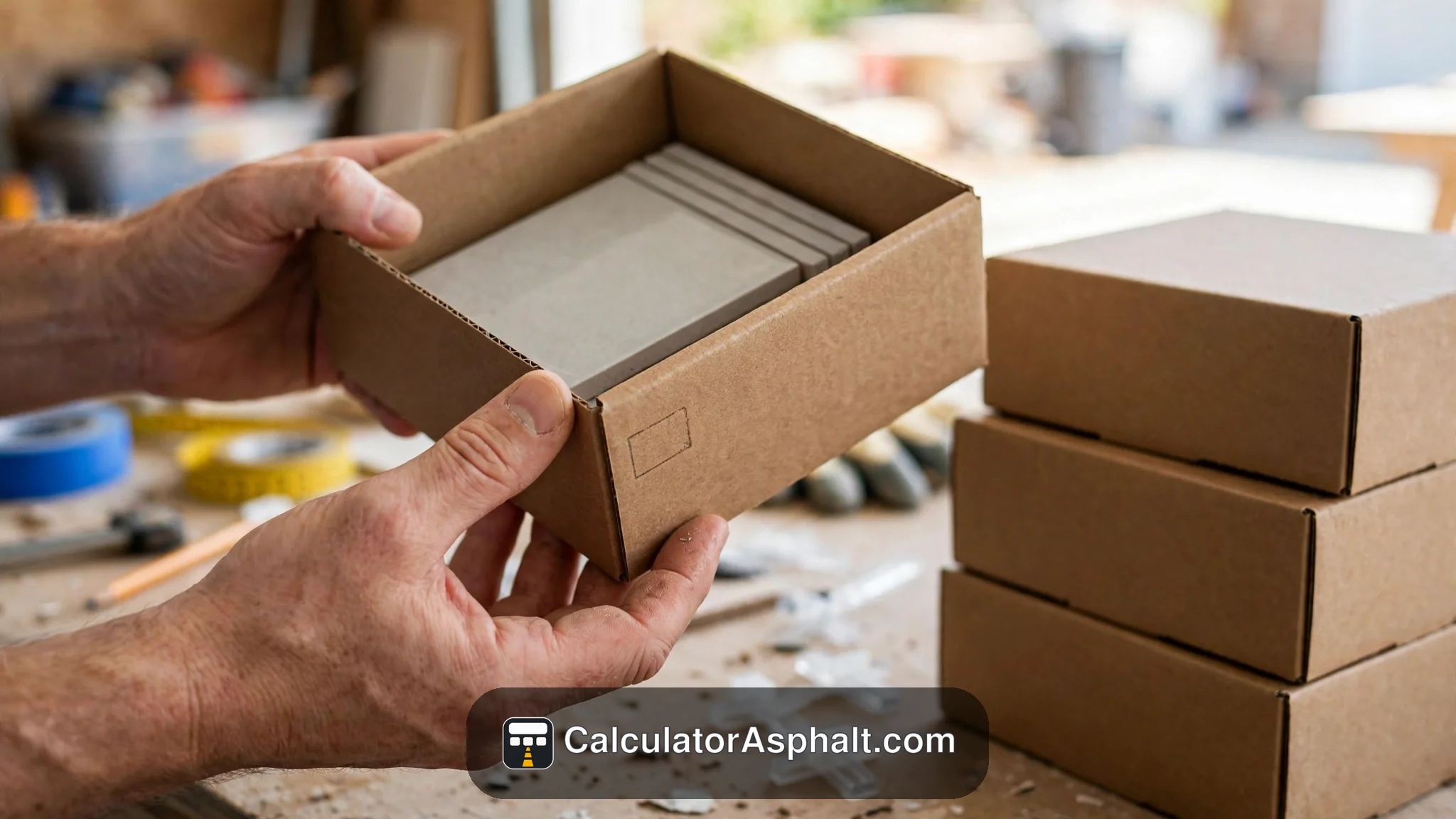
Mixing dye lots. Check the lot number printed on every box before you leave the store. Two boxes with different lot numbers can look identical in the store and different on the floor. Exchange a mismatched box at the store, not after it is laid.
Counting grout from the tile count. Grout is counted from area, tile size, and joint width, not from the number of tiles.
Spreading thinset too thick. A thick bed does not fix an uneven floor, and it eats the thinset budget in the first rows. Level the floor first; thinset is an adhesive, not a leveling compound.
Forgetting the transition. The tile floor has to meet the hallway floor at the doorway, so buy a reducer strip or threshold with the tile and measure the height difference first.
Frequently asked questions
How many tiles do I need for a wall, not a floor?
The same method, with one change: wall tile is often smaller, so the joint count is higher and the grout need rises. Measure the wall area, subtract openings, divide by tile size, add the waste allowance, and round up to boxes.
Can I return unopened boxes of tile?
Most suppliers accept returns of unopened boxes, which is why rounding up to whole boxes is safe. Keep the receipt, keep the boxes dry, and do not open the last box until the floor is laid and you know it is needed. An unopened box in the attic is also your repair stock.
What if my room is not a rectangle?
Divide the floor into rectangles, count each one separately, and add the results. An L-shaped bathroom is two rectangles. A room with a curved shower is a rectangle plus a measured curve, counted generously. Irregular rooms take the 15 percent waste allowance, not the 10 percent one, because every odd corner produces a cut.
How much extra tile should I keep for repairs?
Keep at least one full box, or about five percent of the floor, in the same dye lot. Store the spare tiles flat, dry, and labeled with the room and the dye lot number.
Save this project on Pinterest
Never Guess Tile Quantities and Regret It
Count Tiles, Grout and Mortar in Minutes