Wallpaper is the only wall covering where the math punishes you for the pattern you picked. Paint is counted in square feet. Wallpaper is counted in drops — one vertical strip from ceiling to floor — and every drop has to start at the right place in the pattern. When the pattern is large, the top of each drop wastes a piece of the roll just to line the design up. Order by square feet and you will be a roll short with one strip of wall left bare, and a matching roll from a different dye lot may not match at all.
The fix is to count drops first and rolls second. Measure the wall, divide by the roll width to get the number of drops, work out how many drops each roll gives you after the pattern repeat, and only then count rolls. This article works through one feature wall in full, shows where the waste hides, and explains the choices that save a roll.
The decision first: drops, not square feet
A roll of wallpaper is a fixed length of a fixed width. A common US double roll is 21 inches wide and 33 feet long. Those two numbers decide everything. The width decides how many drops the wall needs. The length, cut down by the pattern repeat, decides how many drops one roll yields.
The pattern repeat is the vertical distance after which the design starts over — often printed on the roll as the repeat, for example 24 inches. Every drop must be cut to a length that is a whole number of repeats, so the pattern lines up with the drop beside it. If your wall is eight feet high and the repeat is 24 inches, a drop cannot be eight feet long. It must be ten feet long, because eight feet plus trimming is not a whole number of two-foot repeats, and the next whole number above it is ten feet. Two feet of every drop is waste, and it comes straight out of the roll.
So the decision before ordering is: how many drops, and how long is each drop after the repeat. Everything else follows.
What to measure
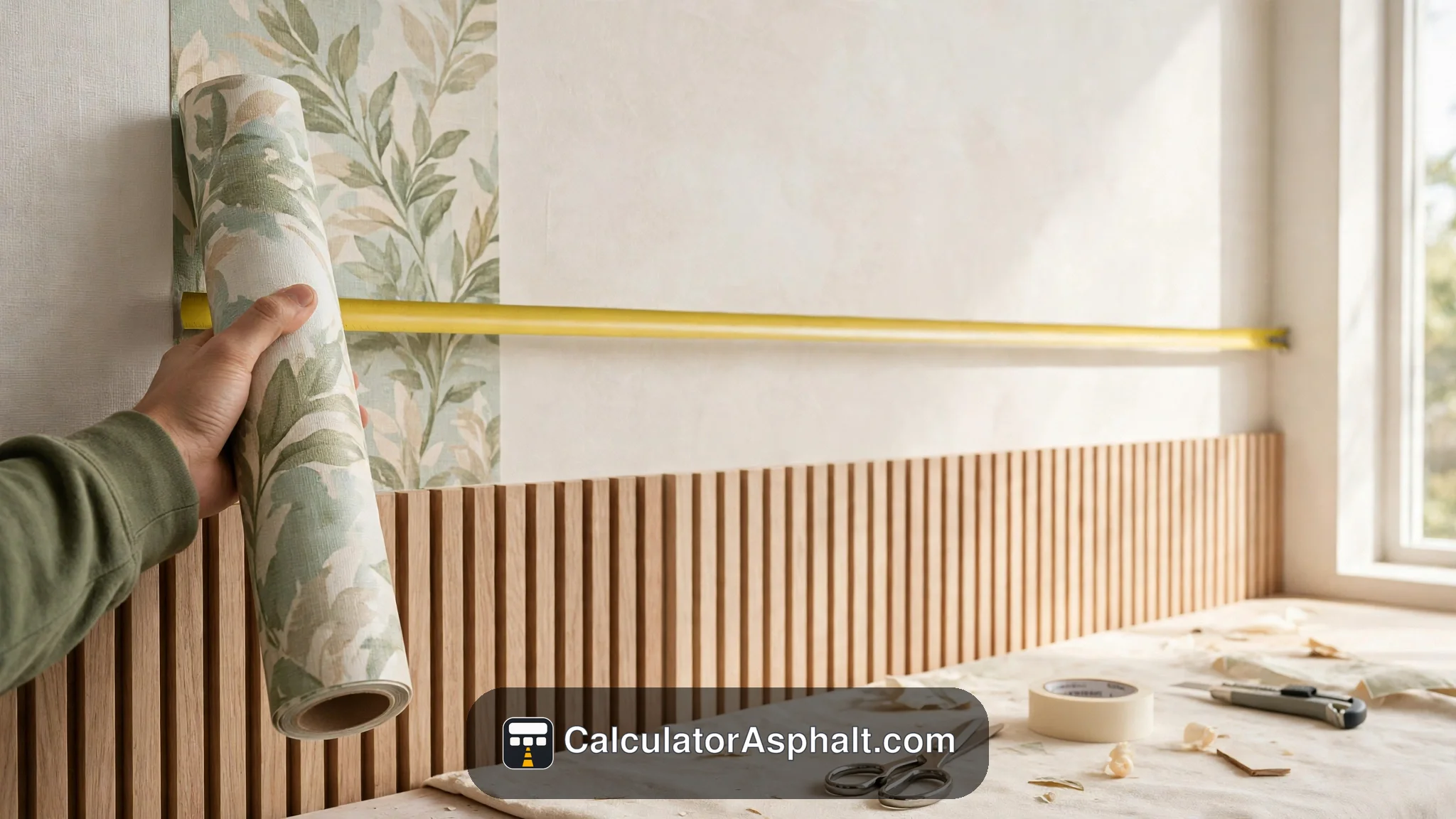
You need four numbers from the room and three from the roll:
- Wall width. Measure the feature wall from corner to corner in inches.
- Wall height. Measure floor to ceiling in inches, then add four inches for trimming top and bottom. Wallpaper is cut long and trimmed in place; the extra four inches is not waste, it is working room.
- Openings. Note any door, window, or outlet on the wall. A drop that falls over a door is still a drop — it is cut around the opening, not skipped — but a large opening can sometimes be covered by the offcut from another drop. Count the drops first, then see whether offcuts cover the narrow pieces beside an opening.
- Roll width, roll length, and pattern repeat. All three are printed on the roll or the product page. Do not guess them. A 21-inch roll and a 27-inch roll give different drop counts on the same wall, and a 12-inch repeat wastes half as much as a 24-inch repeat.
Worked example: a 12-foot feature wall
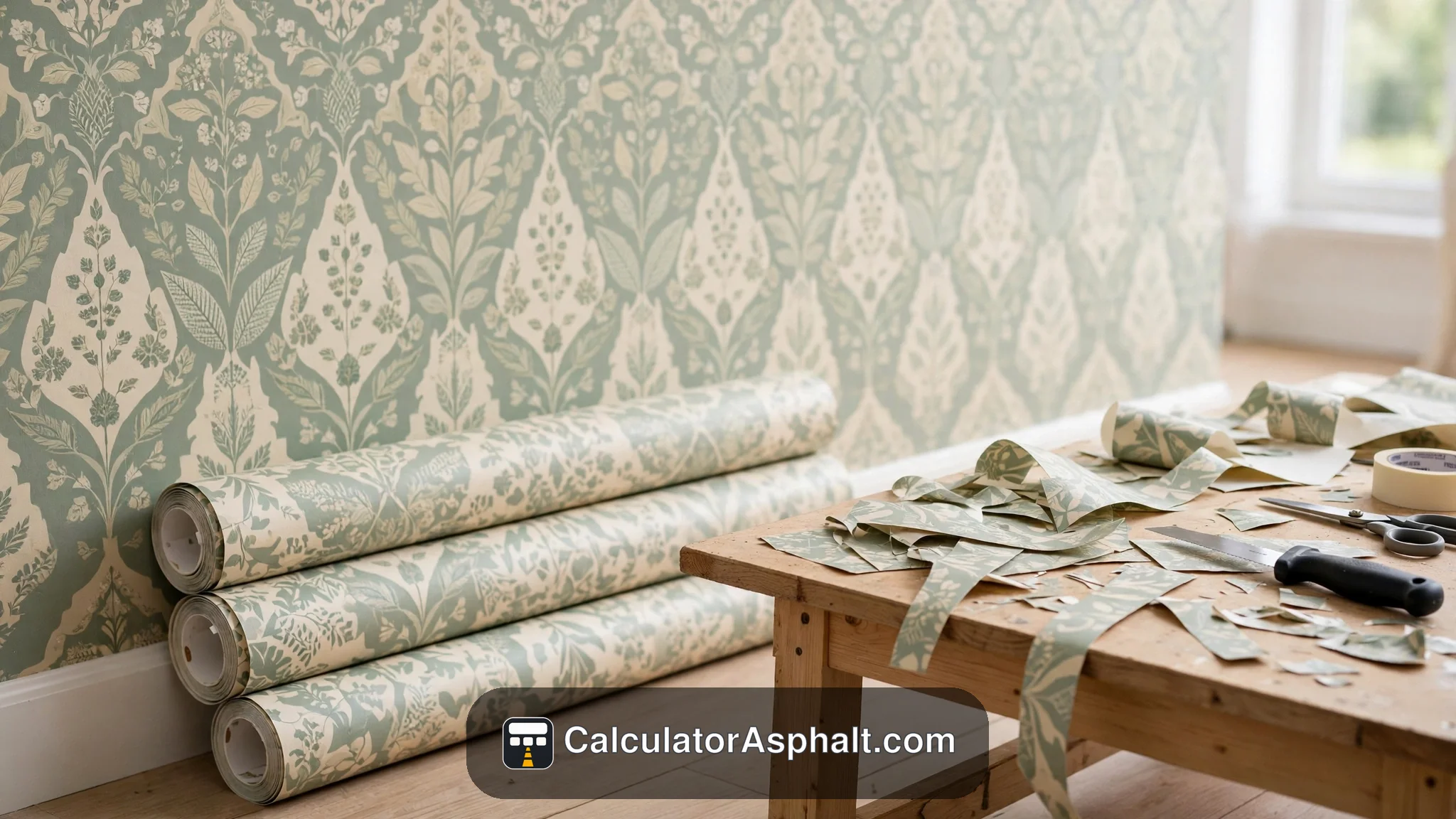
Take a feature wall 12 feet wide and 8 feet high, with no doors or windows on it. The paper is a double roll 21 inches wide and 33 feet long, with a pattern repeat of 24 inches. The renter wants the pattern to line up across the whole wall.
Step 1: number of drops. The wall is 12 feet, which is 144 inches. Divide by the roll width: 144 ÷ 21 = 6.86 drops. Round up — a partial drop is still a drop — to 7 drops.
Step 2: drop length before the repeat. The wall is 8 feet high. Add 4 inches for trimming: 8 feet 4 inches, or 100 inches. In feet, that is 8.33 feet.
Step 3: drop length after the repeat. The repeat is 24 inches, or 2 feet. The drop must be a whole number of repeats, and it must be at least 8.33 feet. Multiples of 2 feet are 2, 4, 6, 8, 10. The first multiple above 8.33 is 10 feet. Each drop is therefore cut 10 feet long, and 10 − 8.33 = 1.67 feet of each drop is pattern-matching waste.
Step 4: drops per roll. The roll is 33 feet long. Divide by the cut length: 33 ÷ 10 = 3.3 drops. Round down — a third of a drop is useless — to 3 drops per roll. Three drops use 30 feet, leaving 3 feet of the roll unused.
Step 5: rolls to buy. The wall needs 7 drops. Each roll gives 3 drops. 7 ÷ 3 = 2.33 rolls. Round up to 3 rolls.
Total: 3 rolls. The wall itself is 96 square feet, and three double rolls cover far more than that on paper. The repeat is what eats the difference: 7 drops at 10 feet each is 70 feet of paper for a wall that is only 56 feet of drops at its true height. Nearly a quarter of the paper bought is pattern waste, and that is normal for a 24-inch repeat.
Change one fact and watch the answer change. With a small 6-inch repeat, the drop length rounds up from 8.33 feet to the next multiple of 0.5 feet, which is 8.5 feet. Drops per roll become 33 ÷ 8.5 = 3.88, or 3 drops, and the roll count stays at 3 — but the waste per drop falls from 1.67 feet to 0.17 feet, leaving far more spare paper for mistakes. With a 12-inch repeat, the drop length is 9 feet, drops per roll are 33 ÷ 9 = 3.67, still 3 drops, still 3 rolls. The roll count is stubborn in this example, but the margin for error is not: the 24-inch repeat leaves almost no spare paper, so one bad cut means a fourth roll.
Decision table: how the repeat changes the order
| Pattern repeat | Drop cut length (8 ft wall + trim) | Drops per 33 ft roll | Drops needed (12 ft wall) | Rolls to buy |
|---|---|---|---|---|
| No pattern (plain or random match) | 8.5 ft | 3 | 7 | 3 |
| 6 inches | 8.5 ft | 3 | 7 | 3 |
| 12 inches | 9 ft | 3 | 7 | 3 |
| 18 inches | 9 ft | 3 | 7 | 3 |
| 24 inches | 10 ft | 3 | 7 | 3 |
| 36 inches | 12 ft | 2 | 7 | 4 |
The table shows the real lesson. Up to a 24-inch repeat, the roll count holds at three because the rounding absorbs the waste. At a 36-inch repeat, the drop jumps to 12 feet, the roll gives only two drops, and the order jumps to four rolls. A large repeat does not just waste paper. It can add a whole roll to the bill, and it is the first thing to check when comparing two papers that look the same price per roll.
Straight match, drop match, and random match
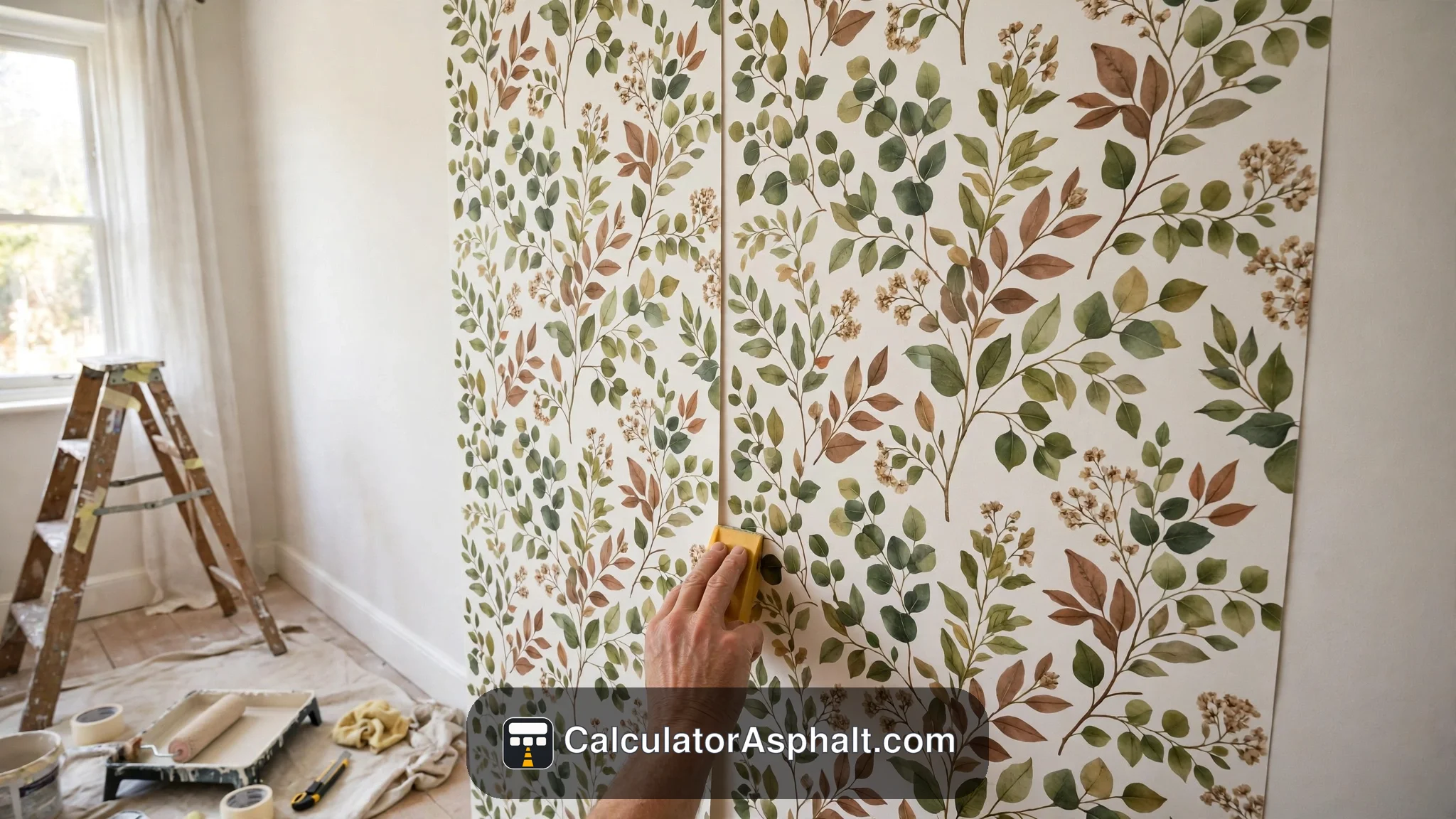
Not all patterns waste the same amount, even at the same repeat. The match type is printed on the roll alongside the repeat, and it decides how the drops line up:
Random match. There is no pattern to align. Every drop can start anywhere on the roll. Waste is limited to the trimming allowance, and the roll gives the most drops. Plain papers, textures, and small random prints are usually random match.
Straight match. The pattern lines up at the same height on every drop. Each drop is cut to a whole number of repeats, as in the worked example. Waste is one repeat at most per drop.
Drop match. The pattern on the next drop is offset by half a repeat, so alternate drops start at different points. The cut length is the same as a straight match, but the drops alternate between two starting positions, which can waste up to half a repeat extra on every second drop. A drop-match paper with a 24-inch repeat can waste more than a straight-match paper with the same repeat, and the roll count should be checked with that in mind.
Where the count goes wrong
Measuring in square feet. A roll's square footage is its width times its length, but drops cannot be reassembled from area. Seven drops of 21-inch paper need 147 inches of width. Square feet are the wrong unit for this job.
Forgetting the trim allowance. Cutting drops exactly to wall height leaves nothing to trim at the ceiling and the baseboard, and a drop cut a quarter inch short cannot be stretched. Always add the four inches before rounding up to the repeat.
Field checklist: before you order
- Wall width and height measured in inches, trim allowance added
- Roll width, roll length, pattern repeat, and match type read from the product page
- Drop count worked out from wall width divided by roll width, rounded up
- Drop length rounded up to a whole number of repeats
- Drops per roll worked out and rounded down
- Roll count worked out and rounded up, plus one spare roll from the same dye lot
- Openings on the wall noted, with narrow pieces planned from offcuts where possible
- Paste, tools, and removal method confirmed for a rental if the paper is not peel-and-stick
Mistakes that leave a wall half papered
The most expensive mistake is ordering by the square footage on the product page and discovering mid-wall that the repeat has eaten a roll. The second is cutting all the drops at once before hanging the first one, then finding the pattern drifts because the first drop was hung a quarter inch off level. Cut two drops, hang them, check the match, then cut the rest. The third is hanging the last drop and finding the final strip is two inches wide because the wall was measured in feet and the roll width was never converted to inches. The fourth is throwing away the offcuts, which are exactly the pieces that cover the narrow strips beside a door frame or above a window. Keep every offcut until the wall is finished.
Frequently asked questions
How many rolls do I need for a whole room, not one wall?
Count each wall separately, because each wall has its own width and drop count and the pattern must match around corners. Add the drops for all walls, divide by drops per roll, and round up. Four 12-foot walls need 28 drops; at 3 per roll that is 10 rolls, plus a spare.
Does a small repeat always save money?
It saves paper, but not always money, because small-repeat papers are often priced differently per roll. Compare the total order cost, not the price per roll. A cheaper roll with a 36-inch repeat can cost more in total than a pricier roll with a 6-inch repeat once the extra roll is counted.
Can I use the leftover from one roll to start the next wall?
Yes, if the leftover is at least one drop long and starts at the right place in the pattern. A leftover of 3 feet where 10-foot drops are needed is not a drop; save it only for narrow pieces.
What if my wall is not a whole number of drops?
It never is. The last drop is always cut to width, and that is normal. Plan the layout so the cut drops land in the least visible places — behind a door, in a corner, or at the end farthest from the entrance. A two-inch strip beside the door is far less visible than a two-inch strip in the middle of the feature wall.
Save this project on Pinterest
Don’t Order Wallpaper Without Matching Repeats
Count Drops First, Then Count Your Rolls