By Steve Axton, PE — Licensed Civil Engineer · Updated November 2026
Use the approved slab cross-section and measure only the added depth of a thickened band if its upper portion was counted in the main slab.
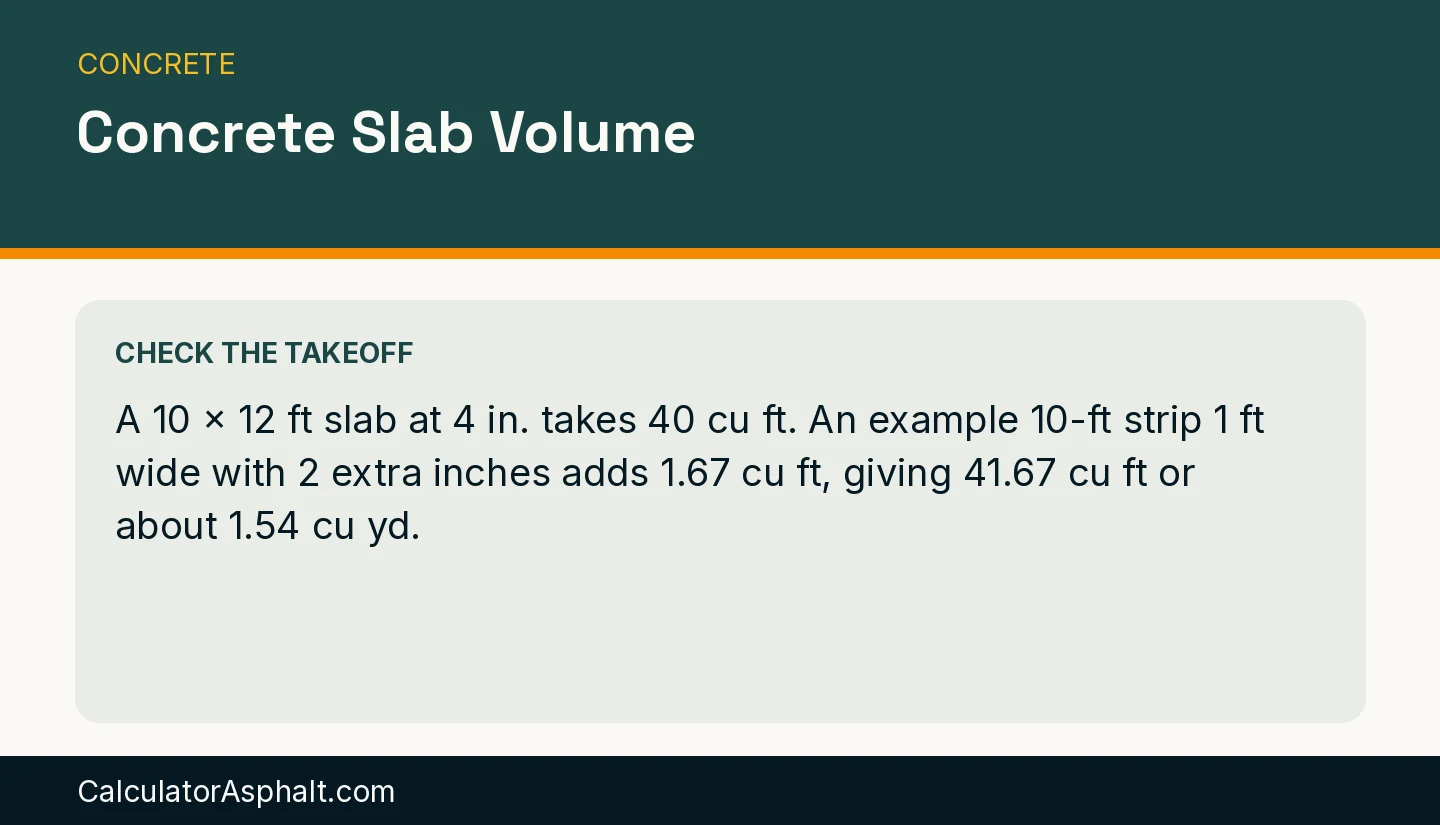
Illustrative result. A 10 × 12 ft slab at 4 in. takes 40 cu ft. An example 10-ft strip 1 ft wide with 2 extra inches adds 1.67 cu ft, giving 41.67 cu ft or about 1.54 cu yd.
Identify the geometry the form will actually enclose
Use the dimensions of the intended concrete element and group volumes by planned pour. Mark edges, changes in section and locations where components touch. Draw the boundary of each calculated block and mark shared faces. The sum should represent the intended physical volume once. A separately ordered product or change in mix must retain its own line even where the geometry is continuous.
Keep the inputs beside the Concrete Slab Volume calculator so its quantities can be checked against the original measurement. For an existing example of a clearly marked work scope, see concrete driveway vs asphalt driveway. Use its boundary or measurement practice only where the conditions match.
Preserve the unit basis through the purchase
Take volume into the quote in cubic feet or cubic yards as appropriate. Convert at the end if the drawing uses mixed units and retain the unrounded value. When a prepackaged product is specified, use the published mixed yield. When dispatch supplies a batch, check its ordering units and how the supplier handles quantities that fall between their increments.
Mark where corner strips meet and calculate common volumes once. Record depressions or steps from the actual detail before estimating the invoice.
Choose base units before multiplying. For a volume that combines dimensions in feet and depth in inches, divide the inches by 12 to express depth in feet. Convert a result in cubic feet to cubic yards by dividing by 27. For surface area, keep the original dimensions and do not include depth. Write the correct dimensional unit beside the subtotal so a later change does not turn a volume into an area estimate.
Record the shape you measured before changing any dimensions. For the next estimate, break irregular geometry into labeled parts and compute them separately. Compare the sum with an outside dimension or an independent check from the drawing. If the readings are too uncertain to justify a single quantity, keep the affected section provisional. That is usually more informative than adding precision to a number derived from the wrong boundary.
Estimate slab volume
If an edge strip wraps around a corner, divide the total into nonoverlapping runs. If the drawings give the slab volume inclusive of edge work, do not add the entire edge section again.
| Worksheet entry | What to record | When to revise |
|---|---|---|
| Measurement or scope | The measured limits and units | A drawing or field dimension changes |
| Product or rate | Exact model, coverage, quote or authority | The product, basis or conditions change |
| Calculated subtotal | Original result and any conversion | An input units check or independent reading changes |
| Order or reviewed amount | Selling increment or reviewed scope | Availability, review findings or inclusions change |
Worked example
- Identify the scope. Use the approved slab cross-section and measure only the added depth of a thickened band if its upper portion was counted in the main slab.
- Set the example inputs and calculate. A 10 × 12 ft slab at 4 in. takes 40 cu ft. An example 10-ft strip 1 ft wide with 2 extra inches adds 1.67 cu ft, giving 41.67 cu ft or about 1.54 cu yd.
- Check the result against the plan or quote. Mark where corner strips meet and calculate common volumes once. Record depressions or steps from the actual detail before estimating the invoice.
- Write down the basis for the next person. Ask the concrete supplier about mix identity, dispatch increments, delivery fees and how quantity adjustments are handled.
Compare scope before changing the quantity
An estimate can include a measured allowance, but the need must be tied to the formwork, expected tolerances and accepted placement plan. Do not reduce approved dimensions to fit a quote. Record whether access, delivery, pumping, finishing and cleanup are in the price. Ask the contractor to itemize scope that belongs in another bid rather than making it disappear in a single unit rate.
Use the how much concrete do i need and the concrete column quantity to keep connected quantities in view. A project can need each of those estimates without allowing their outputs to be summed. Identify the unit and purpose on every line.
For a separate quantity on the same project, see concrete footing takeoff. A built example in gravel patio with concrete pads shows why defining the finished area or work scope is more useful than estimating from a single outside dimension.
Work through the unit conversion once
Sketch the outline the calculation actually includes and keep a second column for the changes that will alter that outline. If two areas meet, assign the shared portion to one of them before summing. A change in representation should leave the quantity unchanged if both representations cover the same physical object.
Document a change before ordering
List what changed and which part of the estimate depends on it. A revised dimension may alter raw quantity with no effect on the number of purchasable packages. A changed product or quote basis can affect costs without changing the geometry. Write the old and new value on the same line and recompute every dependent quantity on that line. Leave independent items alone unless the revision changes their scope.
Use the specified slab thickness and details. Volume arithmetic does not choose reinforcement, base preparation or load capacity.
Where this work connects to existing or planned asphalt, record the paving scope separately using the asphalt paving guide. Keep the location and work boundary in the estimate so any interface changes can be reviewed before purchase or construction.
Run your project numbers. Run the project inputs in the calculator for concrete slab volume. To check a connected line item, use how much concrete do i need or concrete column quantity. Transfer the quantities and units back to the same plan or quote before comparing totals.
Frequently asked questions
What should I measure first?
Use the approved slab cross-section and measure only the added depth of a thickened band if its upper portion was counted in the main slab.
Should I round each measured section as I go?
Retain precise intermediate quantities for compatible sections. Sum them before rounding for the vendor. Keep materials, depths or treatments with a distinct specification on separate rows.
Which assumption deserves a second check?
Mark where corner strips meet and calculate common volumes once. Record depressions or steps from the actual detail before estimating the invoice.
What should I give the supplier or reviewer?
Ask the concrete supplier about mix identity, dispatch increments, delivery fees and how quantity adjustments are handled.
Calculation method reviewed November 2026. Use the CalculatorAsphalt worksheet and its stated inputs to reproduce the example.