By Steve Axton, PE — Licensed Civil Engineer · Updated November 2026
Board feet express volume on a specified dimensional basis. Confirm whether the seller quotes nominal, actual or rough dimensions before comparing prices.
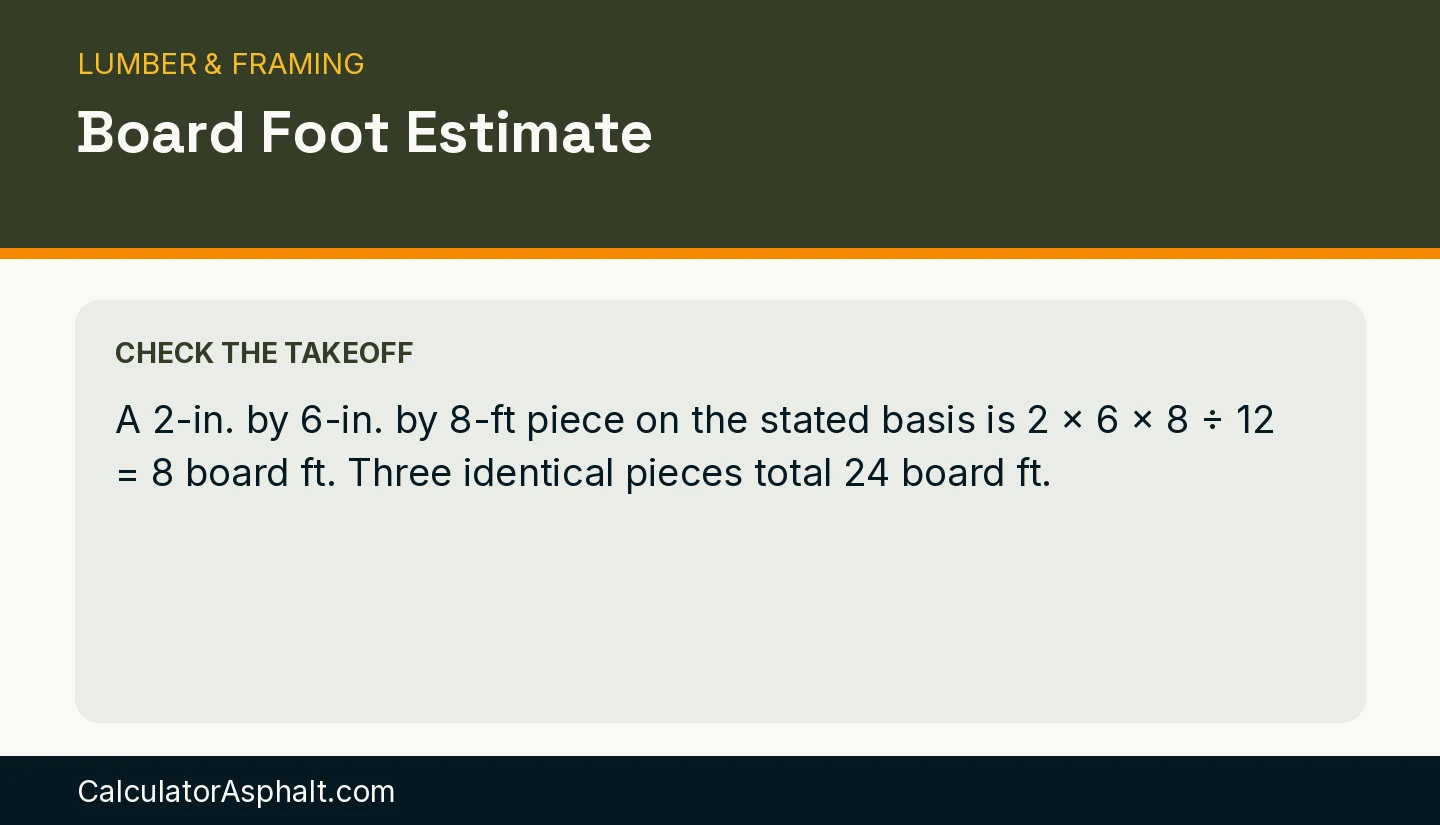
Illustrative result. A 2-in. by 6-in. by 8-ft piece on the stated basis is 2 × 6 × 8 ÷ 12 = 8 board ft. Three identical pieces total 24 board ft.
Use the layout references on the approved drawing
Carry the dimension references onto the worksheet before summing the cut list. Stock pieces of equal nominal size can differ in grade, finish, moisture condition or available length. Group entries only where the drawing and the supplier data identify them as the same material. Note where the count is from a geometric grid and where it comes from a separate assembly detail.
Keep the inputs beside the Board Foot Estimate calculator so its quantities can be checked against the original measurement. For an existing example of a clearly marked work scope, see deck to paver patio landing. Use its boundary or measurement practice only where the conditions match.
Distinguish pieces from equivalent length
An aggregate length may be adequate for a budget, but it cannot show whether the longer pieces can be cut from the order. List the longest uninterrupted pieces first, then match the shorter lengths to suitable stock. Keep intended stock ends, saw loss and unusable offcuts visible. Distinguish a shared boundary from two separately specified members before totaling pieces.
Use thickness and width in inches and length in feet in this version of the formula. Do not silently switch between surfaced and rough dimensions.
Identify whether the value describes a count, a rate, a measured dimension or a ratio. Preserve the units and work out which entries can be added. If the basis changes, apply the alternate conversion anew and compare the results on a common basis. For items sold in bundles or lengths, count the amount of the order the physical pieces can actually cover. Record any package or quote total independently of your calculation.
Put a sketch or item schedule next to the arithmetic. Make a mark at each reported location or use one line for each labeled product. Check which inputs are known from the exact items and which represent a proposed alternative. If the plan calls for separate orders, retain the individual pieces or products on their own lines until you have verified availability and compatibility.
Price the board feet
Itemize mixed dimensions before calculating an average price per board foot. A differently surfaced stock item can have the same nominal label but a different quoted billing basis.
| Worksheet entry | What to record | When to revise |
|---|---|---|
| Measurement or scope | The measured limits and units | A drawing or field dimension changes |
| Product or rate | Exact model, coverage, quote or authority | The product, basis or conditions change |
| Calculated subtotal | Original result and any conversion | An input units check or independent reading changes |
| Order or reviewed amount | Selling increment or reviewed scope | Availability, review findings or inclusions change |
Worked example
- Identify the scope. Board feet express volume on a specified dimensional basis. Confirm whether the seller quotes nominal, actual or rough dimensions before comparing prices.
- Set the example inputs and calculate. A 2-in. by 6-in. by 8-ft piece on the stated basis is 2 × 6 × 8 ÷ 12 = 8 board ft. Three identical pieces total 24 board ft.
- Check the result against the plan or quote. Use thickness and width in inches and length in feet in this version of the formula. Do not silently switch between surfaced and rough dimensions.
- Write down the basis for the next person. Ask which dimensions determine billing and which describe the delivered piece. For mixed boards, calculate each size separately.
Reconcile the list with the material schedule
Attach the relevant drawing revision to the order. Confirm that substitutions have been reviewed, especially where the selected material is identified by a performance or strength requirement. Record hangers, fasteners and other hardware separately if the approved schedule calls them out. Count the actual parts at changed details before assuming the original material list still applies.
Use the lumber takeoff and the plywood sheet estimate to keep connected quantities in view. A project can need each of those estimates without allowing their outputs to be summed. Identify the unit and purpose on every line.
For a separate quantity on the same project, see cost per square foot. A built example in interlocking patio deck tiles over concrete shows why defining the finished area or work scope is more useful than estimating from a single outside dimension.
Set the conversion or layout basis before comparing alternatives
Keep a column for the number of units physically required and a separate column for what arrives. Write package size and the remainder beside the order total. Before comparing a second product, make sure the package can satisfy the same input and use the second product's stated coverage or dimensions.
Review a recorded observation before revising everything
A real measurement may differ from a drawing, and an observation can apply to only the part of the site that was inspected. Mark the location and the conditions of the check, then determine which line needs revision. Bring a change in scope to the appropriate reviewer. Keep quantities that are actually comparable separate from values derived under different conditions.
Use verified physical sizes for installation. Volume and lumber grade are separate purchase attributes.
Where this work connects to existing or planned asphalt, record the paving scope separately using the asphalt paving guide. Keep the location and work boundary in the estimate so any interface changes can be reviewed before purchase or construction.
Run your project numbers. Run the project inputs in the calculator for board foot estimate. To check a connected line item, use lumber takeoff or plywood sheet estimate. Transfer the quantities and units back to the same plan or quote before comparing totals.
Frequently asked questions
What should I measure first?
Board feet express volume on a specified dimensional basis. Confirm whether the seller quotes nominal, actual or rough dimensions before comparing prices.
Can I use this figure for a different product or layout?
Only if the changed input is tested on the same dimensional and product basis. When the coverage, rate, rating or physical layout differs, recompute the affected lines and check the actual order item.
Which assumption deserves a second check?
Use thickness and width in inches and length in feet in this version of the formula. Do not silently switch between surfaced and rough dimensions.
What should I give the supplier or reviewer?
Ask which dimensions determine billing and which describe the delivered piece. For mixed boards, calculate each size separately.
Calculation method reviewed November 2026. Use the CalculatorAsphalt worksheet and its stated inputs to reproduce the example.