Ordering asphalt is one of the few construction decisions where being off by a little costs you a lot. Come up short and the crew stops mid-pour waiting on a second load that may not match the first batch; over-order and you’re paying for material that gets left on the ground. In twenty years of estimating I’ve learned the math itself is simple — the mistakes come from skipping the compaction and waste allowances, or mixing up the units. Here’s the whole method, the way I work it on a real job.
Quick answer: Multiply length × width × (thickness ÷ 12) to get cubic feet, multiply by 145 lb/ft³ for hot mix, then divide by 2,000 for tons. Add about 8% for compaction and 5% for waste. As a rule of thumb, one ton of asphalt covers roughly 55 square feet at 3 inches compacted.
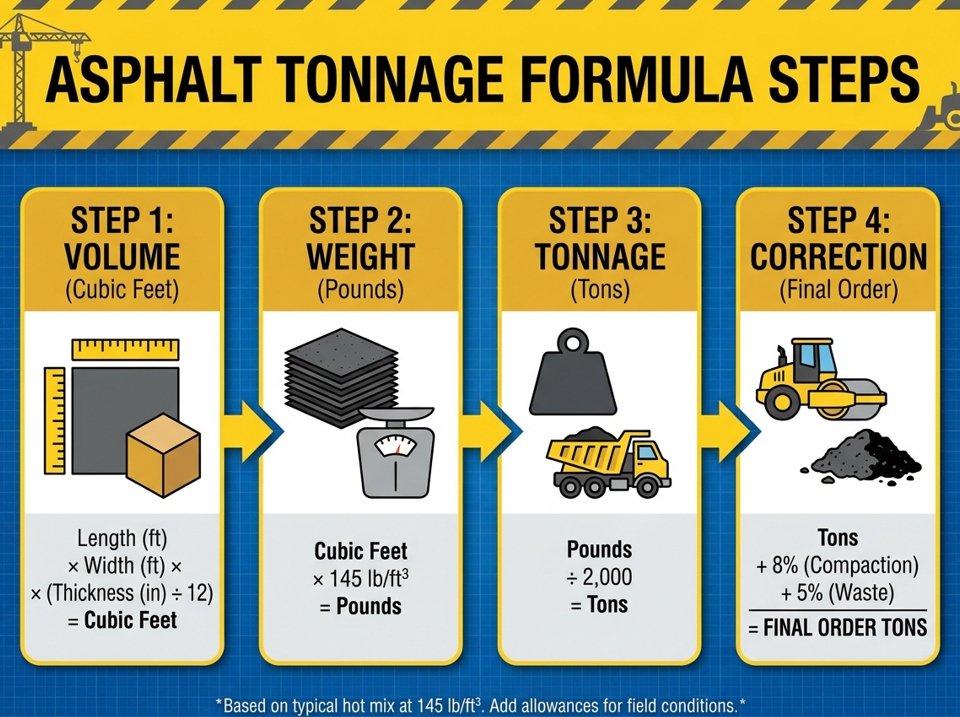
The formula, step by step
Every asphalt quantity comes down to the same physical chain: volume, then weight, then a correction for how the material behaves in the field.
- Find the volume. Length × width gives square feet. Multiply by thickness in feet (inches ÷ 12) to get cubic feet.
- Convert to weight. Compacted hot mix asphalt weighs about 145 pounds per cubic foot. Cubic feet × 145 = pounds.
- Convert to tons. Divide pounds by 2,000. Asphalt is always ordered and priced by the US short ton.
- Add compaction and waste. Fresh mix compresses 8–12% under the roller, so you order more than the loose volume suggests. Add another 5% for spillage, edges, and irregular shapes.
The 145 lb/ft³ figure comes from the Asphalt Institute’s mix-design manual (MS-2) for a typical dense-graded surface mix; open-graded and specialty mixes differ, which is why the density you use matters. I cover why in asphalt mix density variations and the practical density range of asphalt mixes. If you’d rather skip the arithmetic entirely, the asphalt calculator runs all four steps and folds in compaction and waste automatically.
A worked example
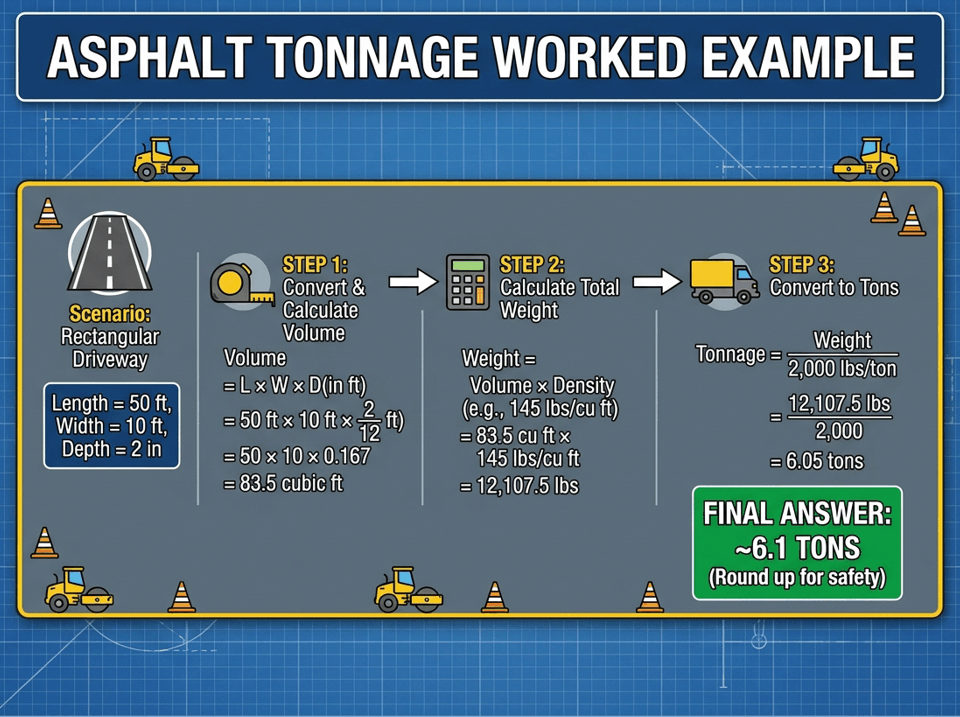
Take a standard two-car driveway: 20 feet wide, 30 feet long, paved 3 inches thick.
- Area: 20 × 30 = 600 sq ft
- Volume: 600 × (3 ÷ 12) = 150 cubic feet
- Weight: 150 × 145 = 21,750 lb
- Tons: 21,750 ÷ 2,000 = 10.9 tons
- With 8% compaction + 5% waste: ≈ 12.3 tons
So that driveway needs about 12.3 tons of hot mix — a little over half a tandem truckload. I show the same style of calculation for a fixed area in material calculation for 250 square feet, and walk through road-length quantities in how to calculate asphalt quantity for a road. The plain-English starting point, if you’re new to this, is how much asphalt do you need.
Coverage per ton by thickness
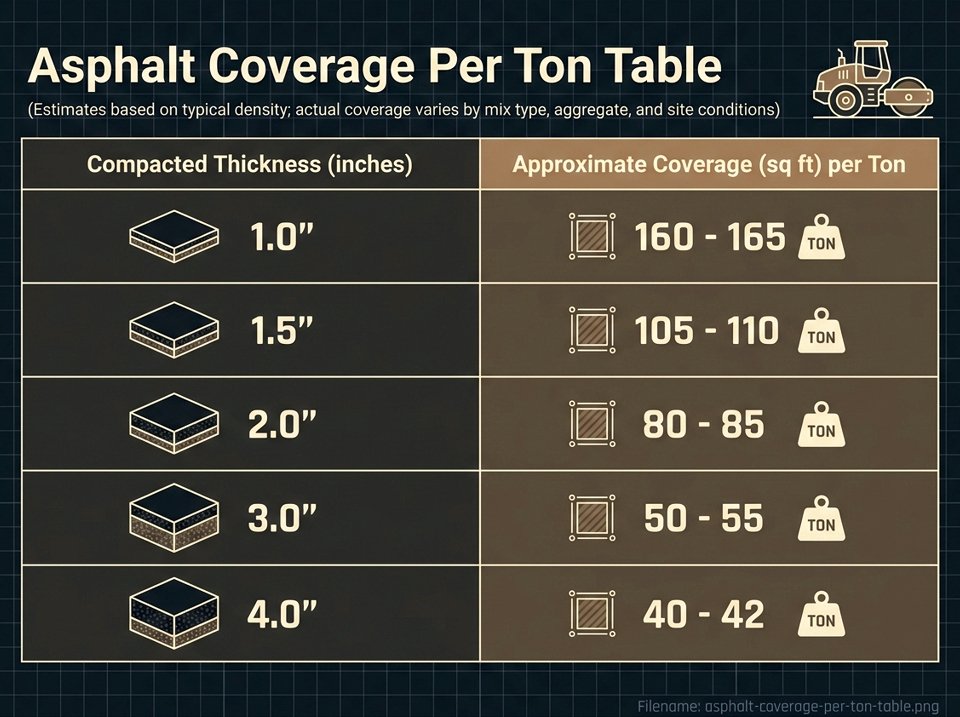
Because coverage scales inversely with depth, one ton stretches further on a thin overlay than a thick structural section. These are the numbers I keep in my head on site.
| Compacted thickness | One ton covers | Tons per 1,000 sq ft |
|---|---|---|
| 1 inch | ~165 sq ft | 6.0 |
| 2 inches | ~83 sq ft | 12.1 |
| 3 inches | ~55 sq ft | 18.1 |
| 4 inches | ~41 sq ft | 24.1 |
For the detailed reference on the most-asked case, see how much a ton of asphalt covers at 3 inches.
The unit conversions that trip people up
Asphalt is measured by area but ordered by the ton, and suppliers sometimes quote in square yards instead of square feet. Getting these conversions wrong is the single most common estimating error I see.
- Square feet to square yards: divide by 9. A 600 sq ft driveway is 66.7 sq yd.
- Square yards to tons: depends on thickness — covered in square yards to tons.
- Measuring irregular areas: break the shape into rectangles, covered in measuring project area in square yards.
Don’t forget the base underneath
The asphalt is only the top of the system. Under it goes 6–8 inches of compacted aggregate base, which you calculate separately — that’s a different material at a different density. The gravel calculator handles the base tonnage, and gravel and asphalt calculation covers both layers together. Once you have your asphalt tonnage, the truckload calculator converts it into delivery trips so you can schedule the pour.
Skip the math: the asphalt calculator gives tonnage, truckloads, and cost in one step. For how asphalt is specified, laid, and maintained start to finish, see the complete asphalt paving guide.
Frequently asked questions
How many tons of asphalt do I need per square foot?
At 3 inches compacted, about 0.018 tons per square foot — one ton covers roughly 55 square feet. Thickness changes this proportionally.
What density should I use for asphalt?
145 lb/ft³ is the standard for a dense-graded hot mix surface course per Asphalt Institute MS-2. Open-graded and specialty mixes run lighter — check your supplier’s mix design if precision matters.
Why add a compaction factor?
Loose hot mix compresses 8–12% when rolled to its target density. You order enough loose material so the finished, compacted layer reaches the specified thickness.
How much extra should I order for waste?
5% covers a simple rectangular job; 10% is safer for driveways with curves, tapers, or multiple edges where cutting and spillage increase.
Formulas and density values verified July 2026 against Asphalt Institute MS-2. Confirm your mix density with the supplier before ordering large quantities.