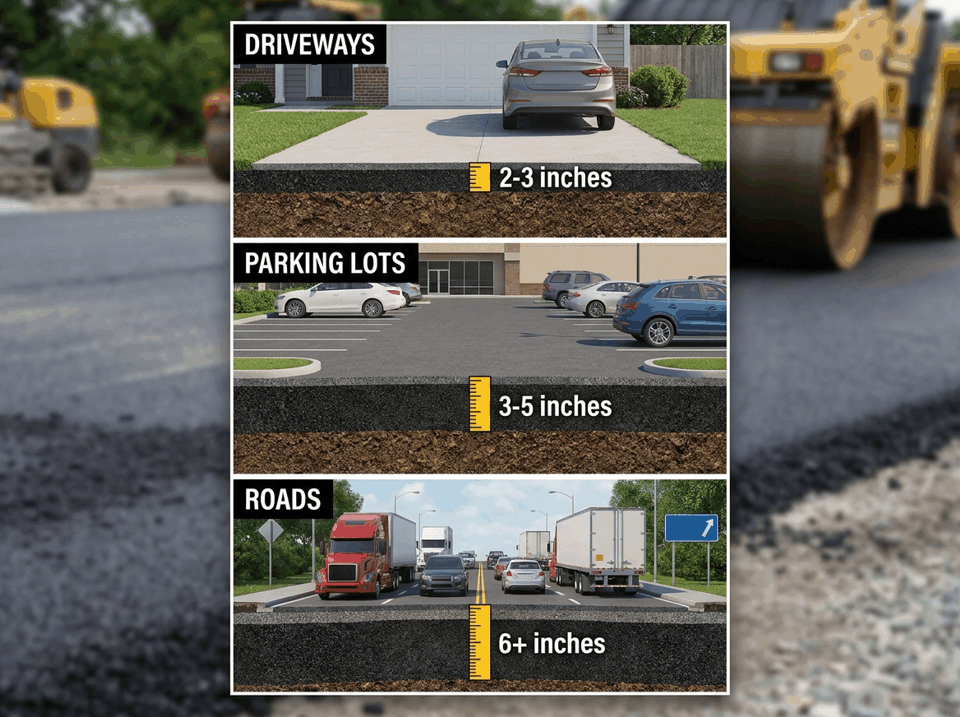
Of every specification decision on a paving job, thickness is the one people get wrong most often — and it’s the one that decides whether the pavement lasts five years or twenty-five. I’ve been called out to diagnose failing driveways and parking lots for two decades, and the root cause is almost always the same: someone saved money on thickness or base, and the pavement is now telling them the bill for that decision, in cracks. This guide gives you the real numbers by application, the engineering reason behind each one, and — more importantly — why the layer you can’t see matters more than the one you can.
Quick answer: A residential driveway needs 2–3 inches of compacted asphalt over 6–8 inches of aggregate base. Parking lots for cars need 3 inches; truck traffic needs 4 inches over 8–10 inches of base. Local roads run 4–6 inches of asphalt. Weak soils and freeze-thaw climates push every number higher. The base thickness matters as much as the asphalt.
Thickness by application
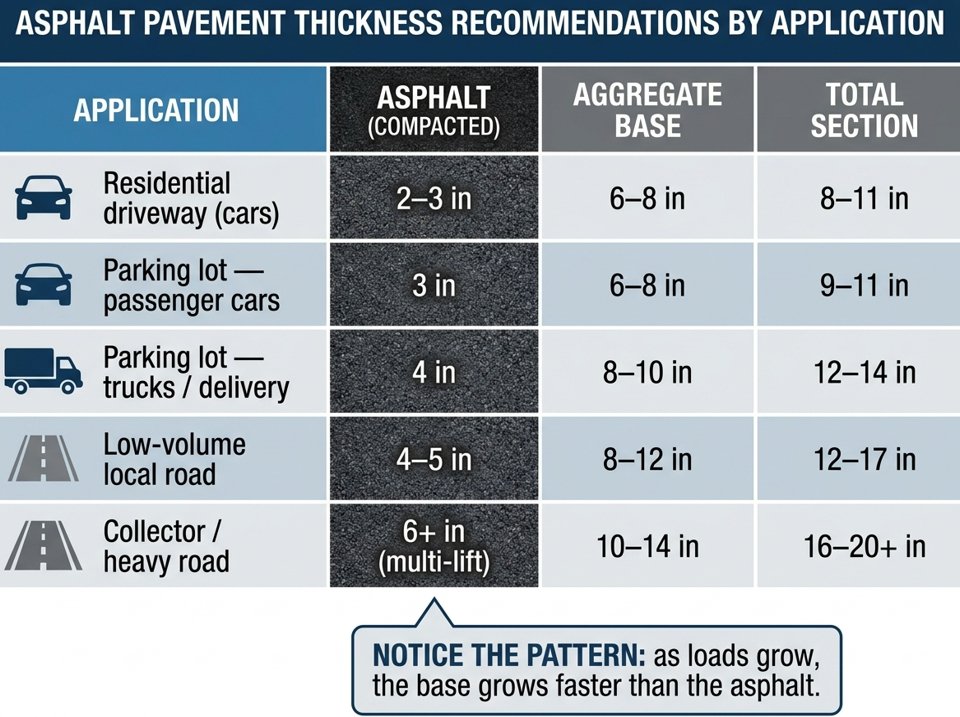
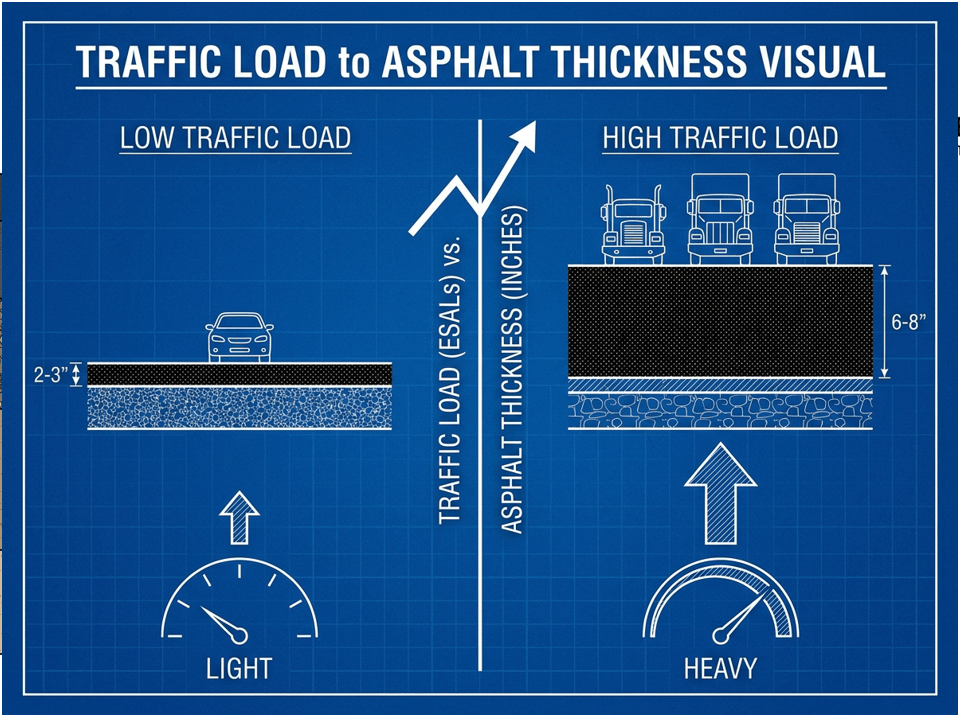
Thickness is driven by one thing above all: the heaviest load the pavement will carry, repeated over its life. A passenger car exerts a fraction of the stress of a loaded delivery truck, and the design reflects that. Here are the standard specifications I work to, expressed as compacted thicknesses.
| Application | Asphalt (compacted) | Aggregate base | Total section |
|---|---|---|---|
| Residential driveway (cars) | 2–3 in | 6–8 in | 8–11 in |
| Parking lot — passenger cars | 3 in | 6–8 in | 9–11 in |
| Parking lot — trucks / delivery | 4 in | 8–10 in | 12–14 in |
| Low-volume local road | 4–5 in | 8–12 in | 12–17 in |
| Collector / heavy road | 6+ in (multi-lift) | 10–14 in | 16–20+ in |
Notice the pattern: as loads grow, the base grows faster than the asphalt. That’s not an accident — it’s the core principle of flexible pavement design, and it’s where most DIY and low-bid failures originate. I go deeper into how thickness and cost interact across residential and commercial jobs in asphalt layer thickness and cost estimation. To size a full multi-layer section for your own project, the pavement calculator takes off the surface, binder, and base layers separately.
Why the base matters more than the asphalt
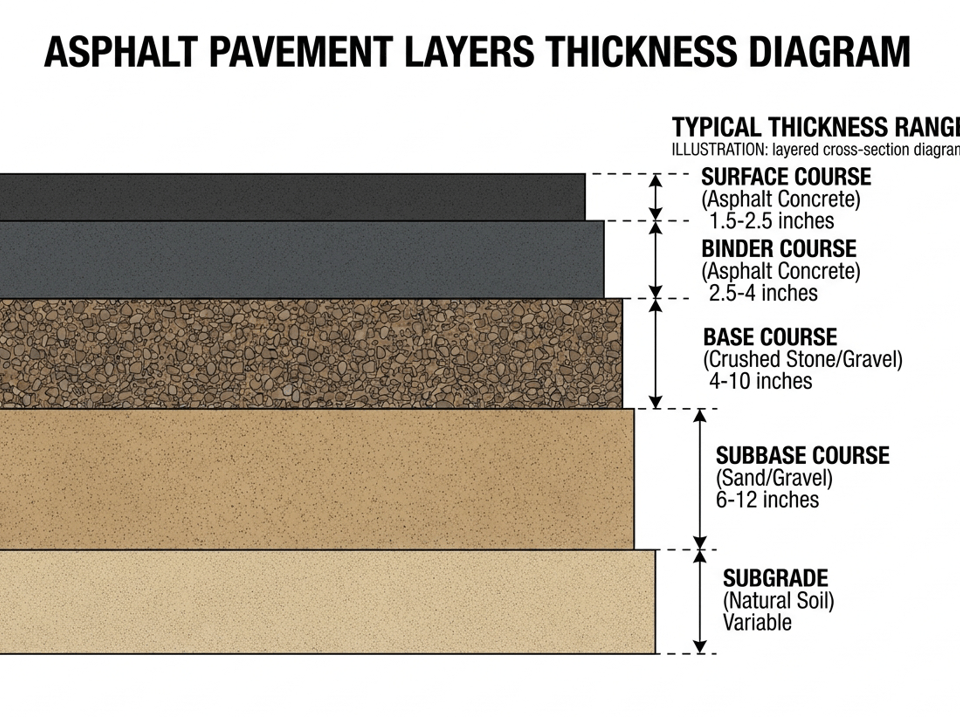
This is the single most important thing I can teach you about paving, so I’ll be blunt: the asphalt is the wearing surface, but the base is the structure. When a vehicle rolls over asphalt, the load doesn’t stop at the surface — it spreads down and outward through the pavement into the layers below, like ripples widening. The base’s job is to catch that spreading load and distribute it across a wide enough area of soil that the ground underneath never overstresses.
A thick slab of asphalt on a thin or absent base is like a countertop on flimsy legs — the material itself is strong, but it has nothing to push against. It flexes under each wheel pass, and repeated flexing fatigues the asphalt until it cracks in the interconnected pattern we call alligator or crocodile cracking. I documented exactly how that failure develops in flexible pavement distresses and crocodile cracking. The base — typically dense-graded crushed stone meeting an AASHTO M147 gradation — is what prevents it. Size yours with the gravel calculator or the crushed stone calculator, and read the full logic in base course and wearing course.
Beneath even the base, on weak or clay-heavy soils, sits a sub-base — a load-spreading layer that bridges soft subgrade. When it’s needed and how thick it should be is covered in optimal asphalt sub-base design, with the sub-base calculator for quantities.
What raises the numbers: soil and climate
Subgrade strength
The soil under the pavement — the subgrade — sets the whole design. Engineers measure its strength with the California Bearing Ratio (CBR): firm, well-draining granular soils have a high CBR and need less structure above them, while soft clays have a low CBR and demand thicker base sections to compensate. A driveway that needs 8 inches of base on sandy soil might need 12 or more on expansive clay. This is why a spec that works for your neighbor may fail for you if your soils differ — there’s no universal number, only a number for your ground.
Freeze-thaw
In cold climates, water that saturates the base and subgrade expands as it freezes, heaving the pavement, then leaves voids when it thaws. Each cycle works the pavement loose. The defense is twofold: adequate base thickness and, critically, drainage — getting water out of the structure before it can freeze. This is why northern specifications call for thicker sections and why I never let a base go in without a plan for where water leaves. Frost depth varies enormously by region, from a few inches in the South to five feet in the far North, and the base should extend below the design frost line where practical.
Hot climates
Heat brings a different problem. Under sustained high temperatures the asphalt binder softens, and heavy stationary loads — a dumpster, a parked trailer — can leave depressions or ruts. The answer isn’t just thickness but binder selection: Superpave performance-grade (PG) binders are specified to the local high-temperature extreme, so a mix in Arizona uses a stiffer high-temperature grade than the same-looking mix in Minnesota. The evolution of asphalt mix design explains how the industry moved from the older Marshall method to the climate-tuned Superpave system now used nationwide.
Single lift vs. multiple lifts
Thin sections go down in one pass. Once the asphalt exceeds about 3 inches, it’s placed in separate lifts — a lower binder course with larger aggregate for strength, topped by a finer wearing course for a dense, smooth surface. There’s a practical reason: asphalt can only be compacted properly in limited thicknesses per pass, so a 6-inch section laid all at once would never reach density in the middle. Between lifts, a thin sprayed tack coat bonds them so the section acts as one monolithic slab rather than sliding layers. Skip the tack and you get slippage cracking within a year. The tack coat calculator sizes the emulsion, and the full multi-layer approach is in optimizing asphalt pavement structure.
How to check a contractor’s spec
When you get a paving bid, the thickness and base spec tell you more about the contractor than the price does. Here’s what I’d look for:
- Is the compacted thickness stated? A bid should specify compacted, not loose, thickness. “3 inches of asphalt” should mean 3 inches after rolling.
- Is the base spec’d separately? A bid that mentions only the asphalt and is silent on base depth is a warning sign. The base is where corners get cut invisibly.
- Does it match the use? A 2-inch driveway spec for a lot that’ll see an RV or delivery trucks is under-designed.
- Is drainage addressed? In freeze climates, a bid with no grading or drainage plan is a bid for a pavement that’ll heave.
The cheapest bid is frequently the thinnest section on the weakest base — which is exactly why it fails first and costs the most over its life. I compare the economics of doing it right versus redoing it in new driveway vs resurfacing cost.
Size your section: the pavement calculator handles all layers at once, and the asphalt calculator gives surface-course tonnage. For the complete picture of how asphalt is specified, built, and maintained, see the complete asphalt paving guide.
Frequently asked questions
How thick should an asphalt driveway be?
2–3 inches of compacted asphalt over 6–8 inches of compacted aggregate base for passenger vehicles. Go to the higher end — 3 inches over 8 — on soft soils, in freeze climates, or if heavier vehicles will use it.
Is 2 inches of asphalt enough for a driveway?
Only for light passenger use over a strong, well-built base. Two inches gives little margin — 3 inches is the safer residential standard, and the extra inch costs far less than early replacement.
How thick does asphalt need to be for trucks?
4 inches of compacted asphalt over 8–10 inches of base for regular truck or delivery traffic. Dumpster pads and loading areas carry concentrated loads and often get thicker sections or concrete instead.
Can I add a thin asphalt overlay to strengthen an old driveway?
An overlay renews the surface but doesn’t fix a failing base. If the underlying structure is cracking from a weak base, an overlay just cracks again — the base problem has to be addressed first.
Does thicker asphalt always last longer?
Not by itself. A moderate asphalt thickness on a proper base outlasts a thick section on a weak one. Balance matters more than raw asphalt depth — the whole system carries the load, not one layer.
Thickness ranges reflect standard flexible-pavement practice; your specific design depends on local soils, traffic, and climate. Consult a licensed engineer or experienced paving contractor for structural work.
By Steve Axton, PE — Licensed Civil Engineer