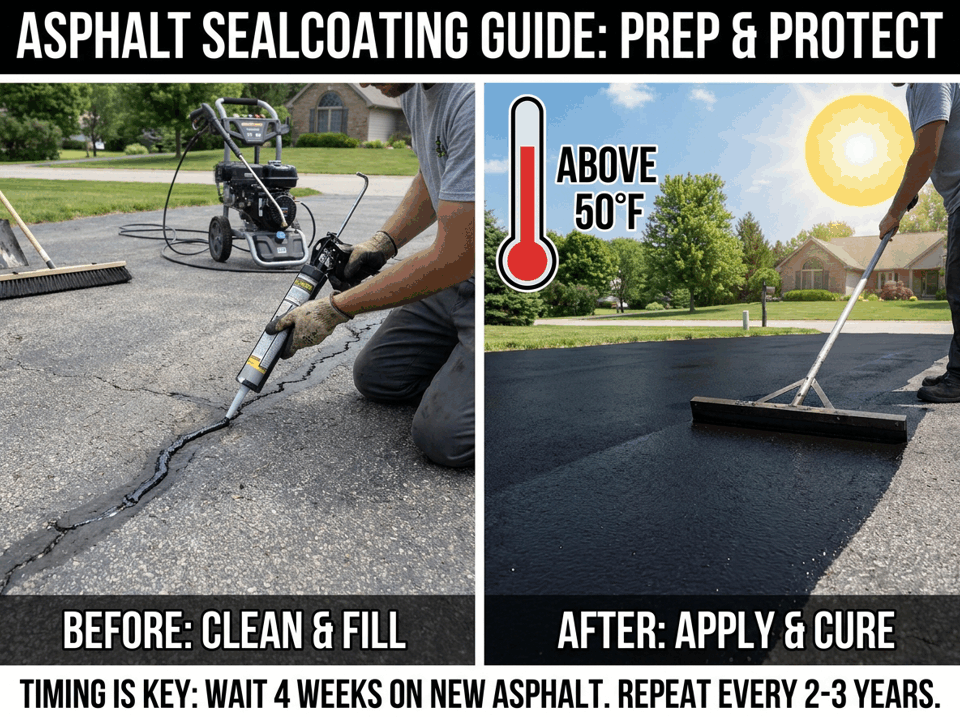
Sealcoating is the highest-return maintenance you can do to asphalt, and also the one homeowners most often do wrong — too soon, too cold, or over cracks that should have been filled first. Done on schedule and correctly, a $150 pail of sealer buys you years of pavement life. Done wrong, it peels off within a season and you’ve wasted a weekend. After decades watching driveways succeed and fail, here’s the honest guide to when, how, and what it costs.
Quick answer: Sealcoat asphalt every 2–3 years, with the first application only after new pavement has cured at least 4 weeks. DIY material runs about $18–$65 per 5-gallon pail; professional sealing costs roughly $0.15–$0.25 per square foot. Apply above 50°F with 24 hours of dry weather, and always fill cracks first.
What sealcoating actually does
Asphalt fails from the top down. The bitumen binder that holds the pavement together oxidizes under UV light and washes out under water, turning a flexible black surface into a brittle gray one that cracks and ravels. Sealcoat is a thin protective layer — a coal-tar or asphalt-emulsion coating — that seals the surface against both attackers. It doesn’t add structural strength; it protects the binder that gives the pavement its strength. That distinction matters: sealcoat is preventive maintenance, not repair. It can’t fix a failing base or bridge an open crack, which is why timing and preparation decide whether it works.
Both common sealer chemistries are governed by real material standards — ASTM D490 for asphalt-based sealers and ASTM D5707 for coal-tar emulsion — so a product meeting those specs performs to a known baseline. The sealer is itself a bitumen product, chemically related to the binder in your pavement and to the emulsions used elsewhere in paving; the bitumen calculator covers that base material, and my broader asphalt maintenance guide puts sealing in the context of a full maintenance program.
By Steve Axton, PE — Licensed Civil Engineer
When to sealcoat — and when not to
Timing is where most sealcoating goes wrong. Two rules matter more than any other.
- Wait at least 4 weeks on new asphalt. Fresh pavement needs to cure before it can accept sealer — manufacturers specify a minimum of about four weeks under warm, dry conditions. Seal too early and you trap volatiles and get poor adhesion. New asphalt also needs its natural oils to oxidize off first.
- Reseal every 2–3 years. Not annually — over-sealing builds up a thick film that itself cracks and peels. Every two to three years matches the rate at which the surface actually weathers.
Weather rules are just as firm: apply when both air and surface are above 50°F and will stay there for 24 hours, with no rain in the forecast. Sealer cures by water evaporation, so cold or damp conditions leave it uncured and vulnerable. That also rules out sealing late in the day in fall, when temperatures drop after sundown. New asphalt still curing? My asphalt drying timeline explains what’s happening in the pavement during those first weeks.
Fill cracks first — always
Sealcoat bridges hairline surface weathering, not open cracks. Any crack wide enough to see is wide enough to admit water into the base, and no amount of sealer will stop that — it flows into the crack and disappears. Every crack over about ⅛ inch must be filled with a proper crack sealant (ASTM D6690 hot-pour material is the durable choice) before the sealer goes down. Skipping this is the most common reason a fresh sealcoat fails to protect the pavement. Size your crack filler with the crack filler calculator, and match the method to the crack type using my guide to filling cracks in an asphalt driveway and the best driveway crack fillers. Oil and grease stains need treatment too — they prevent adhesion, and I cover removal in preventing oil stains on asphalt.
How much sealer you need
Coverage depends heavily on the product and your pavement’s condition, and this is where reading the label matters. Concentrated coal-tar sealer covers roughly 50–60 square feet per gallon for two coats on aged pavement; ready-mixed and diluted products cover around 100 square feet per gallon per coat; premium asphalt emulsions can stretch further. A rough, porous, older surface drinks more than a smooth one.
| Surface condition | Coverage (2 coats) | Notes |
|---|---|---|
| Smooth, newer asphalt | ~80–100 sq ft/gal | Less porous, needs less sealer |
| Average, weathered | ~60–80 sq ft/gal | The typical case |
| Rough, old, porous | ~50–60 sq ft/gal | Drinks sealer — buy extra |
Because coverage varies this much, calculate from your actual area and the product’s stated rate rather than guessing. The sealcoating calculator converts your driveway size and chosen coverage into gallons and pails, so you buy once instead of running out mid-job.
What it costs in 2026
Sealcoating is cheap relative to what it protects. For DIY, a 5-gallon pail runs about $18–$28 for budget coal-tar emulsion, $28–$45 for mid-range asphalt emulsion, and $45–$65 for premium polymer-modified products. A typical two-car driveway needs two to three pails. Professionally applied, sealing runs roughly $0.15–$0.25 per square foot — so about $90–$150 for a 600-square-foot driveway.
Weigh that against the alternative: an unsealed, neglected driveway typically needs replacement in 10–12 years, while a maintained one lasts 20-plus. Spending a few hundred dollars every few years to defer a multi-thousand-dollar replacement is the best return in driveway ownership. I put those numbers side by side in my replacement vs resurfacing cost comparison, and cover the full economics in the complete asphalt paving guide.
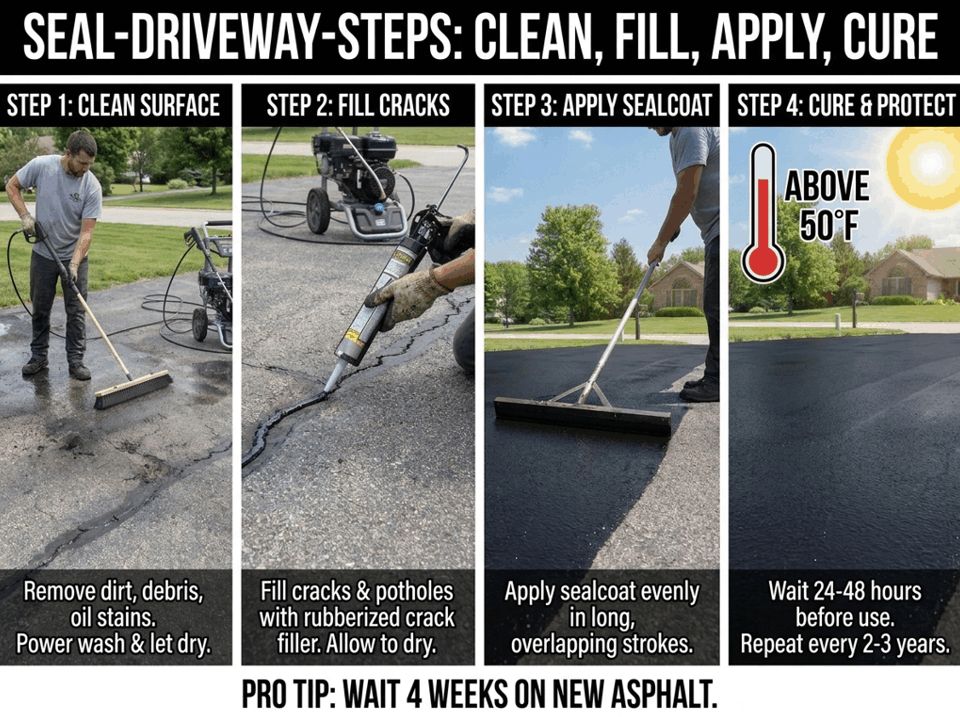
The application steps
- Clean thoroughly. Sweep, then pressure-wash or blow off all dirt, dust, and loose material. Sealer bonds to clean pavement only.
- Fill cracks and treat stains. Hot- or cold-pour filler in every visible crack; degreaser on oil spots. Let cure per the product.
- Check the weather. Above 50°F, dry for 24 hours, no rain coming.
- Apply thin coats. Squeegee or brush the edges, spray or squeegee the field. Two thin coats beat one thick one — thick sealer cracks as it cures.
- Cure before traffic. Wait at least 24 hours before driving on it; longer in cool weather.
Plan your job: the sealcoating calculator gives gallons and pails from your driveway size, and the crack filler calculator handles the prep step. Both link back to the full asphalt paving guide.
Frequently asked questions
How often should I sealcoat my driveway?
Every 2–3 years. Annual sealing builds up excess film that cracks and peels; every two to three years matches how fast the surface actually weathers.
How long should new asphalt cure before sealcoating?
At least 4 weeks under warm, dry conditions per manufacturer specifications. Sealing sooner traps volatiles and produces poor adhesion. The pavement’s natural oils need time to oxidize first.
Coal tar or asphalt emulsion sealer — which is better?
Coal tar resists oil and chemicals better and lasts slightly longer; asphalt emulsion is lower-odor, lower-VOC, and restricted in fewer areas. Some regions limit coal-tar products, so check local rules. Both meet ASTM performance standards when properly formulated.
Can I sealcoat in cold weather?
No. Both surface and air must stay above 50°F for 24 hours, with no rain. Sealer cures by water evaporation, so cold or damp conditions leave it uncured and it will fail.
How much does it cost to sealcoat a driveway?
DIY, about $40–$130 in material for a typical two-car driveway. Professionally, roughly $0.15–$0.25 per square foot, or $90–$150 for 600 square feet.
Coverage rates, ASTM standards (D490, D5707, D6690), and 2026 pricing verified against manufacturer specifications and current retail data. Always follow your specific product’s label.