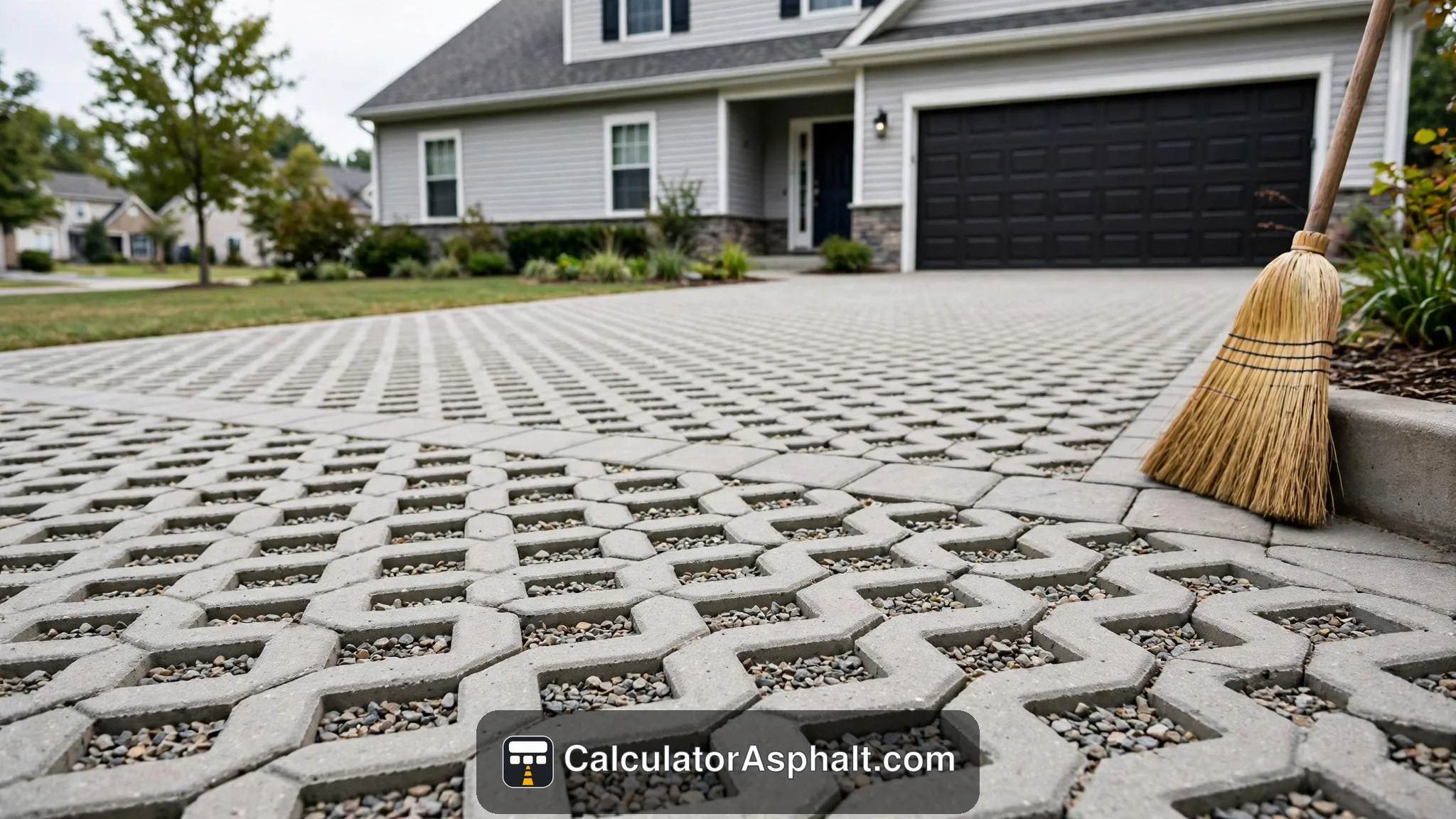
A permeable driveway is not a fit-and-forget surface. Its joints, gaps and pores are the drainage system. When they fill with leaves, sand, soil and tire dust, water stops soaking in and starts ponding. Choose by the upkeep you will actually do, not by day-one looks.
- Sweep a few times a year, park daily: permeable pavers. Joints can be topped up, single pavers lifted and reset, and the surface stays firm under turning tires.
- Green look, light parking, will water and mow: grass grids. They need sun, water and time to establish.
- Simplest top-up, loose natural look: stabilised gravel grids. Raking and topping up are the main jobs, but gravel still moves.
- Smooth surface, will arrange specialist cleaning: porous concrete. No joints to refill, but clogging is harder to see and fix.
If none of those routines sounds realistic, a conventional driveway with a planned outlet may suit you better than a permeable system left to clog.
Ask the maintenance question first
Start with three questions, not appearance. What will fall on the surface? Leaves, sand, garden soil and dust clog different systems in different ways. Who will do the work, and with what? A broom and blower are not the same as a vacuum sweeper. What happens when the surface is partly clogged? Some systems slow gradually and can be cleaned; others look fine until water ponds.
Walk the site first. Note the overhanging trees, the slope that brings soil onto the drive, where the car turns each morning, and where snow is piled.
A related guide compares two of these systems as materials: Permeable Driveway Ideas: Compare Grass Pavers and Gravel-Filled Grids. This guide is maintenance-first, adds permeable pavers and porous concrete, and adds a calendar and a water test.
The four systems, compared by maintenance
1. Permeable pavers
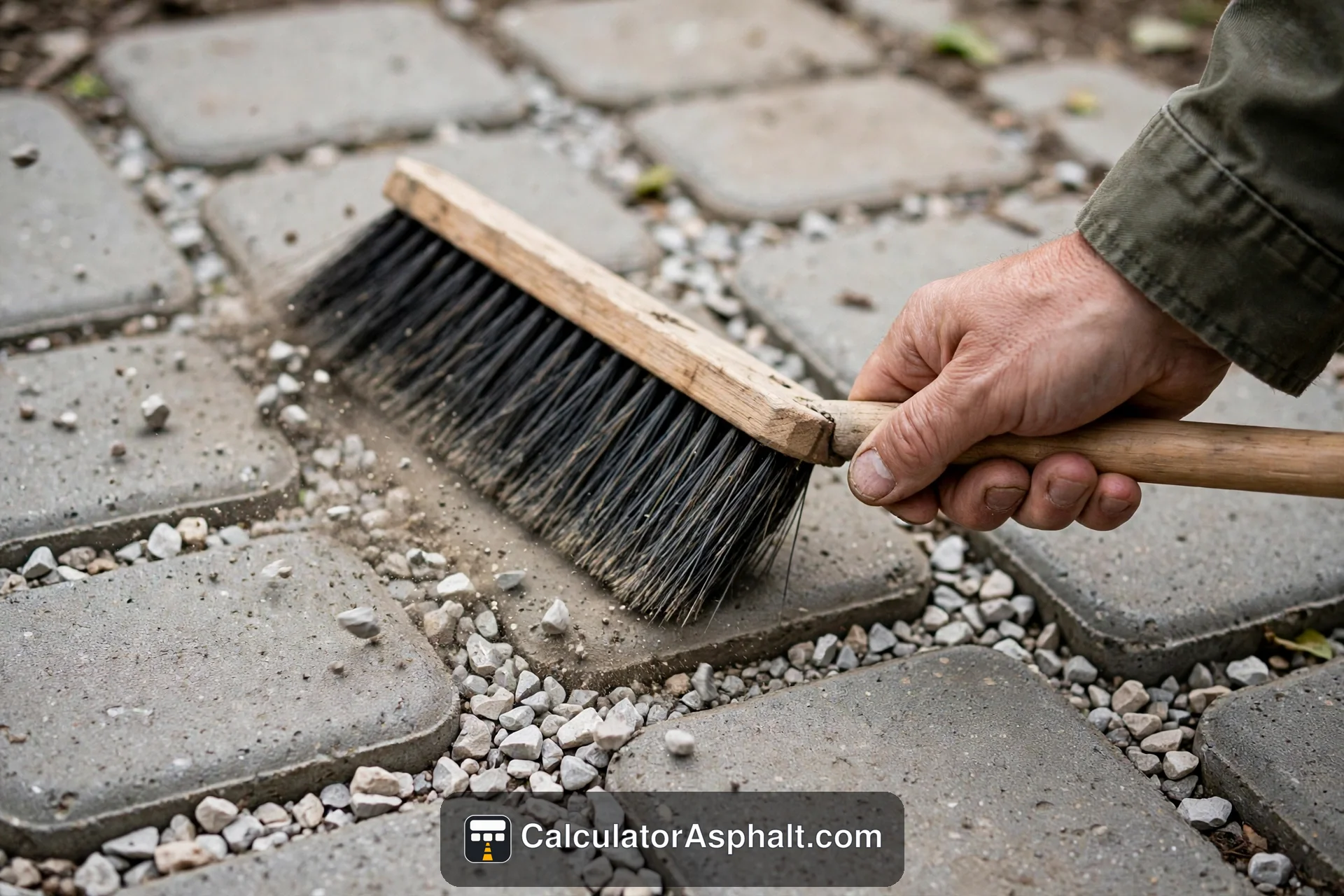
Permeable pavers are units laid with open joints filled with small, clean stone, not sand. Water passes through the joints into an open-graded stone base. Trade guides commonly describe the open area as roughly 8–20% void space, with a clean system infiltrating at around 6 inches per hour — trade-guide claims, not measurements from this site.
Sweep leaves and grit off before they are ground into the joints, top up joint stone where tires push it out, and check the edges. Avoid sand in winter. A cracked or settled paver can usually be lifted and reset.
2. Grass grids
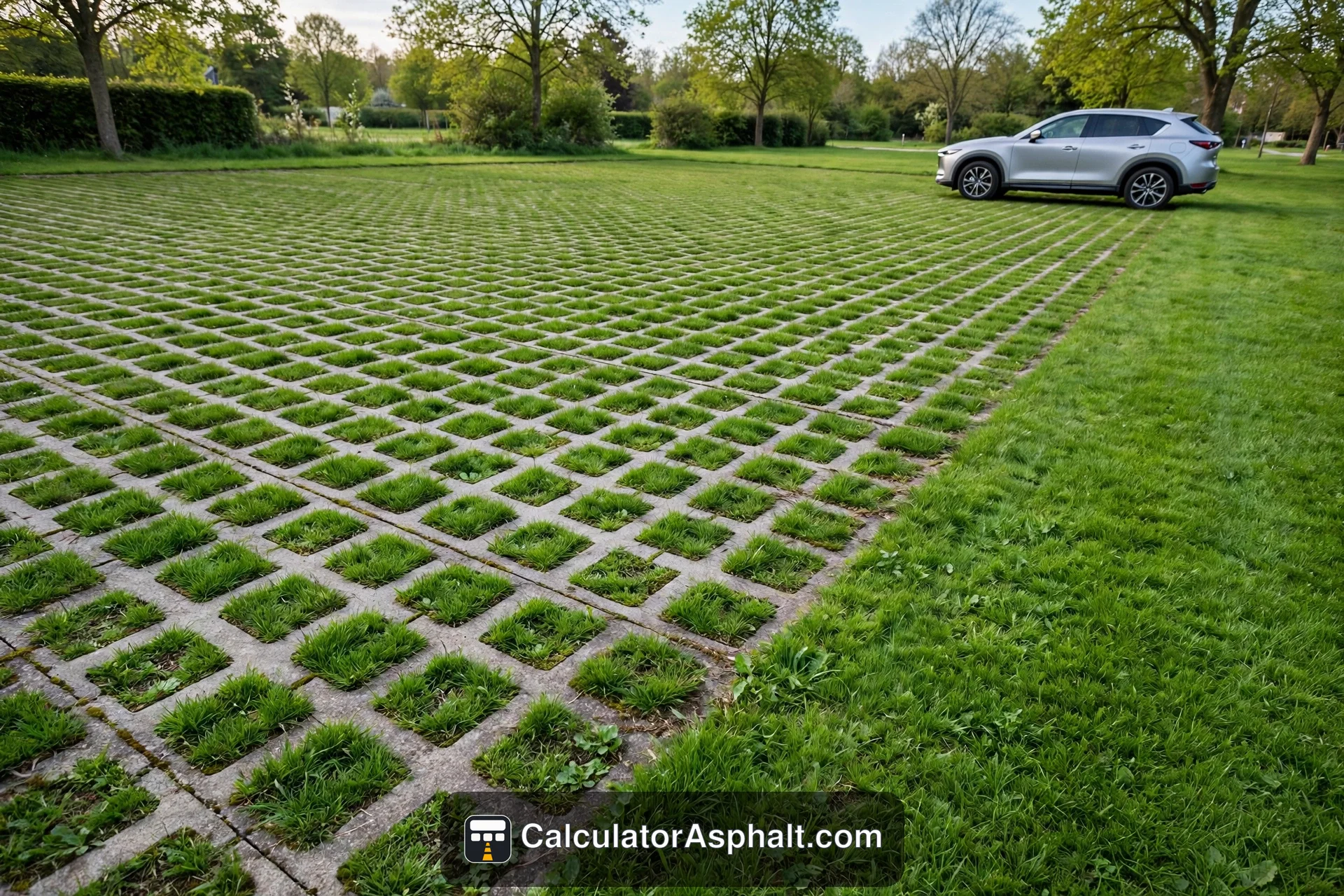
Grass grids are plastic or concrete cells filled with soil and grass. The grid spreads the load so tires do not rut the lawn beneath. Routine work is gardening as much as driveway work: sun, water while the grass establishes, mowing and overseeding. Leaves left on top smother the grass, and bare patches turn to mud if driven over too early.
Constant turning in the same spot wears the grass faster than it recovers. Grass grids suit a lightly used strip, guest bay or overflow area better than a busy daily driveway. Keep vehicles off new grass until the installer says it is ready.
3. Stabilised gravel grids
Stabilised gravel grids are honeycomb panels that hold gravel in place so it does not migrate as freely as loose gravel. Water still drains through the gaps between stones. Routine work is straightforward but never finished: rake gravel back into wheel tracks, top up thin spots, pull weeds at the edges, and check the grid has not lifted. Keep soil and mulch out of the gravel, because fine material fills the gaps and slows drainage.
Most repairs are small and local: add gravel, rake it level, reset a lifted panel. Gravel still moves under turning tires, so a clear edge is essential. For a fuller routine, see the Gravel Driveway Maintenance Checklist: Read the Ruts Before Adding Stone.
4. Porous concrete
Porous concrete is a continuous slab made with little or no fine sand, so water passes through connected voids in the concrete itself. There are no joints to refill and no grass to mow. Keep leaves and grit off, and vacuum sweep on the installer’s schedule — a pressure washer can drive fines deeper.
Once fine sediment has worked deep into the slab, routine sweeping may not restore it, and cracks are harder to repair invisibly than a single paver. Do not choose porous concrete because it sounds low-maintenance — choose it because you have a realistic cleaning plan for a surface you cannot take apart.
Comparison table
| System | Routine task | How often | What fails first | Winter care | Repair |
|---|---|---|---|---|---|
| Permeable pavers | Sweep joints; top up stone; check edges | Monthly in leaf season | Sand and grit in joints; loose edge | Plastic shovel; avoid sand | Low–moderate: lift and reset pavers |
| Grass grids | Mow, water, overseed; clear leaves | Growing season | Bare patches; wear at turns | Avoid piling snow and salt | Moderate: reseed or replace cells |
| Stabilised gravel grids | Rake level; top up gravel; weed edges | After storms; seasonally | Soil in gravel; gravel migration | Rake gravel back; no sand | Low: add gravel, rake, reset panels |
| Porous concrete | Keep clear; vacuum sweep | Regularly; on installer’s schedule | Fine sediment deep in pores | Avoid sand and grit | High: patching is visible; deep clogging hard to reverse |
Frequencies are planning guides, not manufacturer instructions. Follow the product and installer guidance for your exact system.
Seasonal maintenance calendar
Spring: Walk the surface after the last frost. Mark ponding, settlement, bare grass and loose edges. Sweep joints and gravel, rake gravel level, reseed bare grass, and run the water test below, recording the result and date.
Summer: Mow grass grids and water new grass in dry spells. Keep soil and mulch out of joints and gravel, and top up stone where tires have pushed it aside.
Autumn: Clear leaves before they are driven into joints, pores and grass, sweeping more often under large trees.
Winter: Keep the surface clear without adding sand, using only the snow-removal method your installer allows.
Once a year: Repeat the water test in the same places, compare it with last year’s result, and decide whether routine cleaning is enough or a deeper clean is needed.
A simple water test
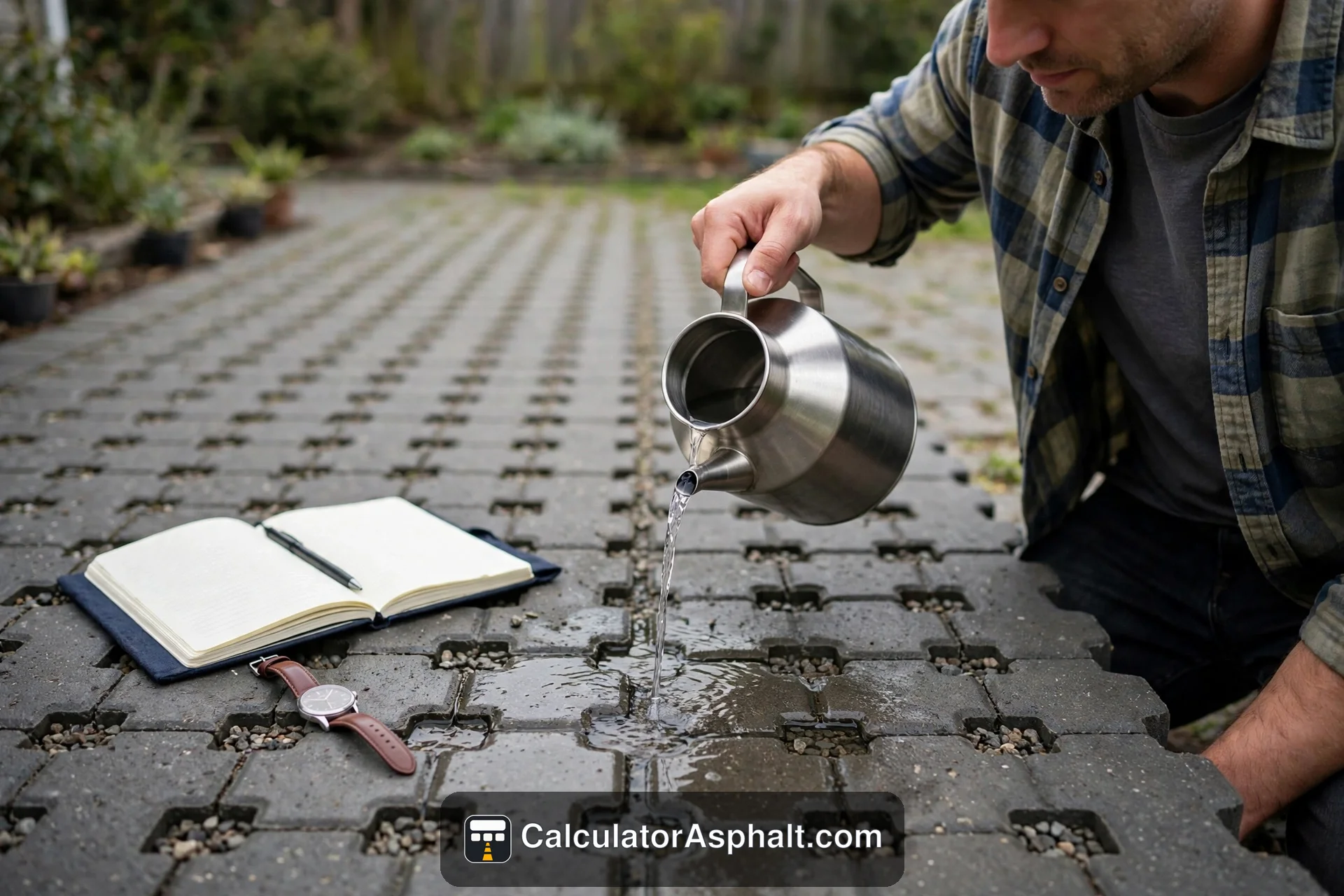
You need a jug, a watch and a dry day. Pick three spots: the main wheel track, a turning spot, and a quiet edge rarely driven on. Sweep loose leaves and grit off each spot first. Pour one litre of water slowly onto a patch about the size of a dinner plate, starting the watch as you pour. On a clean surface, the water should disappear into the joints, gaps or pores without forming a standing puddle. Repeat in the other two spots, using the same amount of water.
Compare the spots. If the wheel track holds water while the quiet edge drains, the problem is likely local clogging in the track. If all three hold water, it is likely wider clogging or a blocked base, and needs an installer. Test in ordinary weather, not just after heavy rain. A single test is a snapshot; the same test a year later is evidence.
Clean, repair or replace?
Clean it when the problem is on the surface and recent: leaves, grit and loose soil that can be swept, blown or vacuumed away, and a water test that improves after cleaning. Clean first, test again, and record the result.
Repair it when cleaning helps in some places but not others: a settled paver, a loose edge, a worn grass patch, a lifted gravel panel, or a cracked section that lets water bypass the surface. Repair the cause — a paver that keeps settling needs its bedding and edge checked.
Ask an installer to assess replacement when the water test stays poor across the whole surface after proper cleaning, when water ponds after every ordinary storm, or when the base below has settled or rutted. Get the scope in writing, with the cause named. If the surface looks worn but the test is still good, you may only need a surface repair; if it looks tidy but the test is poor, the problem is deeper.
Worked example: base for a 400 sq ft parking pad
This example works out the open-graded stone base for one layer only — an arithmetic example, not a structural design. Full depth and specification depend on soil, traffic, frost and local rules, and should come from your installer.
Assumptions: pad 20 ft × 20 ft = 400 sq ft; one base layer 6 in deep; ordering allowance 10%; stone density 100 lb per cu ft — the midpoint of the 95–105 lb per cu ft range for open-graded stone on the site’s Aggregate Calculator page. Use your supplier’s density if it differs.
Arithmetic: area 20 × 20 = 400 sq ft. Depth 6 in ÷ 12 = 0.5 ft. Net volume 400 × 0.5 = 200 cu ft = 200 ÷ 27 = 7.4 cu yd. With 10%: 220 cu ft = 220 ÷ 27 = 8.2 cu yd. Tonnage: 220 × 100 = 22,000 lb = 11.0 tons with the allowance (10.0 tons net).
So, for this example only, order about 8.2 cu yd, or about 11 tons, for a 6-inch base under a 20 × 20 ft pad. Run your own area and depth through the Aggregate Calculator before ordering. For pavers, work out paver count and bedding sand separately with the Paver Calculator and Sand Calculator.
Field checklist
- [ ] Trees, slopes and soil sources noted.
- [ ] Wheel tracks, turning spots and parking positions marked.
- [ ] Quiet edge chosen for the water-test comparison.
- [ ] Cleaning method and who does it named.
- [ ] Winter snow and grit rules written down.
- [ ] Edge, outlet and overflow route on the drawing.
- [ ] Water test run in three spots, with dated photos.
- [ ] Base depth, stone type and density confirmed with the supplier.
- [ ] Yearly water-test repeat in the calendar.
Likely mistakes
- Choosing by colour alone. A surface that is never cleaned will clog.
- Adding sand. Sand fills joints and pores.
- Driving on grass grids too early. Unestablished grass wears out at turning spots first.
- Pressure-washing porous concrete first. It can drive fines deeper; ask about vacuum sweeping.
- Treating one good water test as a pass for life. Trade guidance cited in the brief puts clean, swept permeable paver infiltration at around 50 inches per hour, falling to around 3–4 without sweeping — a trade-guide claim, not a site measurement. Repeat your own test yearly.
- Ordering base stone by area alone. Depth, density and allowance change the order.
Frequently asked questions
How often should I sweep a permeable driveway?
Sweep leaves and grit off before they are ground in, most often in autumn and after storms. Repeat the water test yearly.
Can I use a pressure washer on permeable pavers?
It can wash joint stone out and drive fines deeper. Sweep and vacuum first, then top up joint stone.
Why does my grass grid look patchy even though the grid is intact?
Patchiness is usually a grass problem: shade, drought, wear at turning spots, or driving on it before it established. Reseed bare areas and keep vehicles off while they recover.
Does a permeable driveway remove the need for drainage planning?
No. It still needs a suitable base, soils that can receive water, and a planned overflow route for heavy rain.
When should I call an installer instead of cleaning it myself?
When the water test stays poor across the whole surface after proper cleaning, when water ponds after ordinary rain, or when the surface has settled. Bring your dated test photos.
Your next practical decision
Do not order material yet. Pick the system whose routine work you will actually keep up; mark your three water-test spots on a sketch; ask your installer for the exact base depth, stone type, cleaning schedule and winter rules, in writing; and run the base volume through the Aggregate Calculator with your own area, depth and supplier density. If you cannot name the person and the schedule for the routine cleaning, pause — a permeable driveway left to clog is a more expensive problem than a conventional surface with a clear drainage plan.
Material calculators
Related project guides
- Permeable Driveway Ideas: Compare Grass Pavers and Gravel-Filled Grids
- Paver Patio Drainage: Find Where the Water Can Go Before You Set Grade
- Gravel Driveway Maintenance Checklist
- Paver Patio Maintenance Checklist: What to Check After Rain and Each Season