By Steve Axton, PE — Licensed Civil Engineer · Updated November 2026
Measure the zone receiving fill and record the specified depth. Convert volume before asking how the supplier quotes loose material.
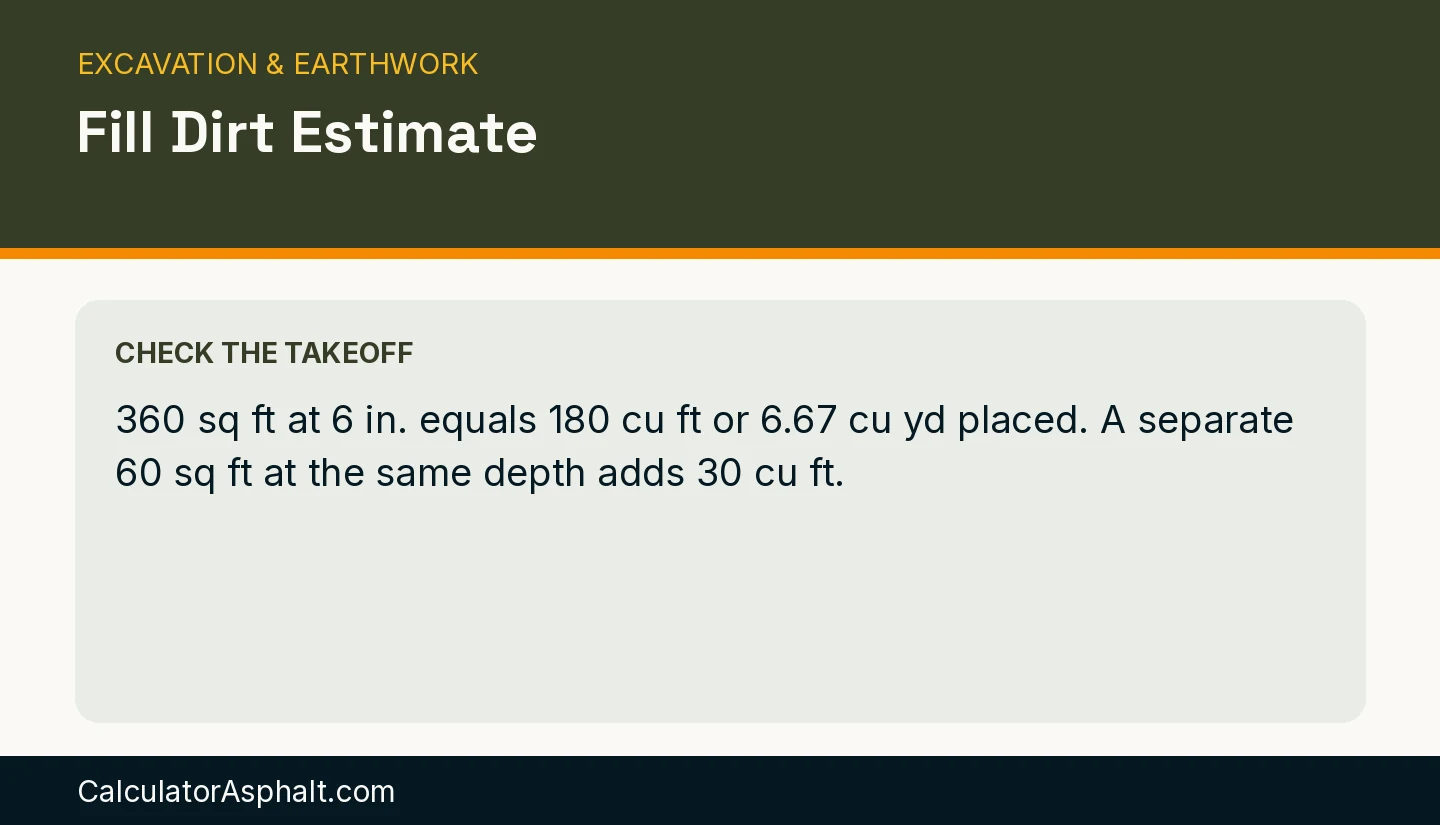
Illustrative result. 360 sq ft at 6 in. equals 180 cu ft or 6.67 cu yd placed. A separate 60 sq ft at the same depth adds 30 cu ft.
Keep the survey and volume state visible
Record the existing and proposed surfaces that define the calculation. Volume measured in place, loose after excavation and placed in a specified layer represent different physical conditions. Keep the labels and any verified project conversion next to the quantity. When intermediate readings change sharply, divide the model into smaller sections instead of assigning one depth throughout.
Keep the inputs beside the Fill Dirt Estimate calculator so its quantities can be checked against the original measurement. For an existing example of a clearly marked work scope, see paver patio drainage planning. Use its boundary or measurement practice only where the conditions match.
Separate handling from the final work area
List excavation, reusable material, imported fill and disposal separately. The same amount can appear at more than one step in the material flow, but it should not be purchased twice. Record whether an estimated quantity applies to loading, final placement, disposal or a truck ticket. Reconcile the scope at route crossings, paved areas and surface restoration.
Check how additional fill meets the existing grade and identify places excluded from the footprint.
Choose base units before multiplying. For a volume that combines dimensions in feet and depth in inches, divide the inches by 12 to express depth in feet. Convert a result in cubic feet to cubic yards by dividing by 27. For surface area, keep the original dimensions and do not include depth. Write the correct dimensional unit beside the subtotal so a later change does not turn a volume into an area estimate.
Record the shape you measured before changing any dimensions. For the next estimate, break irregular geometry into labeled parts and compute them separately. Compare the sum with an outside dimension or an independent check from the drawing. If the readings are too uncertain to justify a single quantity, keep the affected section provisional. That is usually more informative than adding precision to a number derived from the wrong boundary.
Convert fill to cubic yards
Record where placed fill overlaps work by a paving or landscape contractor. Give each scope one drawing boundary so neither quote adds the full layer over an area only one party will fill.
Keep reclaimed material separate from imported material
Identify where work may produce material that a professional can approve for reuse. A filled volume from survey does not, by itself, show how much will be purchased. Quote the placed needs, the approved reused quantity and the remaining delivered requirement on distinct lines.
| Worksheet entry | What to record | When to revise |
|---|---|---|
| Measurement or scope | The measured limits and units | A drawing or field dimension changes |
| Product or rate | Exact model, coverage, quote or authority | The product, basis or conditions change |
| Calculated subtotal | Original result and any conversion | An input units check or independent reading changes |
| Order or reviewed amount | Selling increment or reviewed scope | Availability, review findings or inclusions change |
Worked example
- Identify the scope. Measure the zone receiving fill and record the specified depth. Convert volume before asking how the supplier quotes loose material.
- Set the example inputs and calculate. 360 sq ft at 6 in. equals 180 cu ft or 6.67 cu yd placed. A separate 60 sq ft at the same depth adds 30 cu ft.
- Check the result against the plan or quote. Check how additional fill meets the existing grade and identify places excluded from the footprint.
- Write down the basis for the next person. Request the designated material, sale unit, access and any supplier conversion between delivered and placed volume.
Take assumptions to the project review
Before the order is committed, identify dimensions that have not been verified and note which protective or access details are controlled by an approved plan. A quantity drawing is distinct from a safety or construction plan. Give the person responsible for the work the same revision used in the estimate and record how they confirmed any changed quantities.
Use the compacted fill estimate and the excavation quantity estimate to keep connected quantities in view. A project can need each of those estimates without allowing their outputs to be summed. Identify the unit and purpose on every line.
For a separate quantity on the same project, see aggregate estimate. A built example in gravel driveway washout planning shows why defining the finished area or work scope is more useful than estimating from a single outside dimension.
Work through the unit conversion once
Sketch the outline the calculation actually includes and keep a second column for the changes that will alter that outline. If two areas meet, assign the shared portion to one of them before summing. A change in representation should leave the quantity unchanged if both representations cover the same physical object.
Review a recorded observation before revising everything
A real measurement may differ from a drawing, and an observation can apply to only the part of the site that was inspected. Mark the location and the conditions of the check, then determine which line needs revision. Bring a change in scope to the appropriate reviewer. Keep quantities that are actually comparable separate from values derived under different conditions.
Use project geotechnical and placement requirements. The example does not select material or compaction criteria.
Where this work connects to existing or planned asphalt, record the paving scope separately using the asphalt paving guide. Keep the location and work boundary in the estimate so any interface changes can be reviewed before purchase or construction.
Run your project numbers. Run the project inputs in the calculator for fill dirt estimate. To check a connected line item, use compacted fill estimate or excavation quantity estimate. Transfer the quantities and units back to the same plan or quote before comparing totals.
Frequently asked questions
What should I measure first?
Measure the zone receiving fill and record the specified depth. Convert volume before asking how the supplier quotes loose material.
Should I round each measured section as I go?
Retain precise intermediate quantities for compatible sections. Sum them before rounding for the vendor. Keep materials, depths or treatments with a distinct specification on separate rows.
Which assumption deserves a second check?
Check how additional fill meets the existing grade and identify places excluded from the footprint.
What should I give the supplier or reviewer?
Request the designated material, sale unit, access and any supplier conversion between delivered and placed volume.
Calculation method reviewed November 2026. Use the CalculatorAsphalt worksheet and its stated inputs to reproduce the example.