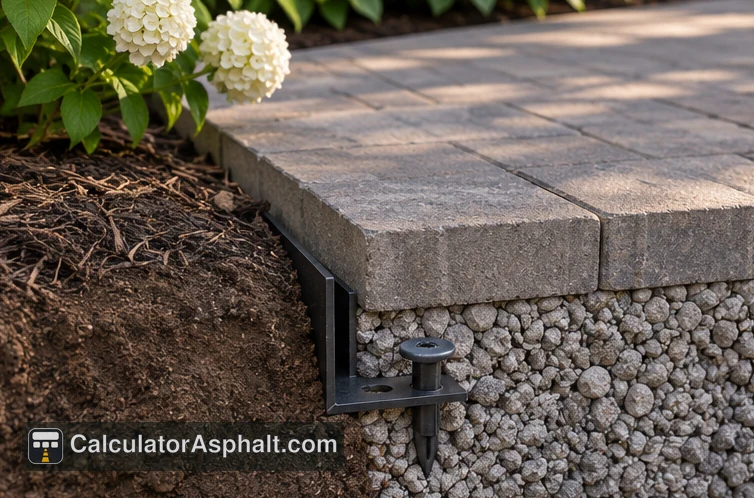
The visible border frames a patio. The edge restraint limits sideways movement. Start by checking the pavers, bedding, base and the surface each edge meets. Then measure each run where the restraint actually sits. This gives you a material list that accounts for straight lawn edges, curves and existing boundaries.
Concealed restraint against the lawn
A low-profile restraint can make the edge disappear beside grass. Confirm the profile fits the paver depth and that the manufacturer allows the proposed curve. Ask how far the compacted aggregate extends to support the fasteners. Request a drawing that shows the paver, restraint and base in the same cross-section.
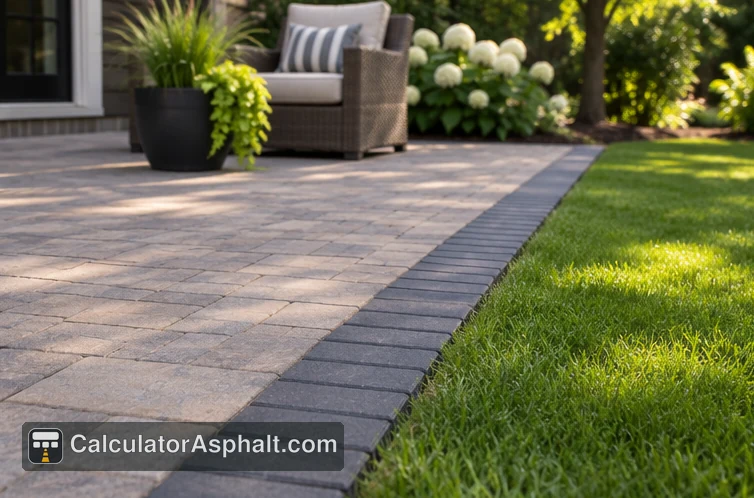
Metal restraint and fixed boundaries
A metal profile suited to the paving system can give a narrow, crisp line. Compare its attachment method, corner connectors and finished height at walking transitions. A designed curb or suitable fixed boundary can restrain an edge when it remains in continuous contact. Inspect any existing hard boundary for movement and check what happens where it ends and the lawn begins.
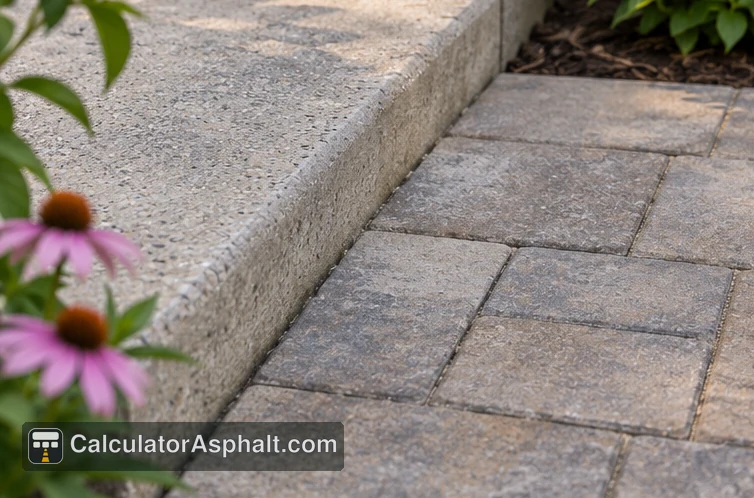
Measure where the restraint sits
Mark lawn, wall, drain and slab transitions on the plan. Follow each curve with a flexible tape along the actual restraint line. Measuring only between the endpoints makes the run look shorter. The visible border and the restraint can have different lengths, especially around bends. Record stock pieces, fasteners, connectors and compacted support aggregate as separate order lines.
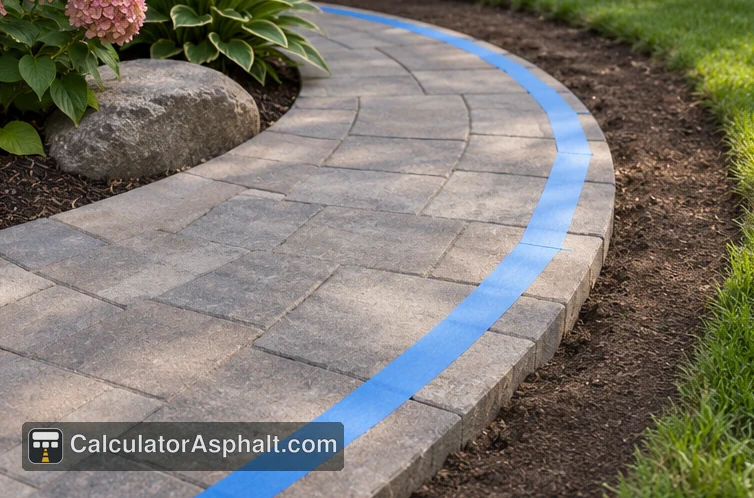
Worked example for a 12 × 16 ft patio
A 12 × 16 ft rectangle has a 56 ft perimeter. If a suitable existing boundary restrains one 16 ft side, the remaining runs total 40 ft. With an illustrative 10% allowance, the target is 44 ft. A product sold in 6 ft lengths requires eight pieces, or 48 ft ordered. A separate border running 40 ft at a 4 in pitch uses about 120 units before cuts. Measure the installed unit plus joint to find the actual pitch.
Worked example for uneven runs
Two straight lawn edges of 11 and 15 ft and a curved edge of 8 ft add up to 34 ft. Six 6 ft pieces offer 36 ft before allowance. Ask whether offcuts fit the specified connection system. If the curved edge uses another product, calculate stock lengths for it separately. Get prices for connectors and corners as well as lengths so you can compare like for like.
Use this checklist on site
At a lawn edge, check root growth and where a mower will cross. At a wall or slab, look for gaps and changes in elevation. Along a curve, mark the tightest turn and confirm that the profile and fastening detail suit that radius. Photograph any widening joints on an existing patio and ask whether the edge or the base has moved before agreeing to a repair.
Watch the edge restraint installation
Unilock demonstrates installing edge restraints beside patio pavers. Compare the example with the instructions for your chosen pavers and restraint.
Use the measurements to estimate materials
Estimate paver base, calculate the paver count and estimate sand quantity from the finished plan. For a combined example, see how much paver base and sand a patio needs. For layout ideas, see the small DIY paver patio guide.
Technical reference CMHA guidance on edge restraints.
Related patio guides
Sinking Patio Pavers, Extend an Existing Paver Patio, 24×24 Paver Patio Ideas