By Steve Axton, PE — Licensed Civil Engineer · Updated November 2026
I measure the lawn for its area first, then draw the strips where they meet a curve, walk or planting bed. The area gives me the minimum number of rolls. The sketch tells me where one roll can furnish both the end of a slice and the start of another. That distinction matters on a narrow side yard and on a broad lawn with several small islands.
Quick answer. A 630 sq ft lawn needs 70 rolls at 9 sq ft of coverage per roll before cuts. If your sketch identifies 36 sq ft of additional material consumed by cuts, the target becomes 666 sq ft, or 74 rolls. Confirm the dimensions and ordering increment with your supplier.
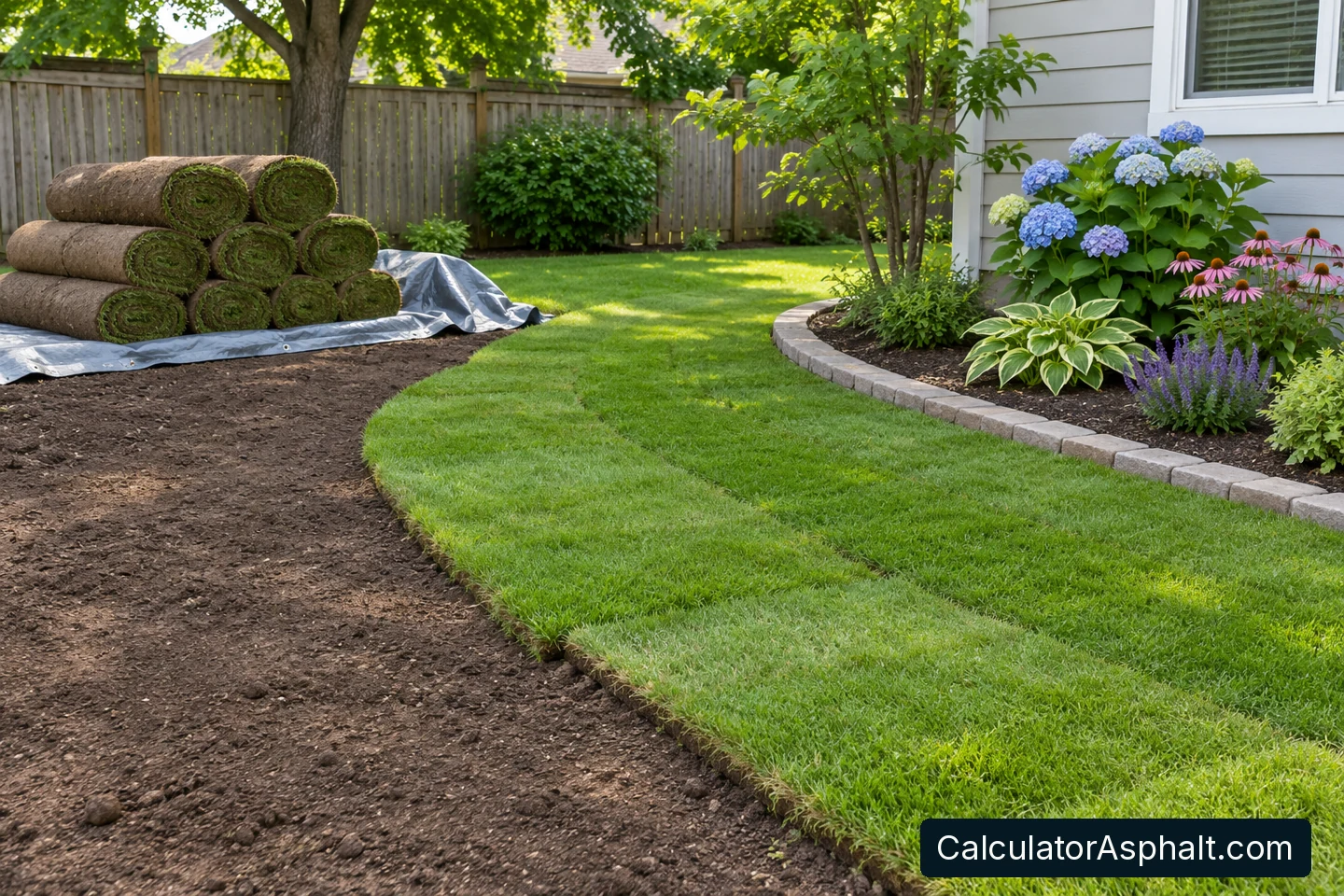
Draw the grass limit before measuring dimensions
Mark the finished line where the sod will end. Identify walks, steps and planting beds that remain uncovered. For a long rectangular center, use length multiplied by width. Draw each curved or angled area separately. A triangular wing with a 14 ft base and 6 ft perpendicular height contributes 42 sq ft. A gently tapered strip can be approximated from its two end widths if the sides between them are nearly straight.
Draw the lengths along straight paths that you can reproduce with a tape. At an irregular edge, measure offsets at several stations from the same baseline. Shorten the distance between stations where the edge curves sharply. The area from each pair of stations is the average of the two widths multiplied by their spacing. Record the stations on the drawing so the next measurement follows the same baseline.
If a lawn meets an existing walk, stake the edges before measuring a long narrow strip. The paver walkway layout examples can help identify the exact width reserved for the path. For a broader planted island, use front-yard mulch bed examples to establish which areas will be plant cover rather than sod.
Get the supplier’s actual roll dimensions
Ask for length, width and installed coverage per roll. A supplier may price by roll, square foot, square yard or pallet. Convert everything to square feet before comparing the totals. Nine square feet equals one square yard, but a product sold as a roll can cover a different area. Ask whether the minimum purchase is an individual roll or a complete pallet.
The same coverage can come from different shapes. A 1.5 ft × 6 ft roll and a 2 ft × 4.5 ft roll each cover 9 sq ft. Along an 18 ft run, the first layout would take three full lengths in one strip. The second would take four. The different width changes how many parallel strips fit across the lawn. One product may leave a wide reusable set of end sections at an island while the other leaves narrow slivers.
| Part of the plan | Measure or draw | Quantity effect |
|---|---|---|
| Long straight edge | Length and first strip orientation | Shows where repeated full rolls fit |
| Inside curve | Offset measurements and strip end shapes | Identifies cuts across otherwise usable ends |
| Planting island | Net uncovered area and first row across it | Subtract area, then count the material needed on both sides |
| Side strip | Finished width and usable roll width | Can consume a second row even where the strip is narrow |
| Pallet increment | Supplier quote and stated coverage | Rounds the quantity at the point of sale |
Worked example: Confirm a 74-roll order
- Total the net lawn areas. Add 24 × 24 = 576 sq ft and 6 × 9 = 54 sq ft. The two nonoverlapping zones total 630 sq ft.
- Calculate the area minimum. At 9 sq ft per roll, divide 630 by 9 for 70 rolls before cuts. A minimum is useful when comparing roll sizes because it leaves out layout effects.
- Count the edge allocation. In this example, the strip sketch identifies 36 sq ft of additional coverage lost to cuts. Add that to 630 for 666 sq ft, or 74 rolls.
- Compare the order increments. If only groups of 10 rolls are available, round 74 up to 80 rolls. Ask if a supplier can sell 70 plus four individual rolls instead.
The area represented by six rolls is 54 sq ft. In the example, that comes from the package rounding after the cut allocation. Keep that number separate when comparing two suppliers. One may offer a lower price per roll but require more rolls to cover the same plan.
Coordinate the lawn edge with grades and delivery
University of Minnesota Extension discusses soil preparation and choosing grasses for local conditions. Ask a local supplier or Extension office which sod suits your light, soil and climate. Final grade affects the usable shape at a walkway or bed and should be settled before finalizing the count. Check where the lawn edges will meet hard surfaces using the yard-side planting examples. For work next to vehicle pavement, review the asphalt paving reference for the separate paving scope.
If one side of the area will stay in gravel, mark it separately on the sketch. The gravel and planting layouts for a front yard illustrate the value of keeping groundcover areas distinct. You can compare a quote with a clear lawn outline to one that mixes gravel, planted areas and new grass without stating how much of each is included.
Confirm the delivery day against the readiness of the grade and the number of people installing. Ask how the supplier handles arrival, storage and timing for the selected product. Keep a picture or sketch of where each zone begins so material can be staged by section instead of carried from the same pile repeatedly.
Ask whether the roll measurements apply before or after trimming damaged ends. If the supplier publishes dimensions in inches, convert each dimension to feet before multiplying. For instance, 18 in. becomes 1.5 ft, so a 6 ft roll of that width covers 9 sq ft.
Next, calculate topsoil separately for low areas.
Estimate the first order with the sod calculator, then test the order against your strip layout. Use the topsoil estimate for any separately specified grade work. Compare a repair or seeded edge with the grass seed quantity calculator using the rate on the package.
Frequently asked questions
Does ordering 70 rolls guarantee coverage of 630 sq ft?
Seventy fits the net area at 9 sq ft per roll. The actual count depends on the strip layout, reusable offcuts and any selling increment.
How should I measure a curved lawn edge?
Measure perpendicular offsets from a straight reference at several stations, then calculate each segment from its average width and length. Use more stations where the curve changes quickly.
Can I deduct the full area of an island from the order?
Deduct the exposed area from the net lawn. Then use your strip sketch to see whether the remaining lawn around the island consumes extra whole rolls.
Should topsoil and sod be ordered from the same calculation?
Keep the quantities separate. Sod uses surface area and roll coverage. Topsoil uses the part of the site receiving added soil and the specified depth of that layer.
Verified November 2026. Sources include University of Minnesota Extension, Seeding and sodding home lawns.