After two decades pricing pavement for everything from single driveways to county roads, I can tell you the honest answer to “what does an asphalt driveway cost” is a range, not a number — and anyone who quotes you a flat figure sight-unseen is guessing. What I can give you is the real math: the per-square-foot ranges that hold across most of the country in 2026, what moves your number up or down within them, and how to sanity-check any contractor’s bid before you sign it.
Quick answer: An asphalt driveway costs $4–$8 per square foot installed in 2026, or roughly $2,400–$4,800 for a standard 600 sq ft driveway. Material (hot mix at $80–$150/ton) is about half; labor, base preparation, and site access make up the rest. Larger jobs cost less per foot; poor access, thick sections, and full base rebuilds cost more.
The per-square-foot breakdown
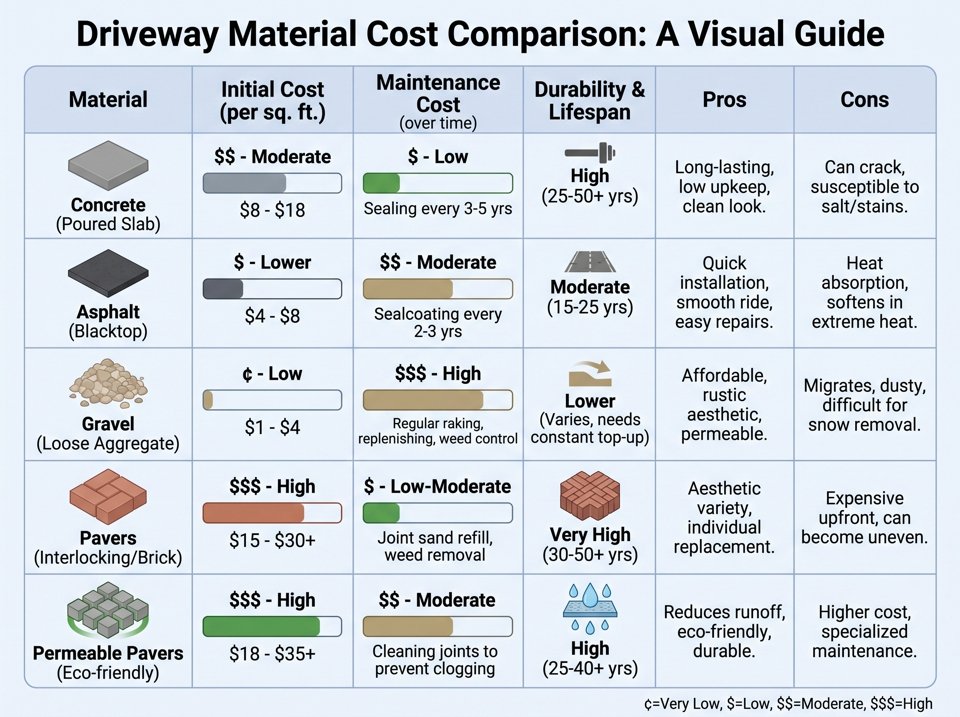
Installed asphalt pricing has four components, and understanding the split is what lets you read a bid intelligently rather than just comparing bottom-line numbers.
| Cost component | Typical share | What drives it |
|---|---|---|
| Hot mix material | $1.80–$3.50/sq ft | Tonnage needed, plant price, bitumen (oil) cost |
| Labor & equipment | $1.50–$2.50/sq ft | Crew size, paver vs hand-lay, job duration |
| Base preparation | $0.50–$1.50/sq ft | Excavation depth, gravel base, compaction |
| Mobilization & overhead | $0.30–$1.00/sq ft | Haul distance, permits, small-job minimums |
The material line tracks the price of bitumen, the petroleum binder that makes up 5–7% of hot mix by weight. Because bitumen is a refining byproduct, asphalt prices move with crude oil — which is why the same driveway can cost noticeably more in a year of high oil prices. If you want to see how the binder fraction affects tonnage cost directly, the bitumen calculator breaks out the binder-to-aggregate split. For the full breakdown of your specific job, run your dimensions through the asphalt cost calculator, which separates material from labor the way a real estimate does.
What a driveway costs by size
Because per-foot pricing drops as jobs get larger — the crew mobilizes once whether they pave 400 feet or 1,400 — here’s what typical sizes run at 3 inches of compacted asphalt over a proper base.
| Driveway size | Dimensions | 2026 installed cost |
|---|---|---|
| Single car | 12 × 24 ft (288 sq ft) | $1,700–$2,600 |
| Standard 2-car | 20 × 30 ft (600 sq ft) | $2,900–$5,200 |
| Long / rural | 12 × 100 ft (1,200 sq ft) | $5,300–$9,600 |
| Large / circular | ~2,000 sq ft | $8,500–$16,000 |
For a detailed walk-through of a common size, I ran the full numbers in the cost of a 1,000 sq ft asphalt driveway. To estimate your own footprint fast, the driveway cost estimator compares asphalt against concrete, gravel, and pavers side by side, and the asphalt calculator gives you the exact tonnage those costs are built on.
What moves your price up or down
Thickness and base
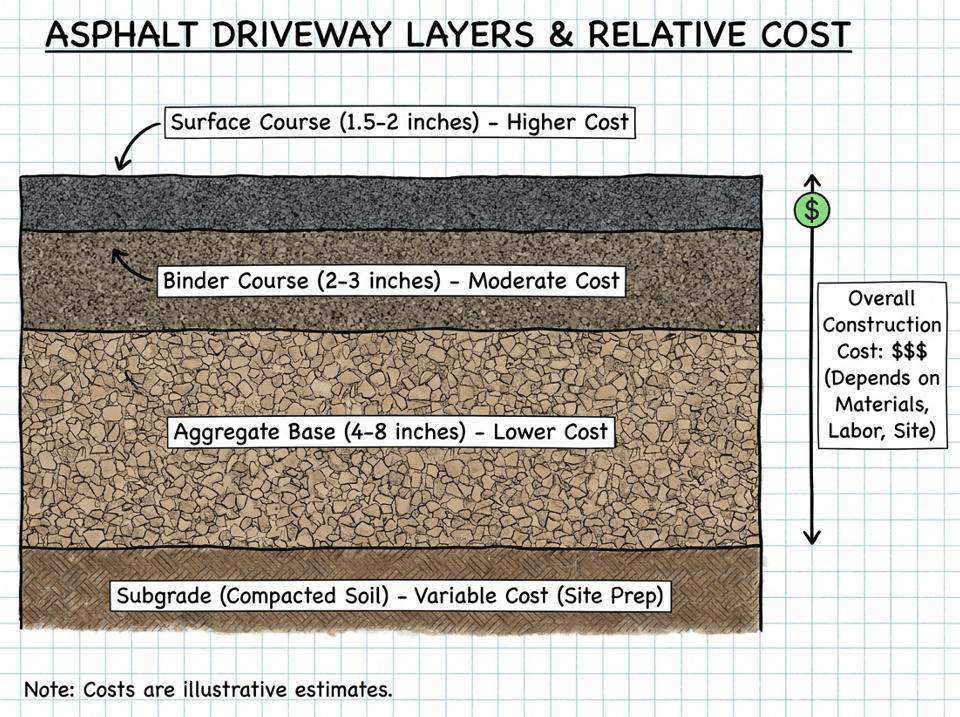
A residential driveway needs about 3 inches of compacted asphalt over 6–8 inches of aggregate base. Skimping on either is the most expensive mistake you can make, because a failed base means tearing out and redoing the surface within a few years. The base does the structural work; the asphalt is the wearing surface. I explain the full layer logic in the base course and wearing course guide.
Site access and existing surface
Tight access that a full-size paver can’t reach forces hand-laying, which is slower and pricier. If you’re replacing an old driveway, removing the existing surface adds cost — though milling it up produces reclaimed asphalt that offsets some of the removal. Whether you resurface or fully replace changes the number substantially; I compare both paths in new driveway vs resurfacing cost and the cost to repave a driveway.
Region and season
Labor rates, haul distance from the asphalt plant, and local demand all shift pricing by region. Paving late in the season or in a high-demand window can cost more. Material prices themselves move with the market — I track where they’re heading in the asphalt market outlook.
Asphalt vs. the alternatives
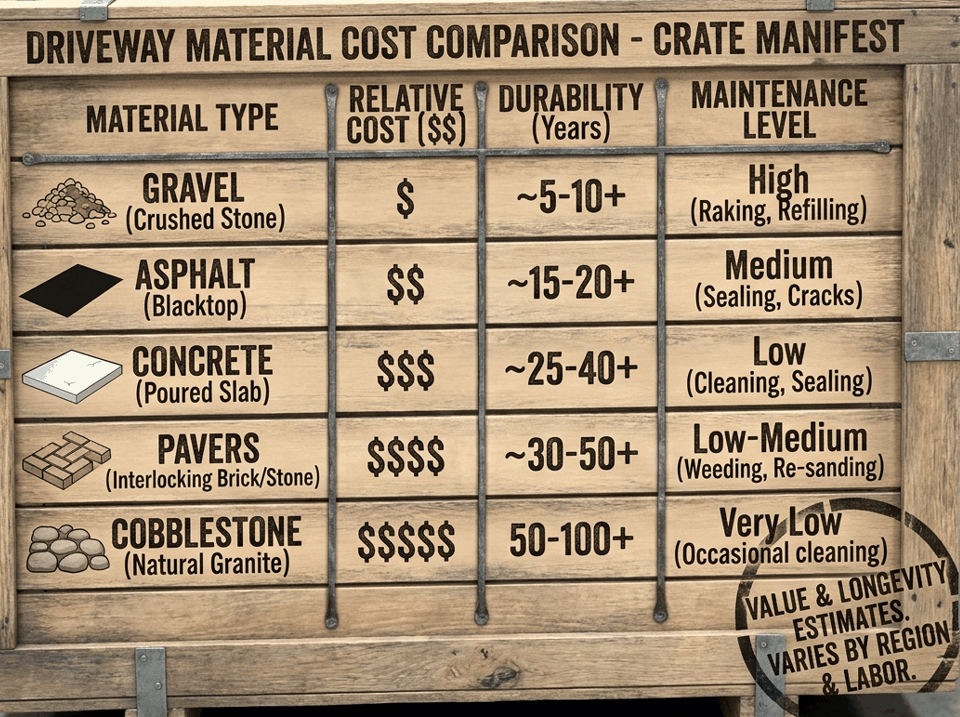
Asphalt’s headline advantage is upfront cost. At $4–$8 per square foot it undercuts concrete’s $6–$12, though concrete lasts 30-plus years to asphalt’s 15–20 with maintenance. Gravel is cheaper still but needs regular replenishment; pavers cost the most but last longest and look best. Climate usually decides: asphalt flexes with freeze-thaw better than concrete, while concrete holds up better under sustained heat. I lay out the full trade-off in concrete driveway vs asphalt driveway, and cover the budget options in driveway alternatives to asphalt.
The real cost is 20 years, not day one
Here’s what I tell every homeowner: the install price is only the first number. An asphalt driveway sealcoated every 2–3 years and crack-sealed promptly lasts 20-plus years. Neglected, it needs replacement in 10–12 — so skipping $200 of maintenance to save money is how people end up paying for two driveways instead of one. Budget the maintenance from day one. The sealcoating calculator and crack filler calculator size those recurring materials, and my asphalt maintenance guide covers the schedule.
Estimate your driveway now: the asphalt cost calculator gives material and labor separately, and the driveway cost estimator compares every material at once. For the complete picture of how asphalt is priced, built, and maintained, see the complete asphalt paving guide.
Frequently asked questions
How much does a 2-car asphalt driveway cost?
A standard 600 sq ft two-car driveway runs $2,900–$5,200 installed in 2026 at 3 inches over a proper base. Run your exact size through the asphalt cost calculator for a tighter figure.
Is asphalt cheaper than concrete for a driveway?
Yes upfront — $4–$8 per square foot versus $6–$12 for concrete. But concrete lasts longer, so the 20-year comparison is closer. See the full comparison.
Why did I get such different quotes?
Usually base preparation and thickness. A cheap bid often means a thinner section or minimal base work — which costs far more when it fails early. Compare what each bid specifies for asphalt depth and base, not just the total.
Does a bigger driveway cost less per square foot?
Yes. Fixed costs like mobilization spread over more area, so per-foot pricing drops as the job grows. Small jobs also carry minimum charges that raise the effective rate.