By Steve Axton, PE — Licensed Civil Engineer · Updated November 2026
I divide the site into zones before I order topsoil. A high strip next to the walk may need only enough material to finish the surface, while a second zone may need more to meet its planned height. I measure both against the intended finished grade. One depth applied to the whole site makes the estimate easy to write and hard to use when the load arrives.
Quick answer. A 160 sq ft area receiving 3 in. of soil takes 40 cu ft. If a separate 50 sq ft area needs 5 in., add 20.83 cu ft. The combined planned volume is 60.83 cu ft, about 2.25 cu yd before the supplier’s delivery conversion or order increments.
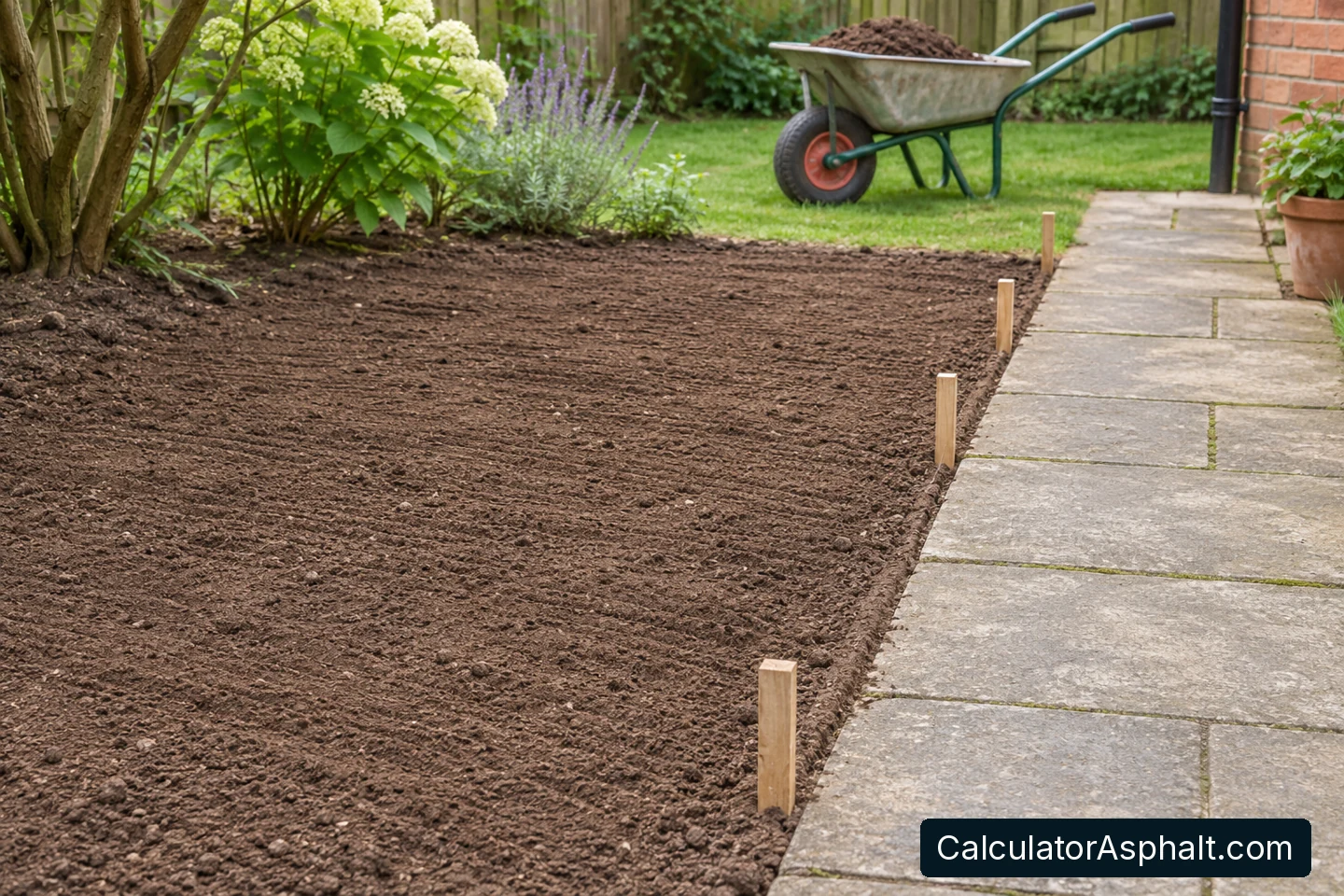
Establish the level the soil should reach
Start from fixed points where the new surface meets a path, bed edging or a paved apron. Draw the grade planned between those points. Record the intended slope and runoff direction on the drawing. The quantity estimate uses the vertical difference between the measured existing grade and the planned top of the placed soil at each location.
A low reading can result from a low existing surface or from a high design surface. Verify both before interpreting it. If a walkway has appreciable fall along its length, an equal elevation at the two ends cannot describe the actual edge. Measure enough points to capture the fall. Keep your readings tied to the same reference so the differences can be compared.
Where a new zone meets an edge, check the amount of freeboard or exposure called for by the design, and record the exact soil limit. The patio edging layout provides a method to separate long edge runs from surface area. For gravel and planting designs near the front walk, mark which parts get soil and which get a separate surface aggregate.
Divide the plan into areas with similar depth
Use one zone where the indicated depth is reasonably uniform. For a steady slope change along a uniform-width strip, use the average of the two endpoint depths as a planning estimate. Check intermediate points before using it: a dip near the middle will not appear in the endpoint average. When the depth or width changes abruptly, break out another zone and calculate its volume from its own measurements.
If one zone has a low corner rather than a uniform low strip, mark off a smaller area to measure it. Record zero where the current surface already reaches the desired level. If an area stands above the desired grade, record it separately as removal where appropriate. Subtracting that volume from the purchased material assumes the cut soil is suitable and can be reused, a decision to check before finalizing the plan.
| Zone type | What to record | How to use it |
|---|---|---|
| Broad shallow layer | Net area and depth at several stations | Multiply area by representative depth |
| Isolated low spot | Boundaries and readings at center and edge | Estimate separately from the surrounding layer |
| High area | Area, existing level and planned grade | Record suitable reusable material separately |
| Raised bed | Inside dimensions and intended soil level | Measure inside the enclosure instead of using the whole footprint |
| Supplier increment | Bulk unit, delivery minimum and product description | Compare order quantity with the estimated placed volume |
Worked example: Combine 3 in. and 5 in. zones
- Calculate the first zone. Multiply 160 sq ft by 3 in. divided by 12 in. per foot. The planned volume is 40 cu ft.
- Calculate the second zone. Multiply 50 sq ft by 5 in. divided by 12. The planned volume is 20.83 cu ft.
- Convert the total to cubic yards. The unrounded sum is about 60.83 cu ft. Divide by 27 for approximately 2.25 cu yd of planned placed volume.
- Compare with order choices. Ask the supplier how it measures the product and whether fractions of a cubic yard are sold. Compare the documented delivered quantity with the planned placed layer before committing.
Using a flat 3 in. over all 210 sq ft gives 52.5 cu ft. That misses approximately 8.33 cu ft in the lower zone. Using 5 in. everywhere gives 87.5 cu ft and adds about 26.67 cu ft above the stated plan. Both calculations are mathematically valid for an imagined uniform layer. Only the zone takeoff represents this measured site.
Distinguish garden fill, grading material and amendments
The material sold as topsoil can vary by supplier in texture, screening and organic matter. Review the intended use and product information. University of Minnesota Extension treats soil preparation and nutrient needs as site-specific for lawn work. Use the local soil recommendations for your plants before assigning volume to compost or another amendment. A bulk quote should identify the actual product, not just the number of cubic yards.
If a raised garden bed’s soil volume is part of the job, measure its inside dimensions as a separate order line. For an area where only the surface layer is missing, a mulch top-up estimate layers a different material over the existing surface. Keep those quantities distinct in the worksheet.
Check the reference points again if the area is beside a driveway or threshold. The asphalt paving guide concerns the adjoining paved system. Topsoil quantities belong to the uncovered area based on the planting design. If the final levels conflict, revisit the grade plan before buying soil by the truckload.
Confirm delivery and placement before buying
Check if the truck can reach the planned drop area and how the supplier describes the volume on the ticket. A scoop charge and a cubic-yard charge are comparable only when the supplier states the scoop volume. If the order will be placed in two delivery stages, record the volume needed in each zone and confirm each load separately. The sketch lets the crew compare the estimated quantity with the finished levels before unloading more material at the same location.
Next, count the rolls after mapping the final lawn shape.
Start with the topsoil calculator for each area and its planned depth. If a project separately specifies grading material, estimate the fill volume on its own line. Keep the compost quantity estimate separate for any documented soil amendment.
Frequently asked questions
Do I need to assume a settlement percentage to order topsoil?
Measure planned placed volume first. Ask the supplier about the actual product and how it converts delivery units to a placed volume. Use a project-specific allowance only when you have a basis for it.
How many bags equal 2.25 cu yd of topsoil?
Use the actual label. For a nominal 1 cu ft bag, 2.25 × 27 = 60.75 cu ft, or 61 bags rounded up, before placement adjustments.
Should I subtract soil removed from a high spot from the purchase?
Only count that material as available if it suits the intended use and can be reused on site. Keep a separate cut quantity until you have confirmed those conditions.
Why measure from the planned grade instead of the current surface alone?
The current surface gives the starting elevation. The vertical difference to the planned finish gives the depth the layer must fill at that point.
Verified November 2026. Sources include University of Minnesota Extension, soil preparation for lawn establishment.