By Steve Axton, PE — Licensed Civil Engineer · Updated November 2026
I measure a bed in several places before putting mulch on the order sheet. The strip beside the walkway may be bare while wood chips still cover most of the area around an established tree. Applying the same depth to both areas costs more and can bury the base of plants. Treat the job as a series of top-ups, each measured from the mulch that is still there.
Quick answer. A bare 90 sq ft zone getting a fresh 2 in. layer needs 15 cu ft. A second 90 sq ft zone getting a 1 in. top-up needs 7.5 cu ft. Together they take 22.5 cu ft, about 0.83 cu yd, before supplier rounding.
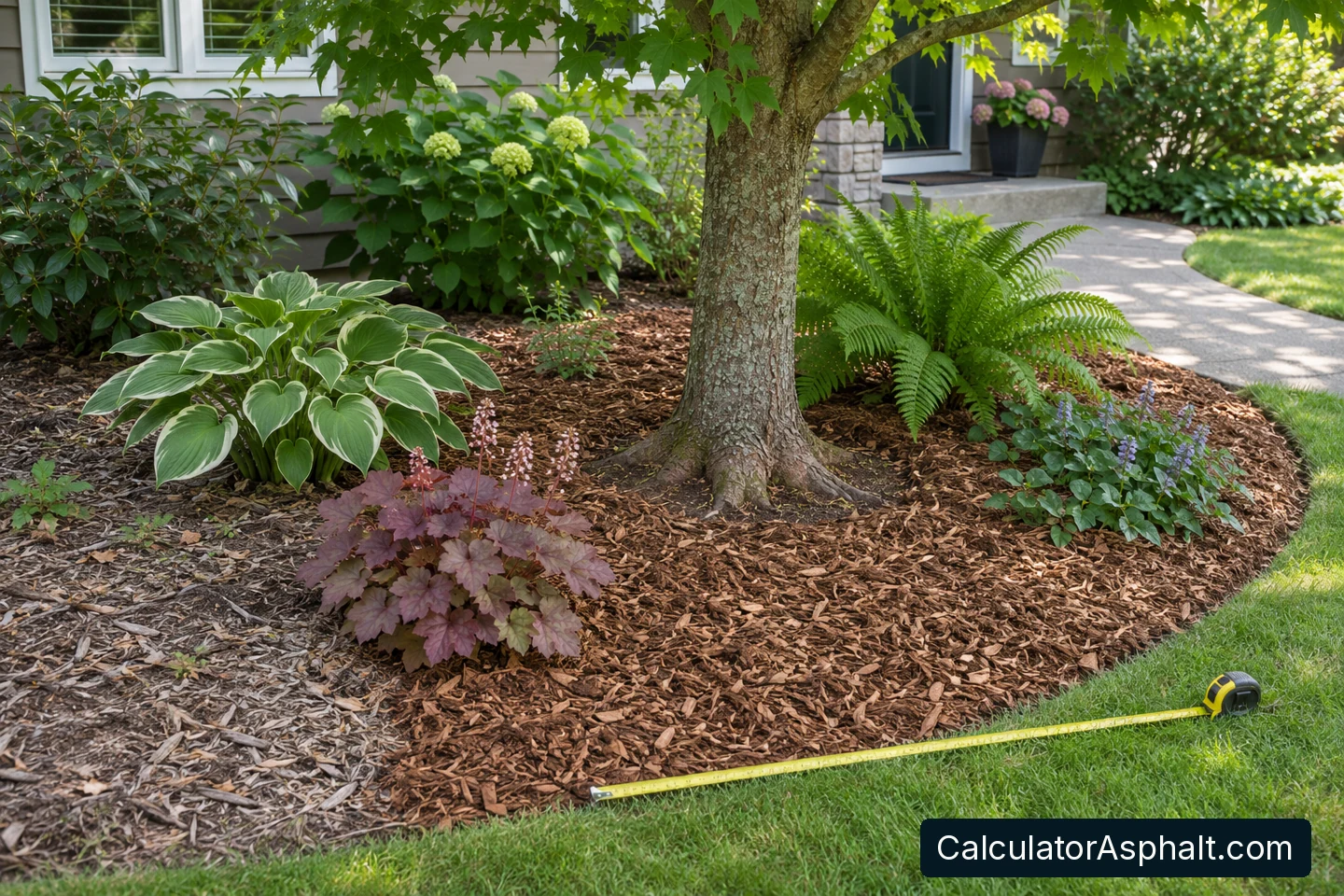
Draw the areas that actually receive mulch
Take lengths and widths at the finished edge. If a bed narrows along a wall, divide the shape into short sections with similar widths. For a single segment whose ends measure 2 ft and 4 ft across and which tapers evenly over 10 ft, use the average width of 3 ft. That segment covers about 30 sq ft. For an irregular outline, sketch rectangles across the widest changes and keep the measurements with the sketch.
Mark hard surfaces, steps and planting pockets that will remain uncovered. The patio garden layouts for compact spaces illustrate how a narrow bed can fit around a seating area. Draw the planting zone as its own shape, since the overall patio footprint is much larger. For a gravel-led front yard, use the gravel planting and path layouts to distinguish planted soil from the paths and gravel panels you will leave as they are.
Record old depth in several spots
Move the chips aside gently at each sample point and measure to the soil surface without pushing the ruler into it. Check the interior and exposed edges. Keep together spots with similar depth and list the bare corners as a separate zone. A single average can hide bare strips and also hide chips near a trunk that are already deeper than you intended.
Penn State Extension advises checking existing mulch before adding more around established trees. Where the depth is sufficient, it suggests that a light raking may be all that is needed to break up a crust. It recommends a 2–4 in. layer of organic mulch around trees, less on poorly drained soil, and keeping the trunk flare visible. Choose a target for the plant and conditions before calculating the difference. The depths used here illustrate the purchasing arithmetic.
| Existing condition | Measure or inspect | How it affects the takeoff |
|---|---|---|
| Bare planting soil | Net surface area and intended depth | Count the full selected layer |
| Thin but intact mulch | Depth at several points | Count only the difference to the chosen depth |
| Old layer still sufficient | Depth and surface condition | Omit from the purchase if the layer only needs redistribution |
| Trunk or stem buried | Locate the flare or stem base | Pull material back and leave the clearance out of the area |
| Mulch beside a hard edge | Height difference and runoff path | Measure the planned mulched area separately |
Worked example: Add two zones with different depths
- Measure the bare area. A 90 sq ft area receiving 2 in. needs 90 × 2 ÷ 12 = 15 cu ft.
- Measure the top-up area. A second 90 sq ft already has 1 in. against the chosen 2 in. finish. The added layer is 1 in., so 90 × 1 ÷ 12 = 7.5 cu ft.
- Sum volumes. Add 15 and 7.5 to get 22.5 cu ft. Divide by 27 to get 0.83 cu yd. Pricing both zones at 2 in. would give 30 cu ft, or 7.5 cu ft extra.
- Compare selling units. At 2 cu ft per bag, divide 22.5 by 2 to get 11.25 bags and round up to 12. For bulk, ask the supplier how it sells fractions of a cubic yard and how it measures a scoop.
Move only enough material into the first zone to meet the intended depth. Check the coverage before spreading the last bag. If the bare area consumes a different amount than the sketch suggested, return to your measurements while the remaining material is still available for the second zone.
Keep soil, chips and hardscape quantities on separate lines
A raised bed filled with soil is a volume inside a box. Mulch is a surface layer. If a renovation calls for both, calculate the soil from the fill dimensions using the raised-bed soil volume examples and record mulch separately. Establish the final soil level before pricing any wood chips above it.
Leave room for water movement around edges. A paver border can contain chips, but the slope and height of the adjoining surface affect where rain and loose material travel. Identify the edge segments on the sketch with the patio edging takeoff method. If this work borders a driveway, use the site’s asphalt paving guide for decisions about the paved surface and keep the planting-bed estimate separate.
Compare bagged and bulk quotes using delivered volume
Convert both quotes to a common unit. A cubic yard equals 27 cu ft. Compare material grade, delivery fee and any minimum order for bulk. A small order can be easy to carry in bags and may cost less after a delivery minimum. A larger job may favor bulk if you have an appropriate, accessible staging area. A quote based on a scoop size should include the volume represented by that scoop.
Keep the zones on the delivery note so you can track how much goes to each bed. Spreading all the new material simply because it arrived can erase the depth checks and raise the layer around plants. Keep the final depth consistent with the chosen target, especially around established trees.
Next, check the base grade where pavement borders the bed.
Run the mulch calculator separately for each zone and its added depth. Use the topsoil volume tool for any separate soil work and estimate compost for a measured spread only where the planting plan calls for it.
Frequently asked questions
Can I use the same thickness for the entire yard?
Measure existing depth by zone. The added depth is the chosen finished depth minus what remains. Where the existing layer already meets the target, omit that area from your order.
Do I subtract the gap around a tree trunk?
Yes, where it materially changes the coverage. Mark the area that will remain clear and keep the trunk flare visible. Avoid counting the clear area twice if you already excluded it from the footprint.
What if there is more mulch than the target depth?
Treat the added depth as zero. Inspect the condition of the existing layer and redistribute or remove excess where needed. A negative value from subtraction means that area does not need another layer.
Does 0.83 cubic yard equal 12 two-cubic-foot bags?
The exact calculated volume here is 22.5 cu ft. Twelve 2 cu ft bags supply 24 cu ft, leaving 1.5 cu ft above the calculated requirement.
Verified November 2026. Sources include Penn State Extension tree mulching guidance.