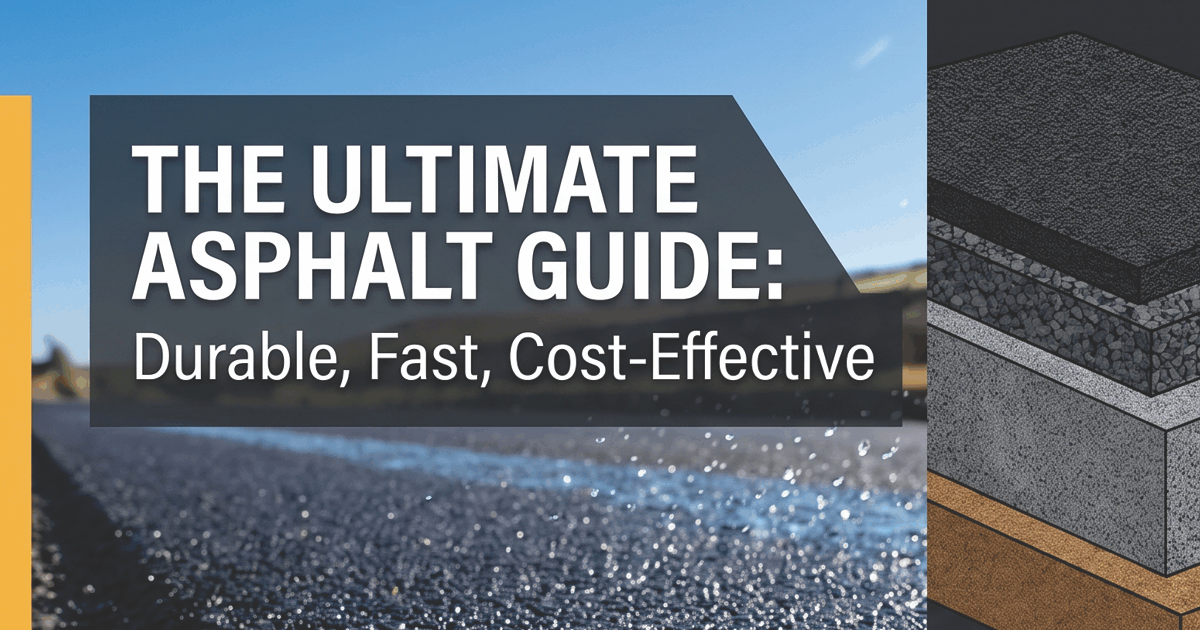
Asphalt paves more than 90% of American roads and the majority of residential driveways, and for one reason: it delivers a durable, water-shedding surface faster and cheaper than any competing material. This guide covers the whole system — what asphalt is made of, how the layers stack, how thick each one should be, how to calculate exactly how much you need, what it costs in 2026, and how to make it last twenty years instead of ten.
The short version: Asphalt is crushed stone (about 95% by weight) bound with bitumen (5–7%). It’s laid hot over a compacted gravel base, rolled to 92–96% density, and cures enough to drive on within 24–72 hours. A residential driveway needs about 3 inches of compacted asphalt over 6–8 inches of base; installed cost runs $4–$8 per square foot in 2026. Sealcoat every 2–3 years and it lasts 15–20 years.
What this guide covers
- What asphalt actually is
- The pavement layer structure
- How thick each layer should be
- Calculating how much asphalt you need
- What asphalt costs in 2026
- How asphalt is installed
- Curing and drying time
- Making asphalt last: maintenance
- Why asphalt fails
- Recycled and alternative asphalt
1. What Asphalt Actually Is
“Asphalt” in everyday use means hot mix asphalt (HMA) — a precise blend of mineral aggregate and bitumen binder produced at a plant and delivered hot. By weight it is roughly 93–95% crushed stone, gravel and sand, and 5–7% bitumen, the black petroleum-derived glue that coats every particle and holds the mixture together. Get the balance wrong in either direction and the pavement fails: too little binder and the surface ravels apart, too much and it ruts and bleeds in summer heat.
The binder itself is worth understanding because it drives both performance and price. Bitumen is a byproduct of crude oil refining, so asphalt cost tracks oil markets — which is exactly why 2026 prices sit where they do. If you want the split between aggregate and binder in any given tonnage, the bitumen calculator breaks it out. For the deeper chemistry and how binder grade is selected for climate, our post on hot mix asphalt goes further, and asphalt concrete vs bituminous concrete clears up the terminology confusion between the names engineers and contractors use for the same material.
The main asphalt types
Not all asphalt is hot mix. The three you’ll encounter:
- Hot mix asphalt (HMA) — the standard, laid at 275–300°F for roads, driveways and lots.
- Warm mix asphalt (WMA) — produced and laid 50–100°F cooler using additives, saving fuel and extending the paving season. See three ways of using warm mix asphalt.
- Cold patch — a bagged, no-heat product for pothole repair. If you’re only patching, the cold patch calculator guide covers how much you need.
The mix design — the exact recipe of stone sizes and binder percentage — is governed by standards like ASTM D3515. Aggregate gradation matters enormously to durability; if you want to understand why, mix design and aggregate gradation and the evolution of asphalt mix design explain how modern Superpave mixes came to be. Density varies by mix too, which affects your tonnage math — see asphalt mix density variations and the practical density range of asphalt mixes.
2. The Pavement Layer Structure
A common mistake is thinking of asphalt as one layer. It’s a system, and the surface you see is the smallest part of it. From the ground up:
- Subgrade — the native soil, graded and compacted. Everything rests on this.
- Sub-base — a load-spreading layer of granular material over weak or frost-prone soils. Size it with the sub-base calculator; the design thinking is covered in optimal asphalt sub-base design.
- Base course — compacted crushed stone (or asphalt base) that carries the structural load. This is where the gravel calculator and crushed stone calculator come in.
- Binder course — a lower asphalt lift with larger aggregate, providing strength.
- Wearing course — the dense, smooth top layer you drive on.
The distinction between the structural base and the wearing surface is fundamental to paving. We cover it from several angles: asphalt base course and wearing course is the primary explainer, with base and wearing course and mastering base and wearing course projects going deeper on field practice. For the base layer specifically, asphalt base course (ABC) explains the aggregate base that everything above depends on.
Planning a full multi-layer section? The pavement calculator takes off the surface course, binder course and aggregate base in one pass — each layer priced separately, the way a real bid is built.
Between asphalt lifts, a thin sprayed tack coat of diluted bitumen emulsion bonds them so the section behaves as one monolithic structure rather than sliding layers. Skip it and you get slippage cracking within a year. The tack coat calculator sizes the emulsion. The overall structural logic — how thick a section needs to be for a given traffic load — is explored in optimizing asphalt pavement structure.
3. How Thick Each Layer Should Be
Thickness is set by what drives on the pavement. Under-build and it cracks under load; over-build and you’ve wasted material. Standard specifications:
| Application | Asphalt (compacted) | Aggregate base |
|---|---|---|
| Residential driveway | 2–3 in | 6–8 in |
| Parking lot (cars) | 3 in | 6–8 in |
| Parking lot (trucks) | 4 in | 8–10 in |
| Local road | 4–6 in | 8–12 in |
These are starting points; weak or clay subgrades and freeze-thaw climates push both numbers higher. Our detailed breakdown, asphalt layer thickness and cost estimation, walks through how thickness and cost interact for residential and commercial jobs. One rule holds everywhere: the base does the structural work. A thin, well-built section on a proper base outlasts a thick one on soft ground every time.
4. Calculating How Much Asphalt You Need
This is the question that brings most people to the site, so here’s the exact method.
The formula: Length × Width × (Thickness ÷ 12) = cubic feet. Multiply by 145 lb/ft³ (compacted HMA density), divide by 2,000 for tons. Add ~8% for compaction and ~5% for waste. As a rule of thumb, one ton of asphalt covers about 55 square feet at 3 inches compacted.
Rather not do the math? The asphalt calculator does all of it — enter dimensions and thickness, get tonnage, truckloads and cost with compaction and waste already built in.
If you prefer to understand the arithmetic behind the tool, several posts work through it by hand: how much asphalt do you need is the plain-English starting point, calculate asphalt tonnage and calculating asphalt tonnage show the tonnage steps, and how to calculate quantity of asphalt in a road handles linear road work. For worked numbers at a fixed size, see material calculation for 250 square feet and the coverage reference how much a ton of asphalt covers at 3 inches.
Unit conversions that trip people up
Asphalt is ordered by the ton but measured by area, and suppliers sometimes quote square yards. To move between them cleanly: asphalt square yards to tons, measuring project area in square yards, and the occasionally-needed gallons of asphalt in a ton. If your job includes the gravel base, gravel and asphalt calculation covers both materials together, and the truckload calculator converts your final tonnage into delivery trips.
5. What Asphalt Costs in 2026
Installed asphalt runs $4–$8 per square foot in 2026 — material tonnage at $80–$150/ton plus $2–$4/sq ft labor. A standard 600 sq ft driveway lands between $2,500 and $8,000 depending on region, access and base condition.
The asphalt cost calculator separates material from labor, and the driveway cost estimator compares asphalt against concrete, gravel and pavers side by side.
For real-world cost scenarios, the cost of a 1,000 sq ft asphalt driveway runs the numbers on a common size, and new driveway vs resurfacing cost plus the cost to repave a driveway help you decide whether to replace or resurface. Choosing between materials entirely? concrete driveway vs asphalt driveway and driveway alternatives to asphalt lay out the trade-offs, and if you want a decorative finish, stamped asphalt driveways covers that option. Prices move with oil and season — the asphalt market outlook tracks where they’re heading.
6. How Asphalt Is Installed
Professional installation follows a fixed sequence, and each step depends on the one before it:
- Excavation and grading — the site is dug to design depth and sloped for drainage. Size the dig with the excavation calculator.
- Base placement — crushed stone is spread and compacted in lifts.
- Compaction — both base and asphalt must hit target density; asphalt is rolled to 92–96%. See the compaction calculator.
- Paving — hot mix is laid by a paver and immediately rolled while hot.
For the full field process, how asphalt roads are made and three ways to pour asphalt into roads show it end to end. Quality control during the pour determines how long the pavement lasts — asphalt quality assurance and optimizing asphalt quality cover the checks that matter. For commercial-scale work, the parking lot paving calculator sizes material by stall count, and road shouldering covers the edge work that protects a pavement’s most vulnerable point.
7. Curing and Drying Time
Fresh asphalt is drivable within 24–72 hours but doesn’t fully cure for 6–12 months as the binder oxidizes and hardens. During that window the surface is soft and vulnerable to power-steering scuffs, stand marks and oil penetration.
The details matter more than most people expect: the asphalt drying timeline lays out what happens hour by hour, how long asphalt takes to dry and its companion for driveways and parking lots answer the direct question, and if weather is against you, quick asphalt drying covers acceleration. Working the mix before it sets is time-limited too — how long you can really rework asphalt explains the window.
8. Making Asphalt Last: Maintenance
This is where owners save or waste thousands. Asphalt fails from the top down as water and UV break down the binder — and both are cheap to defend against.
The maintenance rule: Sealcoat every 2–3 years, fill cracks the season they appear, and clean oil spills promptly. A driveway maintained this way lasts 20+ years; a neglected one needs replacement in 10–12.
Size your maintenance materials: the sealcoating calculator gives gallons and pails by area, and the crack filler calculator converts crack length into product needed.
The maintenance library: asphalt pavement maintenance is the overview, how to fill cracks in an asphalt driveway and the best driveway crack fillers cover crack repair, and for surface renewal short of replacement, micro-surfacing, cape seal treatments and whether a driveway can be resurfaced lay out the options. Oil stains are the sneaky killer — preventing oil stains, the best oil stain remover and getting car oil out of asphalt handle them. When maintenance is no longer enough, asphalt restoration and parking lot rehabilitation cover the rebuild.
9. Why Asphalt Fails
Understanding failure modes tells you what to watch for. Nearly every asphalt failure traces to one of three causes: water reaching the base, an under-built structure, or binder aging out. The visible symptoms — alligator cracking, potholes, rutting, raveling — are late-stage signals of an earlier problem.
Our failure references: asphalt failure types catalogs what each crack pattern means, flexible pavement distresses and crocodile cracking goes deep on the most common structural failure, and stopping pavement defects and failures covers prevention. The through-line: catch water and cracks early, because the base is far more expensive to fix than the surface.
10. Recycled and Alternative Asphalt
Asphalt is the most recycled material in America — old pavement is milled up and blended back into new mix as reclaimed asphalt pavement (RAP). This lowers cost and environmental impact, and for driveways and paths, crushed recycled asphalt is a budget surfacing option in its own right.
The recycled-material posts: asphalt millings price and millings for paving and DIY roadwork cover cost and use, choosing the right crushed asphalt grade and benefits of crushed asphalt for driveways help you spec it, and installing crushed asphalt walkways shows the install. On the sustainability side, higher RAP percentages, permeable asphalt and where to buy recycled asphalt round out the topic. To estimate milling removal on your own job, the asphalt milling calculator converts area and depth into RAP tonnage.
11. Climate, Season and Timing
Asphalt is temperature-sensitive at both ends of its life. During installation, the mix must stay hot enough to compact — which is why paving season runs spring through fall in most of the country and why cold-weather paving carries real risk of poor density. Ambient temperature ideally sits above 50°F and rising when the mat goes down, and the crew has a fixed window to roll it before it cools below workable temperature. Warm mix asphalt exists partly to stretch that window, letting crews pave later into the season and haul longer distances without the mat cooling too fast.
Over its service life, climate drives the failure clock. In freeze-thaw regions, water that penetrates a crack expands as it freezes, levering the pavement apart a little more each winter — which is why northern driveways live or die on drainage and prompt crack sealing. In hot southern climates the enemy is different: sustained heat softens the binder and heavy stationary loads can leave rutting and depressions, so binder grade is selected specifically for the local high-temperature extreme. The same 3-inch driveway is engineered differently in Minnesota and Arizona, and the difference lives in the mix design rather than anything you can see on the surface. This is also why regional pricing and specs vary so much, and why every estimate here exposes editable fields rather than forcing one national number.
Frequently Asked Questions
How much asphalt do I need for a 2-car driveway?
A typical two-car driveway of about 600 square feet at 3 inches compacted needs roughly 11 tons of hot mix, plus its gravel base. Run your exact dimensions through the asphalt calculator for tonnage, truckloads and cost in one step.
Is asphalt cheaper than concrete?
Yes upfront — asphalt runs $4–$8 per square foot installed versus $6–$12 for concrete. But concrete lasts 30+ years to asphalt’s 15–20, so the lifetime comparison is closer than the sticker price suggests. Climate usually decides: asphalt in freeze regions, concrete in extreme heat. The full comparison covers the trade-offs.
How long before I can drive on new asphalt?
24 to 72 hours for normal traffic, but the surface stays soft for months as it cures. Avoid sharp turns while parked, heavy point loads and parking in the same spot during the first summer. See the drying timeline for specifics.
How often should I sealcoat?
Every 2–3 years, with the first application 6–12 months after paving once the surface fully cures. Sealcoating is the single highest-return maintenance you can do — it defends the binder against the UV and water that cause most failures. The sealcoating calculator sizes the material.
Do I really need a gravel base under asphalt?
Yes. The base does the structural work — it spreads load and, critically, drains water away from the subgrade so freeze-thaw can’t destroy it. Six to eight inches of compacted crushed stone is the residential standard. A thick asphalt layer on bare soil fails fast; a modest one on a proper base lasts decades.
What does one ton of asphalt cover?
About 55 square feet at 3 inches compacted, or roughly 80 square feet at 2 inches. Coverage scales inversely with thickness — double the depth, halve the coverage. The coverage guide has the full table.
Put the numbers to work
This guide covers the how and why. When you’re ready to estimate your own project, these are the tools built for each step:
Estimating: Asphalt Calculator · Cost Calculator · Pavement Calculator · Driveway Estimator
Base & site: Gravel · Sub-base · Excavation · Compaction · Truckload
Maintenance: Sealcoating · Crack Filler · Milling · Tack Coat · Bitumen